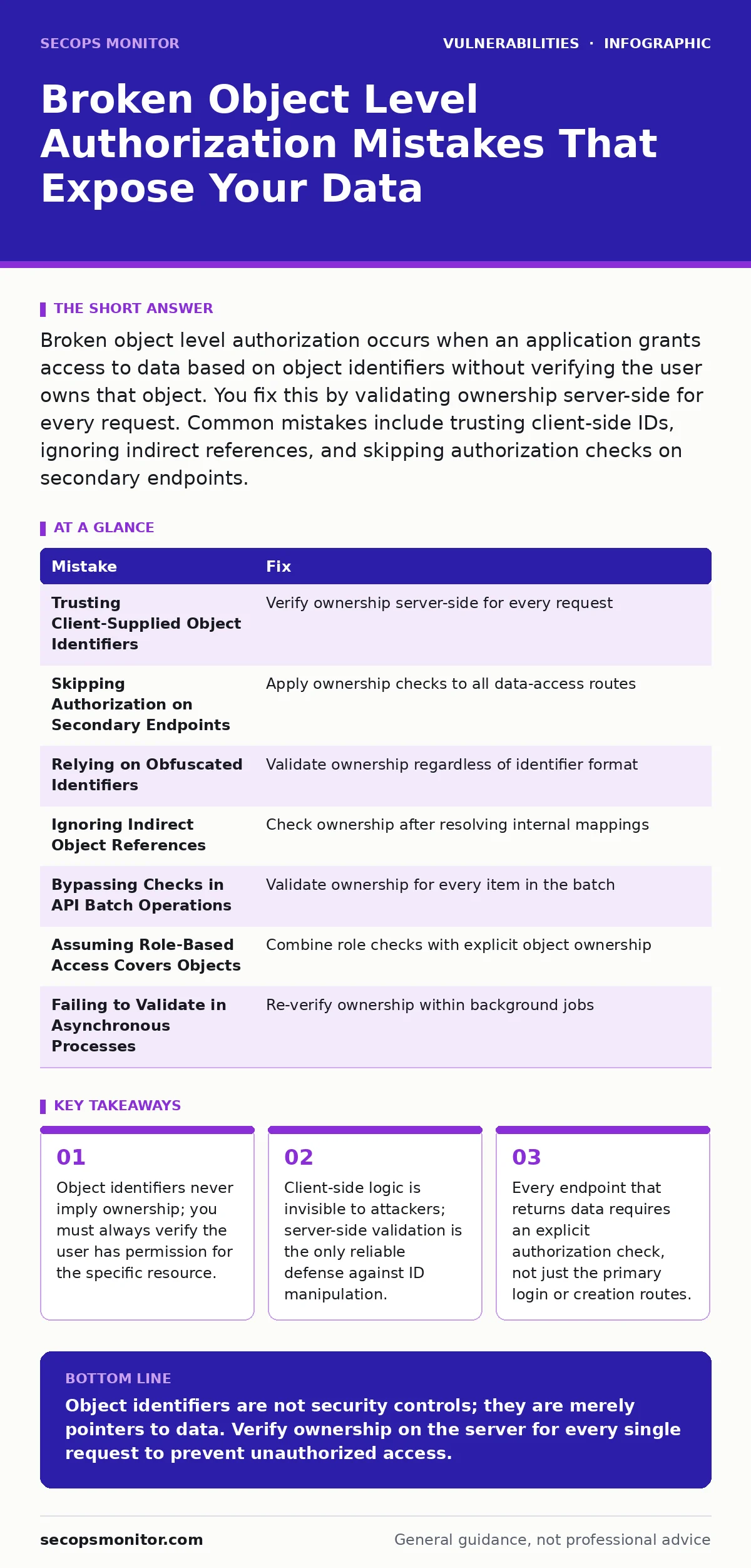
Broken object level authorization occurs when an application grants access to data based on object identifiers without verifying the user owns that object. You fix this by validating ownership server-side for every request. Common mistakes include trusting client-side IDs, ignoring indirect references, and skipping authorization checks on secondary endpoints.
Mistake 1: Trusting Client-Supplied Object Identifiers
Your application receives an object identifier from the user interface to fetch a record. You assume the identifier is valid because the user saw it in their own view. This assumption fails when an attacker modifies the identifier to match a different user’s record. The server processes the request using the modified identifier.
Why it hurts:
The database returns the sensitive data associated with the new identifier. The attacker gains unauthorized access to private information. This exposure happens silently, often without triggering authentication alerts, because the user is legitimately logged in. The breach occurs at the authorization layer, not the authentication layer.
The fix:
Retrieve the object from the database using the provided identifier. Compare the owner field of the retrieved object against the authenticated user’s identity. If the identities do not match, reject the request immediately. Never return data if the ownership check fails. This validation must occur on the server, not in the browser.
Mistake 2: Skipping Authorization on Secondary Endpoints
You secure the primary data retrieval endpoint with strict ownership checks. You then add related endpoints for actions like downloading attachments, viewing history, or exporting data. You assume the initial check covers these related resources. This assumption leaves secondary endpoints vulnerable to direct manipulation. Attackers target these overlooked routes.
Why it hurts:
The primary endpoint remains secure, but the secondary endpoint allows data exfiltration. Attackers use the secondary route to bypass the main security controls. This creates a blind spot in your security monitoring. You may detect the breach only after significant data loss, because the initial access vector appears legitimate and authorized.
The fix:
Apply the same ownership verification logic to every endpoint that accesses protected resources. Do not rely on the context of the user session. Each request must independently verify that the user has permission for the specific resource being requested. Consistency across all routes prevents gaps in your defense strategy.
Mistake 3: Relying on Obfuscated Identifiers for Security
You replace sequential integers with UUIDs or hash-based identifiers to hide the structure of your data. You believe this prevents attackers from guessing valid identifiers. This approach provides only security through obscurity. An attacker who obtains a single valid identifier can still use it to access the corresponding record. The obscurity does not prevent access.
Why it hurts:
The protection fails as soon as an attacker captures one valid identifier. This often happens through error messages, logs, or cached pages. The attacker then uses that identifier to access other records. You waste resources on complex identifier generation schemes while leaving the core authorization logic weak. The underlying vulnerability remains unchanged.
The fix:
Use strong, unique identifiers for database integrity and API stability, but do not rely on them for security. Implement explicit authorization checks regardless of the identifier format. The complexity of the identifier is irrelevant if the server does not verify ownership. Focus your effort on the authorization logic, not the identifier generation.
Mistake 4: Ignoring Indirect Object References
Your application uses internal database keys that are not exposed to the client. You map these internal keys to external identifiers in the application code. You fail to verify that the mapping is exclusive to the current user. An attacker can manipulate the external identifier to trigger a lookup that returns data from another user’s context.
Why it hurts:
The indirect reference creates a false sense of security. The attacker does not need to know the internal database structure. They only need to find the pattern of the external identifier. This allows them to traverse data boundaries without direct knowledge of the schema. The breach occurs because the mapping function lacks ownership validation.
The fix:
When resolving an indirect reference, verify that the resulting object belongs to the authenticated user. Do not assume that the mapping function restricts access. Explicitly check the ownership of the resolved object before returning any data. This adds a critical layer of verification that prevents indirect access attacks.
Mistake 5: Bypassing Checks in API Batch Operations
Your API supports batch operations to improve performance. You validate ownership for the first item in the batch but skip checks for subsequent items to save processing time. You assume that if the first item is valid, the rest are likely safe. This optimization creates a privilege escalation vector. Attackers exploit the unchecked items.
Why it hurts:
The batch operation processes multiple objects in a single request. The unchecked items allow the attacker to access data they do not own. This results in large-scale data exposure with minimal effort. The performance gain is negligible compared to the risk of unauthorized data access. The violation occurs silently within the batch response.
The fix:
Validate ownership for every object in a batch operation. Do not skip checks for performance reasons. The security risk of unchecked items outweighs the minor latency improvement. Implement efficient bulk authorization checks that verify ownership for all items in the batch simultaneously. This ensures consistent security without compromising performance.
Mistake 6: Assuming Role-Based Access Controls Cover Objects
You use role-based access control to manage user permissions. You assign a role that allows viewing data, but you do not restrict which objects the role can view. You assume the role implies ownership. This confusion between roles and objects leads to excessive data exposure. Users with the same role can access each other’s private records.
Why it hurts:
Role-based access control determines what actions a user can perform, not which specific data they can access. Without object-level checks, a user with a "viewer" role can view all records in the system. This violates the principle of least privilege. The breach occurs because the authorization logic does not distinguish between users with the same role.
The fix:
Combine role-based access control with object-level authorization. The role grants the ability to perform actions, but the object check grants access to specific data. Verify that the user owns the object or has explicit permission for it, regardless of their role. This layered approach ensures precise data access control.
Mistake 7: Failing to Validate in Asynchronous Processes
Your application uses background jobs or webhooks to process data. You pass object identifiers to these asynchronous processes without re-verifying ownership. You assume the initial request validation is sufficient. This assumption fails if the background process is delayed or retried. The context of the original request may no longer be relevant or secure.
Why it hurts:
The asynchronous process operates independently of the initial request. It may process data for a different user if the identifier is manipulated or if the job queue is compromised. This leads to data processing errors and potential data leakage. The breach is hard to trace because it occurs outside the main request-response cycle.
The fix:
Re-validate ownership within the asynchronous process before acting on the data. Do not rely on the validation performed in the initial request. Treat the background job as a separate entry point. This ensures that data processing respects ownership boundaries even in decoupled systems. This approach aligns with best practices for security misconfigurations.
| Mistake | Fix |
|---|---|
| Trusting Client-Supplied Object Identifiers | Verify ownership server-side for every request |
| Skipping Authorization on Secondary Endpoints | Apply ownership checks to all data-access routes |
| Relying on Obfuscated Identifiers | Validate ownership regardless of identifier format |
| Ignoring Indirect Object References | Check ownership after resolving internal mappings |
| Bypassing Checks in API Batch Operations | Validate ownership for every item in the batch |
| Assuming Role-Based Access Covers Objects | Combine role checks with explicit object ownership |
| Failing to Validate in Asynchronous Processes | Re-verify ownership within background jobs |
Key takeaways
- Object identifiers never imply ownership; you must always verify the user has permission for the specific resource.
- Client-side logic is invisible to attackers; server-side validation is the only reliable defense against ID manipulation.
- Every endpoint that returns data requires an explicit authorization check, not just the primary login or creation routes.
Object identifiers are not security controls; they are merely pointers to data. Verify ownership on the server for every single request to prevent unauthorized access.
Frequently asked questions
Does HTTPS prevent broken object level authorization?
No, HTTPS encrypts data in transit but does not verify if the user has permission to access the specific object. Authorization checks must occur on the server regardless of transport encryption.
How do I detect BOLA in my application?
Review code paths that use object identifiers to fetch data. Look for missing ownership checks between the identifier lookup and the data return. Automated tools can also scan for common BOLA patterns.
Is JWT sufficient to prevent BOLA?
JWTs contain user identity claims, but they do not inherently verify object ownership. You must still check if the user in the JWT has permission for the specific resource requested.
Can a web application firewall tuning fix BOLA?
A web application firewall can block some common attack patterns, but it cannot understand application logic. Server-side code changes are required to fix BOLA vulnerabilities properly.
How this guide was produced: written by the SecOps Monitor editorial team with AI assistance, checked against the public references listed below, and reviewed when the facts change. See our editorial policy or report an error.