
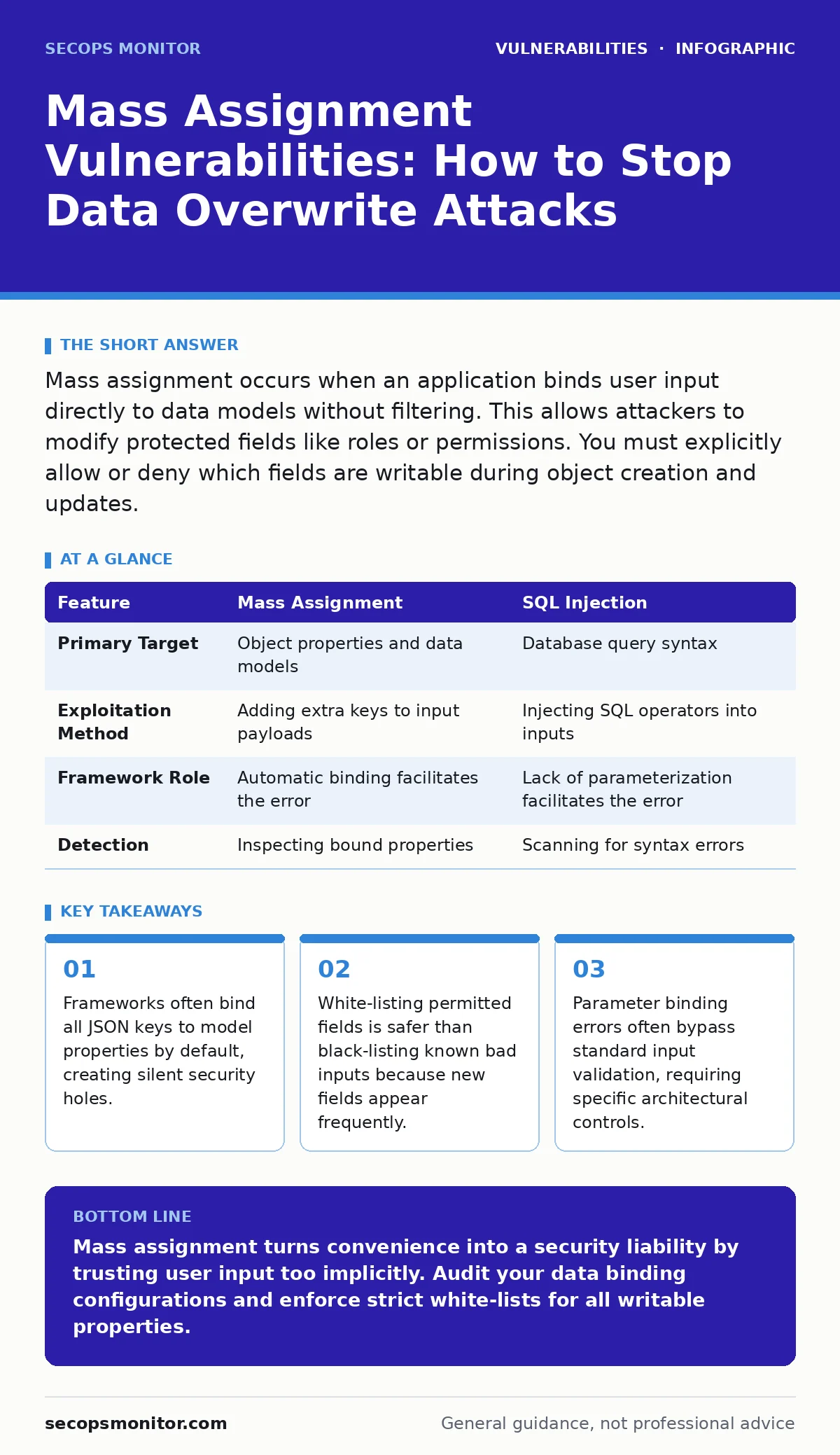
Mass assignment occurs when an application binds user input directly to data models without filtering. This allows attackers to modify protected fields like roles or permissions. You must explicitly allow or deny which fields are writable during object creation and updates.
What exactly is mass assignment?
Mass assignment is a vulnerability where an application accepts user-supplied data and automatically maps it to object properties or database fields. This usually happens in web frameworks that try to reduce boilerplate code by binding request parameters directly to data models. The system assumes the input is safe because it matches the expected structure, ignoring the intent behind the data.
Why do modern frameworks make this easier?
Developers prefer concise code, so many frameworks provide features that automatically populate objects from HTTP request bodies. This convenience removes the need to manually assign each field, but it also removes the developer’s explicit control over which fields are writable. The framework binds every key in the incoming JSON or form data to a corresponding property in the backend object.
How does an attacker exploit this flaw?
Suppose you have a user profile update endpoint that expects a name and an email address. The backend maps these inputs to a User object that also contains an isAdmin boolean flag. If the framework binds all inputs, the attacker sends a JSON payload including "isAdmin": true. The application accepts this value and updates the database, granting the attacker administrative privileges without authentication checks.
Is this the same as SQL injection?
No, because mass assignment does not involve injecting malicious code into a query string. Instead, it abuses the application’s data binding logic to modify state. SQL injection tricks the database into executing arbitrary commands, while mass assignment tricks the application into trusting user input as authoritative data. Both result in unauthorized changes, but the mechanism of failure is entirely different.
| Feature | Mass Assignment | SQL Injection |
|---|---|---|
| Primary Target | Object properties and data models | Database query syntax |
| Exploitation Method | Adding extra keys to input payloads | Injecting SQL operators into inputs |
| Framework Role | Automatic binding facilitates the error | Lack of parameterization facilitates the error |
| Detection | Inspecting bound properties | Scanning for syntax errors |
Why does input validation often fail here?
Standard input validation checks if data fits a specific format, such as verifying an email address has an @ symbol. It rarely checks if the data is allowed to be written to a specific field. An attacker can send a perfectly formatted email address alongside a hidden role field. The validator passes the email, and the binder updates the role, because neither tool questions the source of the data.
See also: How Kubernetes RBAC Works: The Hidden Authorization Flow · How OpenSSL Vulnerabilities Exploit Memory, Step by Step
How do you secure object creation methods?
You must explicitly define which properties are allowed to be set by user input. Most modern frameworks offer decorators, annotations, or configuration options to mark fields as read-only or hidden from binding. For example, marking a role field as protected ensures that even if the attacker sends it, the framework ignores it during the update process. This shifts the burden from filtering bad inputs to permitting only good ones.
What is the hidden cost of fixing this?
Refactoring large codebases to add binding controls is tedious and error-prone. Developers may accidentally leave a field unprotected during a quick patch, creating a new vector. It also requires a shift in mindset where every data model is audited for write permissions. This adds time to the secure software development lifecycle, as security becomes a structural concern rather than a peripheral check.
Can dynamic testing find these issues?
Dynamic application security testing (DAST) tools can detect mass assignment by fuzzing API endpoints with extra parameters. However, they often produce false positives if the application silently ignores the extra fields without erroring. The tool sees the request went through, but it may not realize the backend rejected the harmful input. Manual verification is usually required to confirm if the binding actually occurred.
How does this relate to other vulnerabilities?
Mass assignment often overlaps with insecure direct object references, where an attacker modifies an ID to access another user’s data. It also complicates threat modeling, as you must map every data field to its permission level. Unlike memory-safe programming languages, which prevent buffer overflows, mass assignment is a logic error that exists regardless of the language’s memory safety features.
What is the long-term maintenance strategy?
You need consistent code review practices that focus on data binding configurations. Every new endpoint or model update should include a check for writable fields. Integrating static analysis tools that flag unprotected binding can help catch regressions early. This ensures that convenience features in your framework do not erode your security posture over time.
Key takeaways
- Frameworks often bind all JSON keys to model properties by default, creating silent security holes.
- White-listing permitted fields is safer than black-listing known bad inputs because new fields appear frequently.
- Parameter binding errors often bypass standard input validation, requiring specific architectural controls.
Mass assignment turns convenience into a security liability by trusting user input too implicitly. Audit your data binding configurations and enforce strict white-lists for all writable properties.
Frequently asked questions
Does HTTPS prevent mass assignment?
No, because HTTPS only encrypts data in transit. It does not validate whether the decrypted data is allowed to be written to specific database fields.
Can I fix this with a web application firewall?
A WAF might block known patterns, but it cannot understand your specific data model. It will likely miss custom fields or allow valid-looking attacks through.
Is this common in REST APIs?
Yes, because REST APIs often use JSON payloads that map directly to backend objects. The lack of strict schema enforcement in many implementations makes this prevalent.
How do I test for this manually?
Intercept a legitimate API request using a proxy tool. Add an unexpected field, such as a role or status flag, and send it. Check if the backend updates that field.
How this guide was produced: written by the SecOps Monitor editorial team with AI assistance, checked against the public references listed below, and reviewed when the facts change. See our editorial policy or report an error.