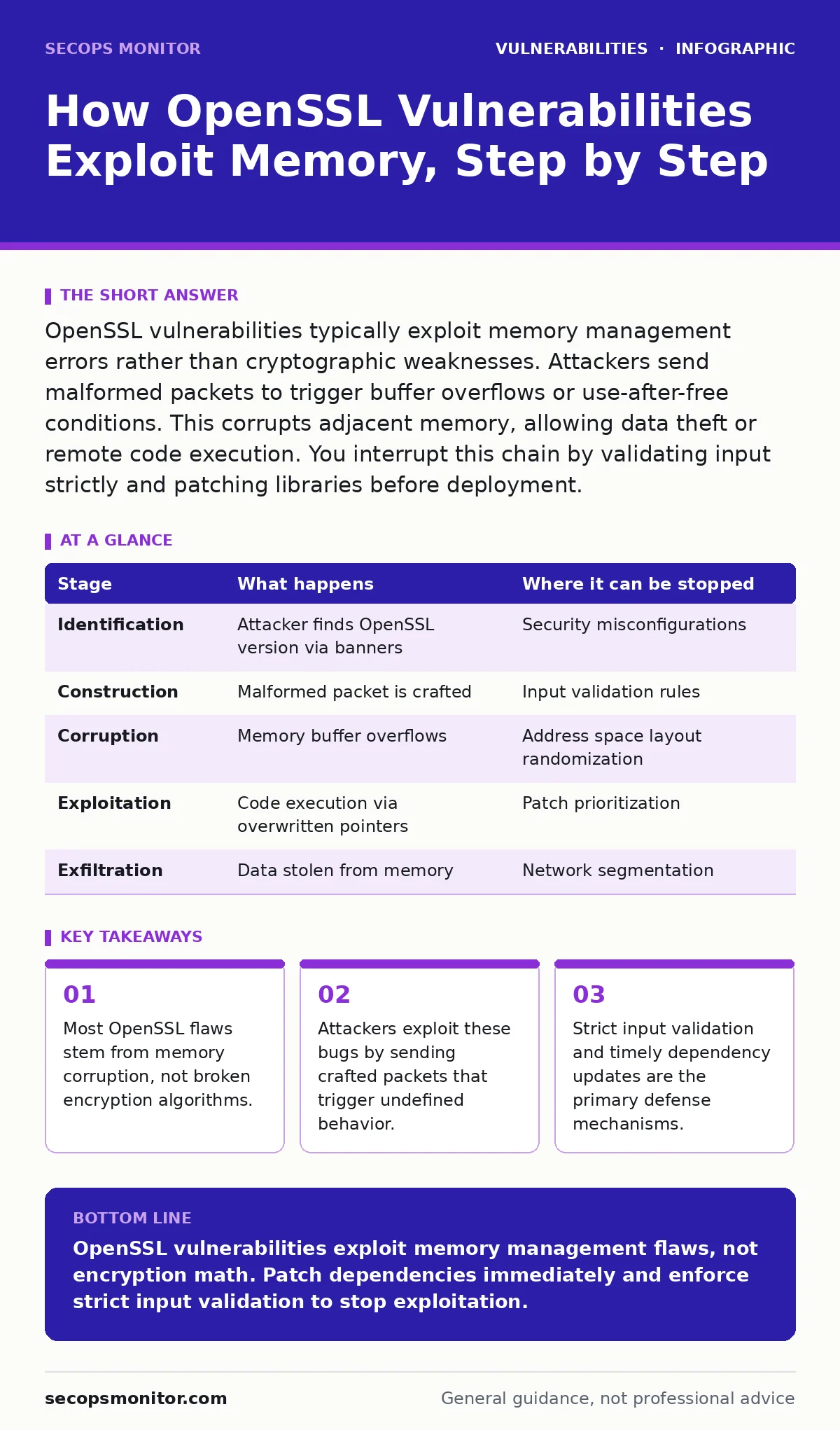
OpenSSL vulnerabilities typically exploit memory management errors rather than cryptographic weaknesses. Attackers send malformed packets to trigger buffer overflows or use-after-free conditions. This corrupts adjacent memory, allowing data theft or remote code execution. You interrupt this chain by validating input strictly and patching libraries before deployment.
The Foundation of OpenSSL Trust
OpenSSL provides the cryptographic library for secure communications across the internet. It implements protocols like TLS, which encrypts data in transit. System administrators rely on it because it is open source and widely audited. The library handles complex tasks like key exchange and certificate verification. When OpenSSL fails, the entire chain of trust breaks down.
The vulnerability surface is not usually the mathematics of encryption. It is the C language code that manages memory. C requires manual memory allocation and deallocation. This gives developers control but introduces risk. A single incorrect pointer can corrupt the system state. Understanding this foundation helps you see why patching is so urgent.
Stage 1: The Attack Surface Identification
Attackers begin by mapping the target infrastructure. They look for services that expose OpenSSL endpoints. Web servers, mail servers, and database connections are common targets. The attacker does not need to know the exact version initially. They send probes to identify the banner or response signature.
This stage relies on information disclosure. If a server reveals its software version in error messages, the attack becomes easier. The flaw here is not in OpenSSL itself but in the configuration of the hosting application. Security misconfigurations often leave default banners active. These banners provide the attacker with the exact version number to target.
Imagine a server that returns a detailed error page when a connection fails. This page lists the OpenSSL version. The attacker now knows exactly which exploits are available. They do not need to guess. This reduces the time to exploit significantly.
Stage 2: The Malformed Packet Construction
Once the target is identified, the attacker crafts a specific network packet. This packet looks valid at the protocol level but contains anomalies in the data fields. The goal is to trigger a specific code path in the OpenSSL library. This path must have a known memory management flaw.
The packet might contain an unusually long string or an unexpected certificate structure. The attacker relies on the library attempting to process this data without sufficient validation. The flaw is in the assumption that input data is always well-formed. OpenSSL must handle every possible input, even malicious ones.
If the input validation is weak, the library proceeds to process the malformed data. This leads to undefined behavior. The attacker calculates the exact payload needed to trigger the bug. This requires deep knowledge of the library's source code or reverse engineering.
Stage 3: Memory Corruption Execution
The server receives the malformed packet and passes it to OpenSSL. The library begins parsing the data. It allocates memory buffers to hold the expected data. When the actual data exceeds the buffer size, a buffer overflow occurs. Data spills into adjacent memory locations.
This corruption changes variables that the system trusts. It might overwrite a function pointer or a return address. The flaw relies on the lack of bounds checking. C does not automatically prevent writes outside allocated memory. The attacker controls the overflow, allowing them to write specific values.
This stage is silent to the user. The connection may appear normal. The server does not crash immediately. The attacker has planted a trigger in the memory. This makes detection difficult. Intrusion detection systems may not see malicious traffic, only valid TLS handshakes with hidden payloads.
Stage 4: Exploitation and Control
With memory corrupted, the attacker executes the exploit. They redirect the program flow to their own code. This is often shellcode injected into the overflow buffer. The code runs with the privileges of the OpenSSL process. This usually means high privilege access.
The attacker can now read sensitive data from memory. This includes private keys and session cookies. They might also establish a reverse shell. The reliance here is on the successful overwrite of execution control. If the system uses address space layout randomization, the attacker must bypass this protection.
Modern systems add layers of defense, but sophisticated attacks can bypass them. The attacker gains a foothold on the server. They can move laterally within the network. The initial vulnerability in OpenSSL has provided full system compromise.
See also: Detect Mass Assignment: Log Signals, Tooling, and Hidden Risks · Patch Prioritization: How to Rank and Deploy Fixes Safely
Stage 5: Data Exfiltration and Persistence
The attacker uses the compromised access to steal data. They extract certificates, user credentials, and encrypted traffic keys. With the private keys, they can decrypt past and future communications. This breaks the confidentiality promise of TLS.
They may also install persistence mechanisms. This ensures access remains even after a restart. The flaw in the original OpenSSL code is now irrelevant. The damage is done. The attacker has achieved their goal. The system is owned.
Defensive Interruption Points
You can interrupt this chain at multiple stages. Input validation is the first line of defense. Ensure that applications validate all incoming data before passing it to OpenSSL. This reduces the chance of triggering memory bugs.
Patch management is critical. Apply security updates to OpenSSL as soon as they are available. Delaying patches leaves the system exposed to known exploits. Monitor for end-of-life software that no longer receives security fixes.
Network segmentation limits the impact of a breach. If one server is compromised, it cannot easily access other systems. This reduces the value of the initial exploit. Use intrusion prevention systems to block known exploit patterns.
Summary of Attack Stages
| Stage | What happens | Where it can be stopped |
|---|---|---|
| Identification | Attacker finds OpenSSL version via banners | Security misconfigurations |
| Construction | Malformed packet is crafted | Input validation rules |
| Corruption | Memory buffer overflows | Address space layout randomization |
| Exploitation | Code execution via overwritten pointers | Patch prioritization |
| Exfiltration | Data stolen from memory | Network segmentation |
Managing Long-Term Risk
OpenSSL is a critical dependency for most systems. You cannot simply remove it. You must manage the risk continuously. Regular audits of your software supply chain help identify outdated libraries.
Automate your patch deployment process. Manual updates are slow and error-prone. Use tools to track dependencies and alert you when vulnerabilities are disclosed. This ensures you react quickly.
Understand that no software is perfect. New vulnerabilities will always emerge. The goal is to reduce the window of exposure. By applying patches quickly and validating input, you minimize the risk. This approach protects your infrastructure against current and future threats.
Key takeaways
- Most OpenSSL flaws stem from memory corruption, not broken encryption algorithms.
- Attackers exploit these bugs by sending crafted packets that trigger undefined behavior.
- Strict input validation and timely dependency updates are the primary defense mechanisms.
OpenSSL vulnerabilities exploit memory management flaws, not encryption math. Patch dependencies immediately and enforce strict input validation to stop exploitation.
Frequently asked questions
Do OpenSSL vulnerabilities break encryption algorithms?
No, they typically exploit memory management errors in the library code, allowing attackers to read data or execute code without breaking the cryptographic math.
How do I know if my system is vulnerable?
Check the OpenSSL version running on your servers and compare it against known vulnerability databases to identify exposure.
Can input validation prevent all OpenSSL attacks?
Input validation reduces risk by rejecting malformed data, but it cannot stop all exploits, especially those triggered by unexpected internal states.
Why is patch prioritization important for OpenSSL?
OpenSSL is widely used, making it a high-value target; rapid patching reduces the time attackers have to exploit known flaws.
How this guide was produced: written by the SecOps Monitor editorial team with AI assistance, checked against the public references listed below, and reviewed when the facts change. See our editorial policy or report an error.