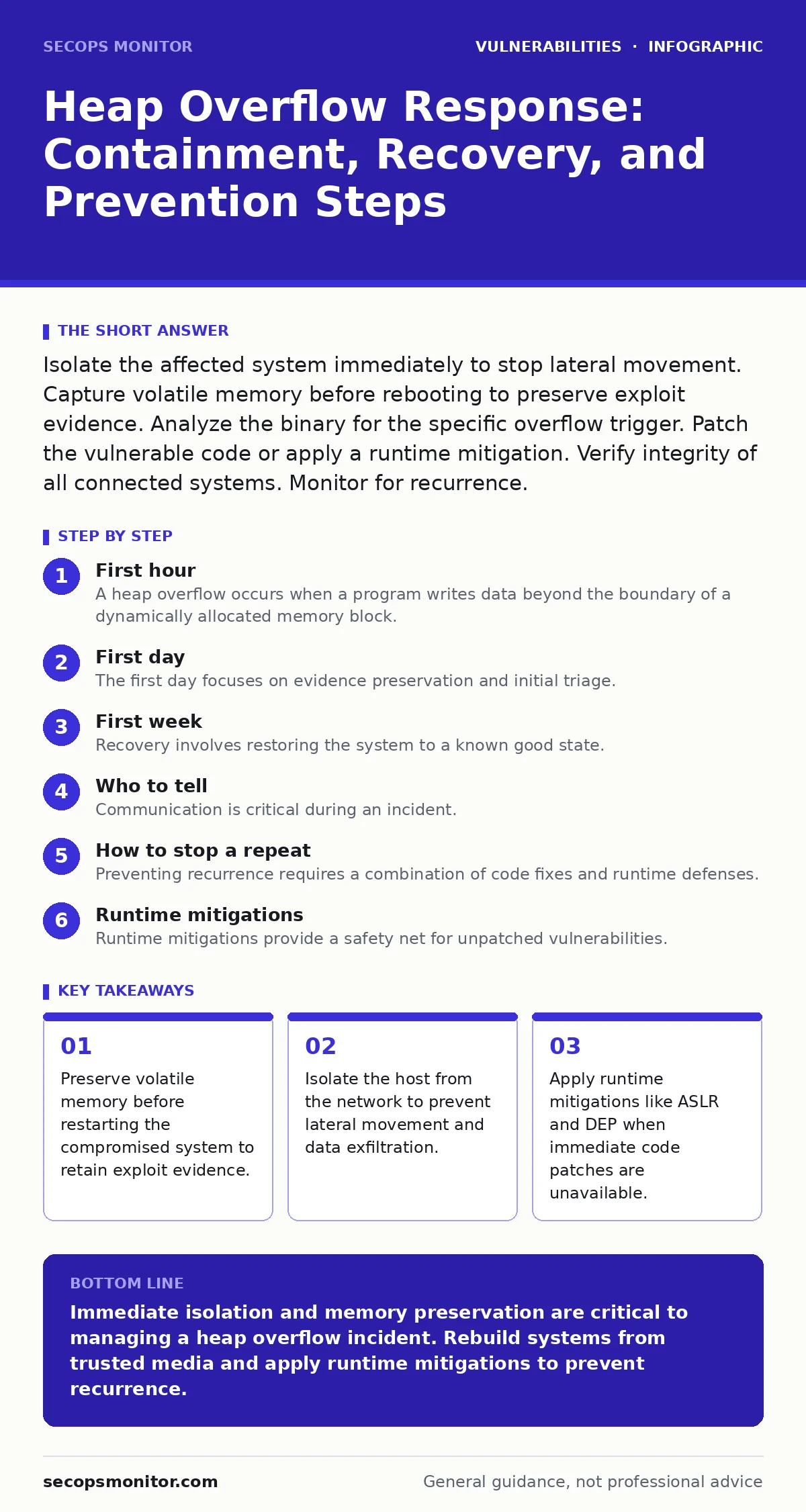
Isolate the affected system immediately to stop lateral movement. Capture volatile memory before rebooting to preserve exploit evidence. Analyze the binary for the specific overflow trigger. Patch the vulnerable code or apply a runtime mitigation. Verify integrity of all connected systems. Monitor for recurrence.
First hour
A heap overflow occurs when a program writes data beyond the boundary of a dynamically allocated memory block. This corruption allows an attacker to overwrite control structures, such as function pointers or object vtables. The attacker gains execution control by redirecting the program flow to malicious code. You must act within the first hour to limit damage.
- Isolate the compromised host from the network while keeping it powered on.
- Capture a full memory dump of the affected system for forensic analysis.
- Identify the specific process or service that triggered the overflow.
- Check for new user accounts or modified system binaries created recently.
- Disable remote access methods to prevent further attacker interaction.
Containment is your primary goal. Do not attempt to fix the issue yet. The attacker may have established persistence mechanisms that survive a simple service restart. Network isolation stops the bleeding. It prevents the attacker from moving laterally to other systems. It also stops data exfiltration attempts that often follow initial access. Keep the system running to preserve the state of the heap and the injected shellcode.
First day
The first day focuses on evidence preservation and initial triage. You need to understand how the overflow happened. Heap overflows are complex because the heap is dynamic. The attacker often uses a technique called heap spraying to place shellcode in memory. They then corrupt a pointer to jump to that sprayed code. Understanding the specific technique helps you find other vulnerable components.
Review the memory dump for signs of heap corruption. Look for overwritten pointers that point to executable memory regions. Identify the vulnerable application. Check if the vulnerability exists in a shared library or a custom application. If it is a shared library, other systems may be at risk. Cross-reference the binary version with known vulnerability databases.
You must determine the scope of the breach. Did the attacker access sensitive data? Did they install backdoors? Check file system timestamps for recent changes. Look for new scheduled tasks or cron jobs. Inspect running processes for unusual activity. Document every finding. This documentation supports your recovery plan and legal requirements.
First week
Recovery involves restoring the system to a known good state. Do not simply patch the running system. The attacker may have modified system files or installed hidden malware. Rebuilding the server from trusted media is the safest approach. If rebuilding is not possible, perform a thorough integrity check. Compare file hashes against known good baselines.
Apply the patch that fixes the heap overflow vulnerability. Ensure the patch addresses the root cause, not just the symptom. Test the patch in a non-production environment first. Verify that the application functions correctly after the patch. Monitor the system closely for signs of instability or recurrence.
You must also review your security controls. Did the overflow bypass existing protections? Consider implementing additional runtime mitigations. These controls add layers of defense against similar attacks. They reduce the likelihood of successful exploitation even if a vulnerability exists.
Who to tell
Communication is critical during an incident. You must inform internal stakeholders promptly. Tell the incident response team and management about the breach. Provide clear, factual updates. Avoid technical jargon when speaking to non-technical leadership. Focus on business impact and recovery timeline.
External communication depends on the nature of the data affected. If customer data was compromised, you may need to notify regulatory bodies. Follow legal requirements for breach notification. Consult with legal counsel before releasing any public statements. Transparency builds trust, but accuracy is paramount. Do not speculate on the extent of the breach.
Consider if related vulnerabilities exist in your environment. For example, if the overflow occurred in a web server, check for security misconfigurations that may have facilitated the attack. Also review vulnerabilities in VPN gateways and application delivery controllers if the attack vector was remote access.
How to stop a repeat
Preventing recurrence requires a combination of code fixes and runtime defenses. You cannot rely on perfect code. Vulnerabilities will always exist. You must assume that an attacker will find a way to exploit them. Your goal is to make exploitation difficult and detectable.
Implement Address Space Layout Randomization (ASLR). ASLR randomizes the memory layout of processes. This makes it harder for an attacker to predict the location of shellcode. Combine ASLR with Data Execution Prevention (DEP). DEP marks certain memory regions as non-executable. This prevents the attacker from running injected code directly.
Use static and dynamic analysis tools to detect potential overflows. Integrate these tools into your build pipeline. Catch vulnerabilities before they reach production. Regularly update your software dependencies. Outdated libraries often contain known heap overflow vulnerabilities.
See also: Cloud Incident Response: 7 Mistakes That Escalate Breaches
Runtime mitigations
Runtime mitigations provide a safety net for unpatched vulnerabilities. These controls are built into modern operating systems and compilers. They add overhead, but the security benefit outweighs the performance cost. Ensure these features are enabled on all servers.
Stack canaries are another effective mitigation. A canary is a random value placed on the stack before the return address. The program checks the canary before returning. If the canary is modified, the program aborts. This prevents many stack-based overflows. While heap overflows are different, the principle of integrity checking applies.
Consider using a secure memory allocator. Standard allocators may not protect against all heap corruption techniques. Secure allocators add checks and restrictions. They make it harder for an attacker to manipulate the heap. Evaluate the performance impact before deploying.
Code review practices
Manual code review is essential for finding complex heap overflows. Automated tools may miss logic errors. Reviewers should look for unsafe memory operations. Check for proper bounds checking on all dynamic allocations. Ensure that memory is freed correctly to prevent use-after-free errors.
Use coding standards that prohibit unsafe functions. Replace functions that do not check bounds with safer alternatives. Train developers on secure coding practices. Make security a part of the development culture. Regular audits help maintain high standards.
Long-term strategy
Security is an ongoing process. You must continuously monitor your environment. Use intrusion detection systems to identify suspicious activity. Correlate events to detect complex attacks. Regularly test your defenses with penetration testing. Simulate heap overflow attacks to verify your mitigations.
Stay informed about new vulnerabilities. Subscribe to security advisories. Participate in security communities. Share knowledge with peers. Collective defense strengthens everyone. Do not ignore the lessons learned from this incident. Apply them to your entire infrastructure.
Review your patch management policy. Ensure that critical patches are applied promptly. Balance security with operational stability. Delaying patches increases risk. Automate patch deployment where possible. Reduce the window of exposure.
Consider the broader context of your software supply chain. If you use third-party libraries, ensure they are maintained. Abandoned projects are a significant risk. Review end-of-life software management practices to avoid running unsupported code. Also, be aware of mass assignment vulnerabilities if the application handles user input dynamically.
Verification and testing
After recovery, verify that the system is secure. Perform a full vulnerability scan. Check for any remaining weaknesses. Test the application under load. Ensure that performance is acceptable. Monitor logs for any anomalies.
Conduct a post-incident review. Analyze what went well and what did not. Update your incident response plan. Incorporate lessons learned. Train your team on the new procedures. Continual improvement is key to resilience.
Remember that no single control provides complete protection. Layer your defenses. Combine code fixes, runtime mitigations, and monitoring. This depth makes it difficult for attackers to succeed. Stay vigilant and proactive.
Key takeaways
- Preserve volatile memory before restarting the compromised system to retain exploit evidence.
- Isolate the host from the network to prevent lateral movement and data exfiltration.
- Apply runtime mitigations like ASLR and DEP when immediate code patches are unavailable.
Immediate isolation and memory preservation are critical to managing a heap overflow incident. Rebuild systems from trusted media and apply runtime mitigations to prevent recurrence.
Frequently asked questions
How do I detect a heap overflow in real-time?
Use intrusion detection systems that monitor for memory corruption patterns. Enable verbose logging in applications to track unusual memory access.
Can firewalls prevent heap overflow attacks?
Firewalls filter network traffic but cannot inspect application-level memory operations. They do not prevent heap overflows directly.
What is the difference between stack and heap overflow?
Stack overflows occur in fixed-size memory areas for function calls. Heap overflows occur in dynamic memory areas allocated during runtime.
How often should I update memory mitigations?
Enable ASLR and DEP permanently. Review and update your mitigation strategy whenever new operating system versions are released.
How this guide was produced: written by the SecOps Monitor editorial team with AI assistance, checked against the public references listed below, and reviewed when the facts change. See our editorial policy or report an error.