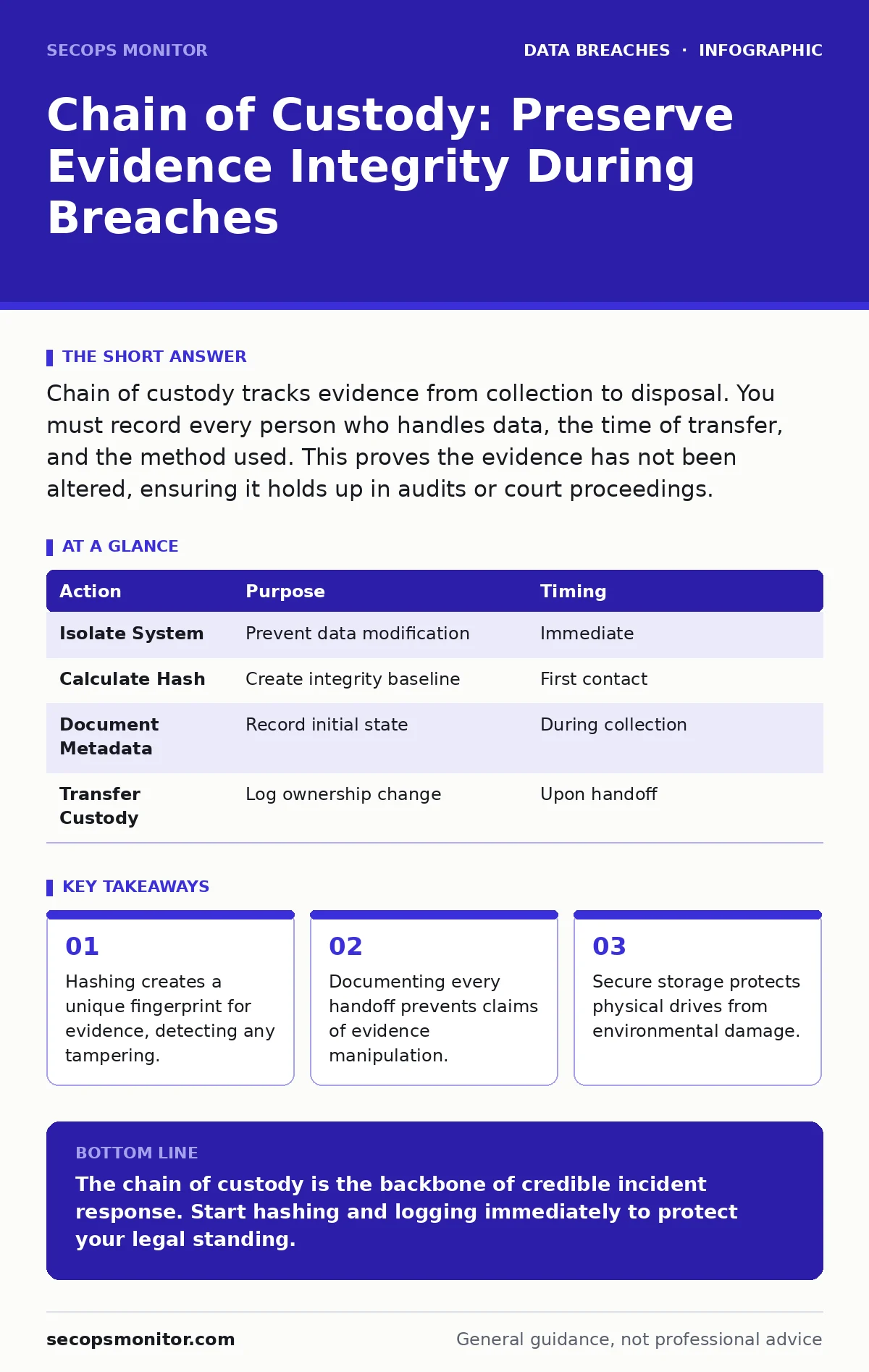
Chain of custody tracks evidence from collection to disposal. You must record every person who handles data, the time of transfer, and the method used. This proves the evidence has not been altered, ensuring it holds up in audits or court proceedings.
What exactly is the chain of custody?
The chain of custody is the documented chronological history of evidence handling. It records who collected the data, where it was stored, and who accessed it. This record proves the evidence remained intact from the moment of discovery to its final use. Without this trail, the data is legally and forensically worthless.
Why does the chain matter in a breach?
Evidence must be admissible in legal proceedings or internal investigations. If you cannot prove the data was not altered, adversaries can claim contamination. This invalidates your findings and weakens your position in liability disputes. It also undermines trust in your incident response process. Maintaining this record is the only way to ensure accountability.
How do you start the chain correctly?
Begin by isolating the affected system to prevent further data alteration. Document the initial state with photographs and detailed notes. Calculate a cryptographic hash of the evidence immediately. This hash serves as a baseline for future comparisons. Any change to the data will produce a different hash.
What is a cryptographic hash?
A hash is a fixed-length string of characters generated from data. Even a single bit change in the input creates a completely different output. This makes it impossible to alter evidence without detection. Common algorithms include SHA-256 and MD5. You use these to verify that files remain unchanged over time.
| Action | Purpose | Timing |
|---|---|---|
| Isolate System | Prevent data modification | Immediate |
| Calculate Hash | Create integrity baseline | First contact |
| Document Metadata | Record initial state | During collection |
| Transfer Custody | Log ownership change | Upon handoff |
Who should handle the evidence?
Only authorized personnel should touch the evidence. Limit access to those with a strict need to know. This reduces the risk of accidental or malicious tampering. Use role-based access control to enforce these limits technically. Log every access attempt, successful or failed. This creates a transparent audit trail.
See also: Cloud Incident Response: 7 Mistakes That Escalate Breaches · SOC vs NOC: How to Choose the Right Operations Center
How do you transfer evidence safely?
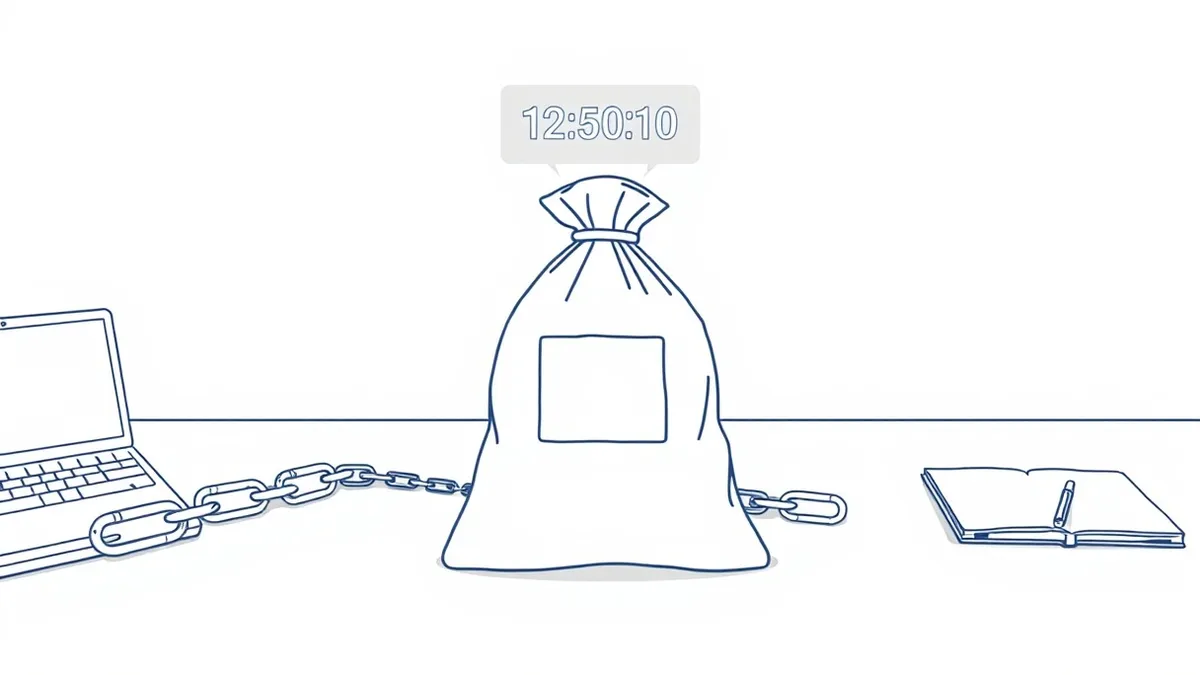
Physical media must be transported in tamper-evident bags. Digital transfers require encrypted channels and authenticated recipients. Record the time, date, and method of every transfer. Both parties must sign off on the handoff. This mutual acknowledgment confirms responsibility shifts correctly. Never leave evidence unattended during transit.
What if the chain is broken?
A broken chain renders evidence inadmissible in most jurisdictions. You cannot repair a break; you must document the gap and its cause. This often requires re-collecting evidence if possible. If not, you must rely on secondary sources like backups. However, backups must also have an unbroken chain. Gaps create reasonable doubt about the data's validity.
How long must you keep records?
Retention periods depend on legal requirements and data sensitivity. Generally, keep records as long as the data itself is retained. Delete them securely when no longer needed. Use certified shredding for physical media. Overwriting digital records multiple times ensures recovery is impossible. Retaining data longer than necessary increases liability risks.
Does cloud storage affect custody?
Cloud providers manage physical hardware, complicating direct control. You rely on their security controls and audit logs. Ensure your contract includes right-to-audit clauses. Verify that logs are immutable and accessible to you. Shared responsibility models mean you control data, but they control the facility. This requires a different approach to verification.
Key takeaways
- Hashing creates a unique fingerprint for evidence, detecting any tampering.
- Documenting every handoff prevents claims of evidence manipulation.
- Secure storage protects physical drives from environmental damage.
The chain of custody is the backbone of credible incident response. Start hashing and logging immediately to protect your legal standing.
Frequently asked questions
Can I use free tools for hashing?
Yes, standard command-line tools like sha256sum are free and widely accepted. Ensure you use the same algorithm consistently.
What if I accidentally modify a file?
Document the incident immediately. The evidence may still be usable if the modification is recorded and explained.
How do I verify a hash later?
Run the same hashing algorithm on the current file. Compare the output to the original recorded hash.
Is email acceptable for evidence transfer?
Only if encrypted. Standard email lacks integrity checks and confidentiality. Use secure file transfer protocols instead.
How this guide was produced: written by the SecOps Monitor editorial team with AI assistance, checked against the public references listed below, and reviewed when the facts change. See our editorial policy or report an error.