You need a NOC to keep systems online and fast. You need a SOC to keep data secure and compliant. Most mature organizations require both because network health does not guarantee security. Choose based on whether your primary risk is downtime or data breach.
Defining the Operational Objective
A Network Operations Center (NOC) ensures your infrastructure stays online. Its staff monitors server uptime, bandwidth usage, and hardware health. If a router fails or a disk fills up, the NOC fixes it.
A Security Operations Center (SOC) looks for malicious behavior. It analyzes logs for signs of unauthorized access, data exfiltration, or malware execution. If an attacker tries to escalate privileges, the SOC investigates and stops them.
The fundamental difference is intent. The NOC cares about whether a service works. The SOC cares about whether someone is abusing that service.
Question 1: What is the Primary Business Risk?
Your first decision depends on what keeps you awake at night. Is it lost revenue from downtime? Or is it reputational damage from a data breach?
If your service level agreements (SLAs) penalize you for seconds of unavailability, the NOC is your priority. You need real-time visibility into packet loss and latency.
If you handle sensitive customer data or regulated information, the SOC is non-negotiable. You need to detect adversary emulation scenarios where attackers mimic normal traffic.
Question 2: How Do You Handle Alerts?
Alert volume determines your staffing model. NOCs generate alerts based on thresholds. These alerts are predictable and often automated.
SOCs generate alerts based on anomalies. A user logging in from two countries simultaneously triggers an alert. These require human judgment to distinguish between a mistake and an attack.
Imagine a system administrator changes a firewall rule. The NOC sees a traffic spike and assumes a failure. The SOC sees the rule change and checks for policy violation.
Without clear alert ownership, teams step on each other’s toes. The NOC might restart a server the SOC is forensically imaging.
Question 3: What Is Your Detection Depth?
Surface-level monitoring satisfies NOC requirements. You can see if a port is open or closed. You can see if a service is responding.
Deep inspection satisfies SOC requirements. You must analyze the content of the traffic. This requires packet capture analysis to inspect payloads for malicious signatures or process injection techniques.
The NOC asks: "Is the connection established?" The SOC asks: "Is the data in the connection safe?"
Using only NOC tools leaves you blind to attacks that use allowed ports. An attacker can hide malicious commands inside standard HTTPS traffic. The NOC sees healthy traffic; the SOC sees the exploit.
Situation-Based Fit
Different organizational stages favor different structures. Early-stage companies often combine roles to save money. Mature organizations separate them to improve precision.
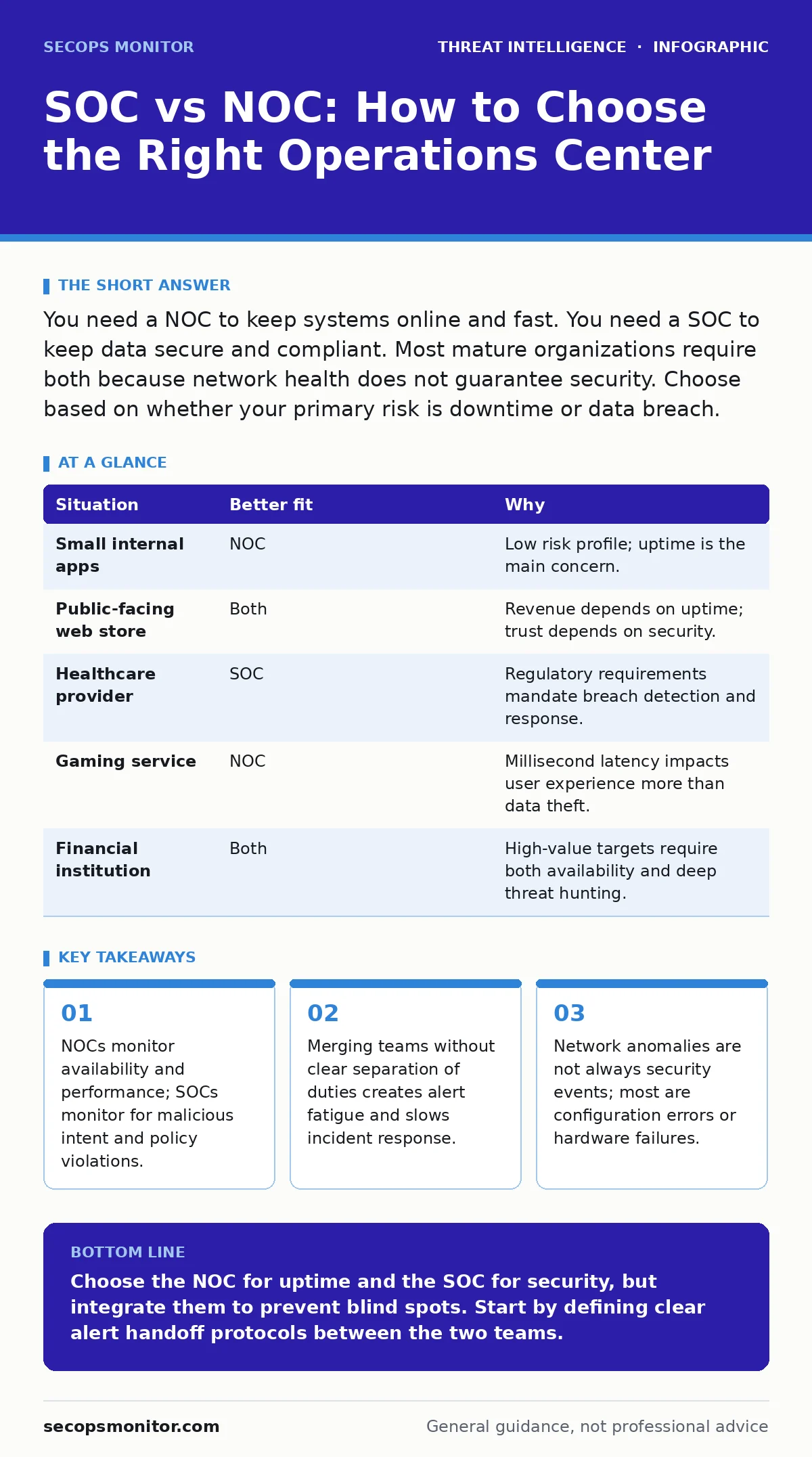
| Situation | Better fit | Why |
|---|---|---|
| Small internal apps | NOC | Low risk profile; uptime is the main concern. |
| Public-facing web store | Both | Revenue depends on uptime; trust depends on security. |
| Healthcare provider | SOC | Regulatory requirements mandate breach detection and response. |
| Gaming service | NOC | Millisecond latency impacts user experience more than data theft. |
| Financial institution | Both | High-value targets require both availability and deep threat hunting. |
See also: Chain of Custody: Preserve Evidence Integrity During Breaches · Cloud Incident Response: 7 Mistakes That Escalate Breaches
Using Both Together
Separating the teams is not enough. They must share data. A firewall log is useless if the NOC cannot correlate it with a network outage.
Imagine a honeypot triggers an alert. The SOC identifies it as a scan. The NOC sees the corresponding traffic spike. If they do not talk, the NOC might provision more bandwidth to fix a "problem" that is actually an attack.
Integrate their tools. Feed NOC performance data into the SOC’s security information and event management (SIEM) system. This helps the SOC filter out noise caused by hardware failures.
Also, feed SOC threat intelligence into NOC dashboards. If the SOC identifies a malicious IP, the NOC can block it at the edge router immediately.
The Cost of Confusion
When roles blur, response times suffer. A NOC technician trained to restart services may lack the forensic skills to preserve evidence. A SOC analyst trained to hunt advanced persistent threats may lack the networking knowledge to diagnose a routing loop.
This confusion leads to misclassified incidents. A DDoS attack looks like a network failure to the NOC. It looks like a security event to the SOC. Without a clear handoff protocol, the attack continues while teams argue about ownership.
Define the handoff. When does a performance alert become a security alert? When does a security investigation require network maintenance? Document these triggers.
Review these triggers quarterly. As your infrastructure changes, so do the patterns of failure and attack. Keep the definitions sharp to maintain operational efficiency.
Key takeaways
- NOCs monitor availability and performance; SOCs monitor for malicious intent and policy violations.
- Merging teams without clear separation of duties creates alert fatigue and slows incident response.
- Network anomalies are not always security events; most are configuration errors or hardware failures.
Choose the NOC for uptime and the SOC for security, but integrate them to prevent blind spots. Start by defining clear alert handoff protocols between the two teams.
Frequently asked questions
Can one person work in both NOC and SOC?
In small organizations, yes. However, the cognitive load of switching between performance troubleshooting and security investigation often leads to missed alerts in both areas.
Do I need a SOC if I use cloud services?
Yes. Cloud providers secure the infrastructure, but you remain responsible for securing your data, identities, and configurations. A SOC monitors these shared responsibility areas.
How do I measure NOC success?
Measure mean time to repair (MTTR) and system availability. The goal is to restore service quickly and maintain high uptime percentages.
How do I measure SOC success?
Measure mean time to detect (MTTD) and mean time to respond (MTTR) for security incidents. The goal is to find and contain threats before they cause damage.
How this guide was produced: written by the SecOps Monitor editorial team with AI assistance, checked against the public references listed below, and reviewed when the facts change. See our editorial policy or report an error.