
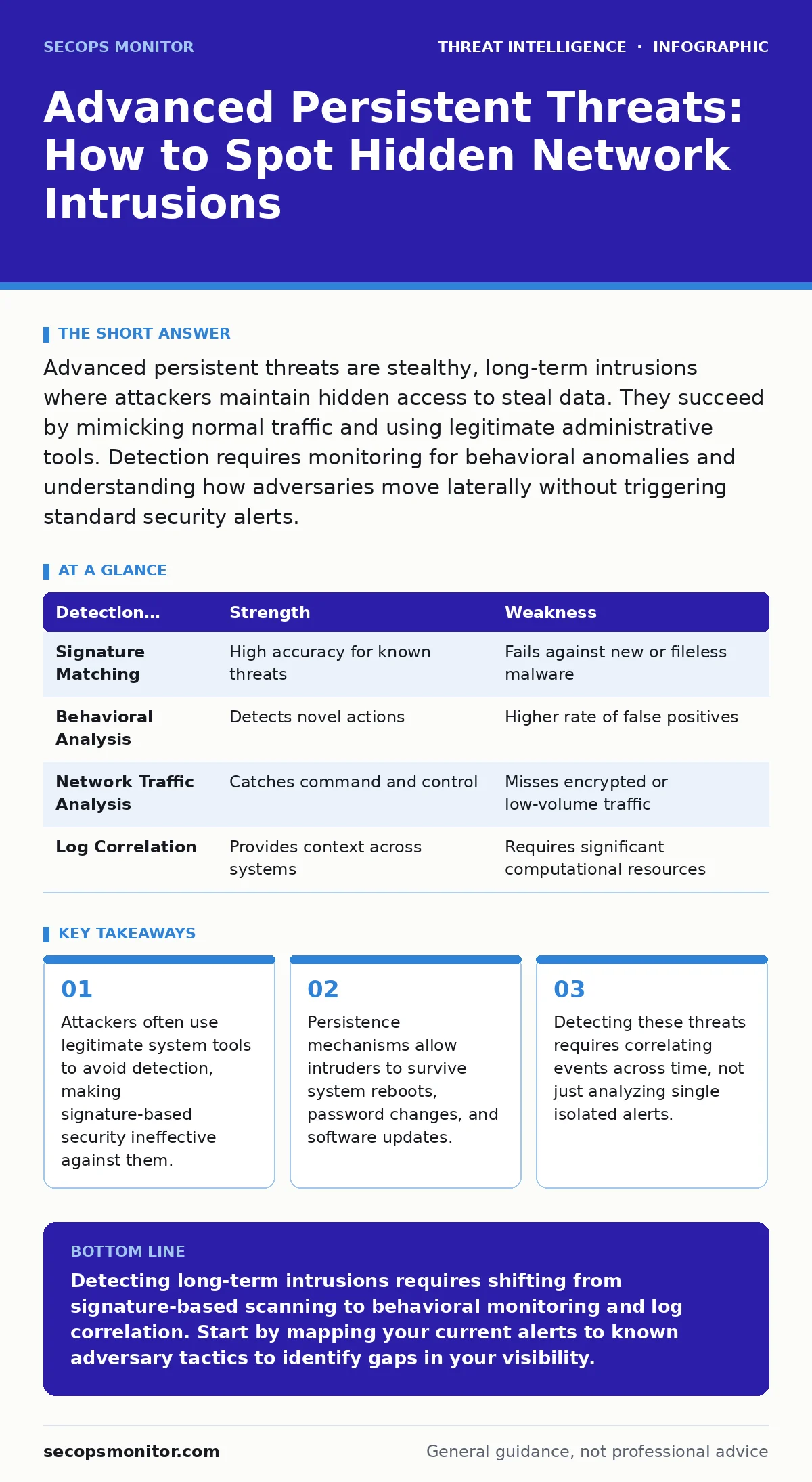
Advanced persistent threats are stealthy, long-term intrusions where attackers maintain hidden access to steal data. They succeed by mimicking normal traffic and using legitimate administrative tools. Detection requires monitoring for behavioral anomalies and understanding how adversaries move laterally without triggering standard security alerts.
What defines an advanced persistent threat?
An advanced persistent threat is a sustained intrusion where an attacker gains unauthorized access to a network and remains hidden for an extended period to achieve specific objectives. Unlike opportunistic cybercrime, these intrusions are methodical, targeted, and funded by sophisticated actors who prioritize stealth over speed. The "advanced" aspect refers to their technical capabilities, "persistent" to their duration, and "threat" to the intent to cause harm or theft. Understanding this definition shifts the focus from immediate containment to long-term surveillance and behavioral analysis.
How do attackers maintain access after initial compromise?
Attackers establish persistence by modifying system configurations, creating new user accounts, or installing background services that execute code automatically upon startup. This ensures that even if you disconnect the initial entry point, they retain control over the compromised host. They often use legitimate system utilities like scheduled tasks or registry keys to hide their presence. For deeper insights into how these modifications work, review our guide on process injection to understand how code executes within running processes without creating new files.
Why do traditional antivirus solutions fail to detect them?
Traditional security tools rely on signatures, which are known patterns of malicious code. Advanced threats use fileless techniques, encrypted communications, or living-off-the-land binaries that look identical to legitimate software. Because these tools do not match known malware signatures, they slip through perimeter defenses unnoticed. This is why monitoring for anomalies in system behavior is more effective than scanning for known bad files. The gap in protection is not a lack of tools, but a mismatch between detection methods and adversary tactics.
What role do tactics, techniques and procedures play in defense?
Tactics, techniques and procedures, or TTPs, describe the specific methods an adversary uses to achieve their goals. While tools change frequently, the underlying behavior often remains consistent across different campaigns. By mapping your alerts to known TTPs, you can identify intrusions even when the malware itself is new or unknown. This behavioral approach allows you to anticipate moves before they happen rather than reacting after damage occurs. See our guide on tactics, techniques and procedures (TTPs) for frameworks that help you catalog and prioritize these behaviors.
How do attackers move laterally without triggering alarms?
Lateral movement involves an attacker spreading from an initial compromised host to other systems within the network. They often use legitimate administrative protocols like Server Message Block or Remote Procedure Call to execute commands on remote machines. Because these protocols are necessary for daily operations, security systems rarely block them, creating a blind spot for intruders. They may also use pass-the-hash techniques to authenticate using stolen credential data without needing passwords.
See also: Diamond Model of Intrusion Analysis: Map Adversaries to Stop Repeat Breaches · Honeypots: 9 FAQs on Deployment, Detection and Data Quality
Can you detect them by analyzing network traffic alone?
Network traffic analysis can reveal suspicious patterns, but advanced threats often encrypt their communications or blend in with normal web traffic. Packet capture analysis allows you to inspect the content of network packets for hidden commands or data exfiltration attempts. However, if the attacker uses standard protocols like DNS or HTTPS, the traffic looks normal to most filters. You must correlate network events with host-level logs to confirm an intrusion. For a deeper look at traffic inspection, refer to our guide on packet capture analysis.
What is the significance of the Diamond Model in this context?
The Diamond Model of intrusion analysis provides a framework for understanding an intrusion by mapping four elements: adversary, infrastructure, capability, and victim. This model helps you connect disparate data points, such as a strange IP address, a specific malware variant, and a targeted department. By filling in the gaps of the diamond, you can predict the adversary’s next move and identify related intrusions. This structured approach prevents you from getting lost in raw log data.
How do internal credentials become the primary attack vector?
Attackers prioritize stealing internal credentials because they grant legitimate access to sensitive systems. Once they have these credentials, they can bypass many security controls that rely on authentication. They often target service accounts or administrative privileges to maximize their reach. Understanding how these credentials are abused is key to limiting the damage. See our guides on Active Directory attacks and DCSync attacks to learn how attackers replicate domain controller data to forge authentication tickets.
| Detection Method | Strength | Weakness |
|---|---|---|
| Signature Matching | High accuracy for known threats | Fails against new or fileless malware |
| Behavioral Analysis | Detects novel actions | Higher rate of false positives |
| Network Traffic Analysis | Catches command and control | Misses encrypted or low-volume traffic |
| Log Correlation | Provides context across systems | Requires significant computational resources |
How can you simulate these threats to test your defenses?
Adversary emulation involves simulating real-world attacks using known tactics, techniques and procedures to test your detection capabilities. Unlike generic vulnerability scans, this method tests your security controls against specific behavioral patterns. It reveals gaps in your monitoring that standard tests might miss. For practical steps on running these simulations, check our guide on adversary emulation. Additionally, deploying honeypots can distract attackers and provide early warning signs of an intrusion attempt by luring them into isolated systems.
Key takeaways
- Attackers often use legitimate system tools to avoid detection, making signature-based security ineffective against them.
- Persistence mechanisms allow intruders to survive system reboots, password changes, and software updates.
- Detecting these threats requires correlating events across time, not just analyzing single isolated alerts.
Detecting long-term intrusions requires shifting from signature-based scanning to behavioral monitoring and log correlation. Start by mapping your current alerts to known adversary tactics to identify gaps in your visibility.
Frequently asked questions
How long do advanced persistent threats typically remain undetected?
Detection times vary widely depending on the organization's monitoring capabilities, but intrusions often persist for months or even years before discovery.
Is it possible to prevent an advanced persistent threat entirely?
Complete prevention is unlikely given the sophistication of attackers, but layered defenses and rapid detection can significantly limit the damage and duration.
What is the first step in responding to a suspected APT?
Isolate the affected systems from the network to prevent lateral movement while preserving logs and memory for forensic analysis.
Do small organizations face the same risk as large enterprises?
Small organizations are often targeted because they may have weaker defenses, making them easier entry points for attackers seeking access to larger partners or customers.
How this guide was produced: written by the SecOps Monitor editorial team with AI assistance, checked against the public references listed below, and reviewed when the facts change. See our editorial policy or report an error.