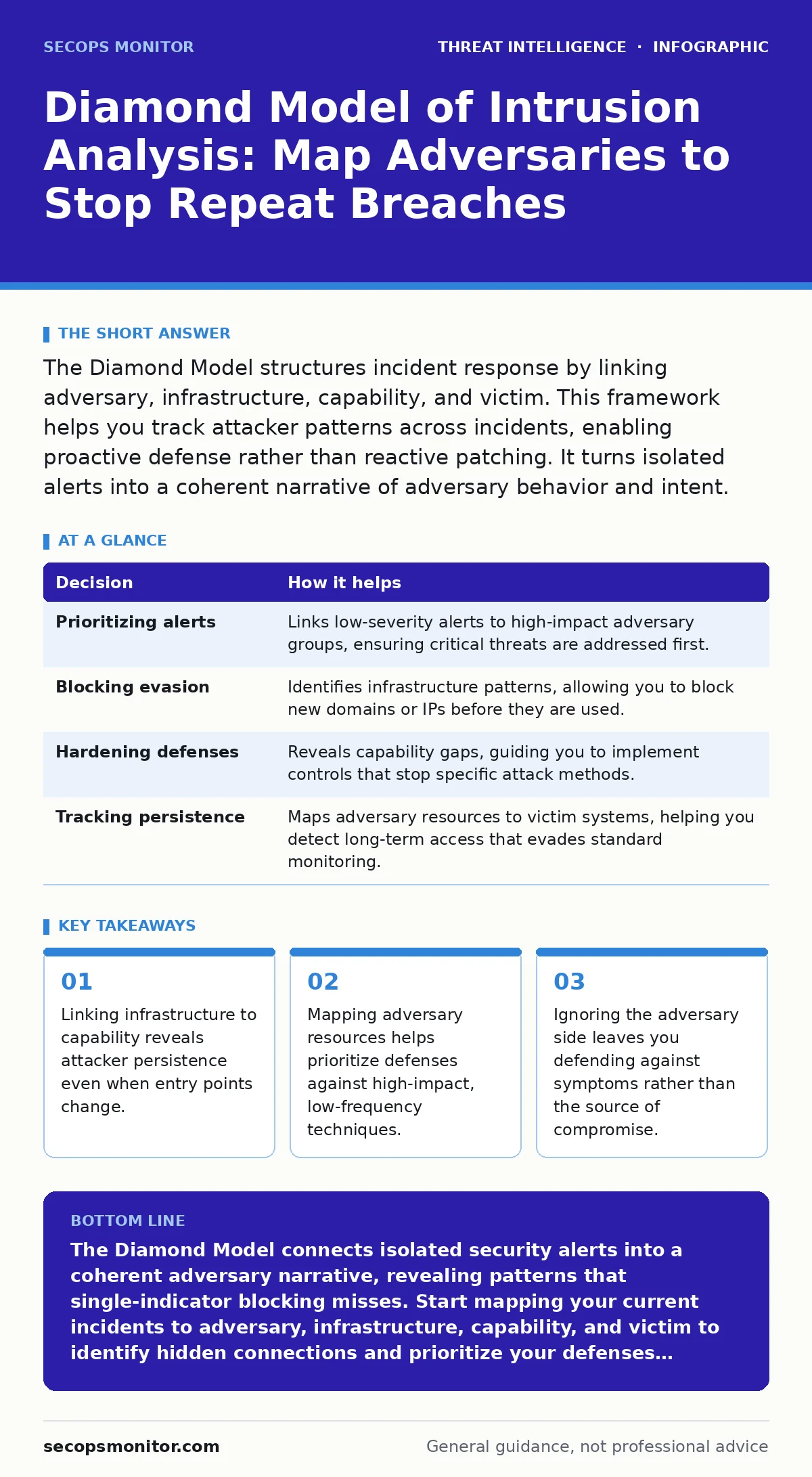
The Diamond Model structures incident response by linking adversary, infrastructure, capability, and victim. This framework helps you track attacker patterns across incidents, enabling proactive defense rather than reactive patching. It turns isolated alerts into a coherent narrative of adversary behavior and intent.
The Failure of Isolated Alerts
Most security operations centers treat alerts as discrete events. You see a suspicious login, block the IP, and close the ticket. This approach assumes the threat ends when the specific indicator is neutralized. In reality, that assumption ignores the broader context of the intrusion.
The Diamond Model of Intrusion Analysis changes this perspective. It is a framework that structures incident analysis around four components: adversary, infrastructure, capability, and victim. By forcing you to map these four elements, the model reveals connections between seemingly unrelated security events.
Imagine a team that blocks a malicious IP address used in a phishing campaign. They consider the incident resolved. Another team uses the Diamond Model to identify that the same adversary group operates a second infrastructure set for lateral movement. The first team faces another breach in weeks. The second team hardens internal defenses before the adversary returns.
The Four Points of the Diamond
The model is visualized as a diamond shape. Each point represents a distinct analytical dimension. Understanding each point allows you to build a complete picture of the threat.
The adversary is the actor behind the attack. This includes the group, their motivation, and their resources. Identifying the adversary helps you predict their next moves based on past behavior.
The infrastructure is the technical resources the adversary uses. This includes IP addresses, domains, servers, and communication channels. Tracking infrastructure allows you to detect new attacks from the same source.
The capability is the specific method or tool used to conduct the attack. This includes malware, exploits, and tactics, techniques and procedures (TTPs). Understanding capability helps you detect the attack regardless of the infrastructure used.
The victim is the target of the attack. This includes the organization, the specific systems, and the data accessed. Analyzing the victim helps you assess impact and identify high-value targets the adversary may pursue next.
| Decision | How it helps |
|---|---|
| Prioritizing alerts | Links low-severity alerts to high-impact adversary groups, ensuring critical threats are addressed first. |
| Blocking evasion | Identifies infrastructure patterns, allowing you to block new domains or IPs before they are used. |
| Hardening defenses | Reveals capability gaps, guiding you to implement controls that stop specific attack methods. |
| Tracking persistence | Maps adversary resources to victim systems, helping you detect long-term access that evades standard monitoring. |
Why Context Matters More Than Indicators
Indicators of compromise, such as file hashes or IP addresses, are easily changed. Adversaries rotate infrastructure to evade detection. If you rely solely on these indicators, you will always be reacting to the latest change.
The Diamond Model shifts the focus from what the adversary is using to who they are and what they can do. Adversaries have limited resources and preferred methods. They often reuse capabilities even when they change infrastructure.
For instance, an adversary might switch from email phishing to spear-phishing via social media. The infrastructure changes, but the capability of credential theft remains the same. By focusing on the capability, you can detect the attack regardless of the delivery method.
This approach is particularly useful when dealing with advanced persistent threats. These groups operate over long periods and adapt their tactics. Mapping their capabilities helps you stay ahead of their evolution.
Integrating with Your Detection Pipeline
You do not need a separate tool to use the Diamond Model. You can integrate it into your existing security information and event management platform. The key is to enrich alerts with context from all four points.
When an alert fires, ask four questions. Who is the adversary? What infrastructure did they use? What capability did they employ? Who is the victim? Answering these questions for every significant alert builds a knowledge base of adversary behavior.
This process complements other detection methods. For example, packet capture analysis can reveal the communication patterns used by the adversary’s infrastructure. Adversary emulation can test your defenses against known capabilities. Honeypots can attract adversaries and reveal their infrastructure and tactics.
By combining these methods, you create a multi-layered defense. The Diamond Model provides the structure to connect the data from these sources. It turns raw data into actionable intelligence.
The Hidden Cost of Ignoring the Adversary
Many teams focus heavily on the victim and infrastructure. They patch systems and block IPs. This is necessary, but it is insufficient. Ignoring the adversary and capability leaves you blind to their intent and resources.
Without understanding the adversary, you cannot prioritize effectively. Not all threats are equal. A script kiddie using a public exploit poses a different risk than a state-sponsored group with custom malware. The Diamond Model helps you distinguish between these threats.
Consider the case of process injection. This capability allows an adversary to hide their malicious code within legitimate processes. If you only monitor for known malicious files, you will miss this attack. By mapping the capability, you can implement behavioral detection that flags suspicious process behavior.
This insight saves time and resources. You stop chasing false positives and focus on the threats that matter. You also improve your response time. When you know who the adversary is, you can anticipate their next move and prepare your defenses.
See also: How TTPs Work: Mapping Adversary Behavior for Detection · Honeypots: 9 FAQs on Deployment, Detection and Data Quality
From Reaction to Proactive Defense
The ultimate goal of the Diamond Model is proactive defense. By understanding the full scope of an intrusion, you can predict future attacks. This allows you to harden your environment before the adversary strikes again.
Start by mapping your current incidents using the four points. Look for patterns in adversary behavior. Identify which capabilities are most dangerous to your organization. Then, implement controls that specifically target those capabilities.
This approach transforms your security posture. You move from putting out fires to preventing them. You build a deeper understanding of the threats you face. And you create a more resilient organization that can withstand sophisticated attacks.
Key takeaways
- Linking infrastructure to capability reveals attacker persistence even when entry points change.
- Mapping adversary resources helps prioritize defenses against high-impact, low-frequency techniques.
- Ignoring the adversary side leaves you defending against symptoms rather than the source of compromise.
The Diamond Model connects isolated security alerts into a coherent adversary narrative, revealing patterns that single-indicator blocking misses. Start mapping your current incidents to adversary, infrastructure, capability, and victim to identify hidden connections and prioritize your defenses effectively.
Frequently asked questions
How does the Diamond Model differ from MITRE ATT&CK?
MITRE ATT&CK catalogs adversary behaviors, while the Diamond Model structures incident analysis. They are complementary: use ATT&CK to identify capabilities and the Diamond Model to link those capabilities to specific adversaries and infrastructure in your environment.
Can I use the Diamond Model if I lack threat intelligence feeds?
Yes. The model relies on your internal data. You can start by mapping known incidents to the four points. As you gather more data, you will build your own adversary profiles, which are often more relevant than generic external intelligence.
How do I handle anonymous or unknown adversaries?
Label them as "unknown" and focus on their infrastructure and capability. Over time, patterns in their behavior may emerge. Grouping unknown adversaries by similar capabilities or infrastructure can help you identify them later.
Is the Diamond Model useful for small teams with limited resources?
Absolutely. The model is a conceptual framework, not a complex tool. It forces you to ask critical questions during incident response. Even a small team can benefit from linking alerts to adversary behavior, improving their efficiency and focus.
How this guide was produced: written by the SecOps Monitor editorial team with AI assistance, checked against the public references listed below, and reviewed when the facts change. See our editorial policy or report an error.