
Honeypots are decoy systems that attract attackers to reveal their methods. They provide high-fidelity data on intrusion attempts but create significant operational noise. You must isolate them from production networks and integrate their alerts into your broader detection strategy to avoid alert fatigue.
What is a honeypot and how does it work?
A honeypot is a decoy system or service designed to appear valuable to attackers while remaining isolated from your production environment. It mimics a legitimate target, such as a web server or database, to lure malicious actors into interacting with it. When an attacker engages with the honeypot, the system records every action they take. This data reveals their tactics, techniques and procedures (TTPs) without risking your actual assets.
Why use a honeypot instead of just monitoring production servers?
Production servers generate massive amounts of legitimate traffic, making it difficult to distinguish between normal user activity and malicious behavior. Honeypots have zero legitimate users, meaning any interaction with them is inherently suspicious. This provides high-fidelity data with virtually no false positives. You gain clear visibility into attack patterns that would otherwise be buried in the noise of your main network logs.
What is the difference between low-interaction and high-interaction honeypots?
Low-interaction honeypots simulate services at a protocol level, offering limited functionality and reduced risk. They are easier to deploy and maintain but provide less detailed data about attacker behavior. High-interaction honeypots run full operating systems and applications, allowing attackers to execute code and move laterally. This yields richer data on advanced persistent threats but requires strict isolation to prevent the honeypot from being used against your network.
How do I isolate a honeypot to prevent it from becoming a liability?
You must place the honeypot in a separate network segment that cannot initiate connections to your production environment. Use firewalls to block all outbound traffic from the honeypot except for specific, monitored channels. This ensures that if an attacker compromises the honeypot, they cannot pivot to your real servers. Consider using virtual machines with no physical network interface cards to enforce this isolation.
Can honeypots help detect insider threats?
Honeypots can reveal insider threats by placing decoy files or credentials in locations accessible to employees but not required for their work. If an employee accesses these decoys, it indicates unauthorized activity or curiosity beyond their role. This method works because legitimate users have no reason to interact with the honeypot. It provides a clear signal of policy violation without relying on complex behavioral analytics.
See also: Diamond Model of Intrusion Analysis: Map Adversaries to Stop Repeat Breaches · Advanced Persistent Threats: How to Spot Hidden Network Intrusions
How do I handle the noise generated by honeypot alerts?
Honeypots generate a high volume of alerts, which can overwhelm your security operations if not managed correctly. You must filter and correlate honeypot data with other security information before it reaches your primary monitoring tools. Use automated rules to suppress known benign scans and focus on interactions that indicate active exploitation. This prevents alert fatigue and ensures your team focuses on genuine threats.
What data should I collect from honeypot interactions?
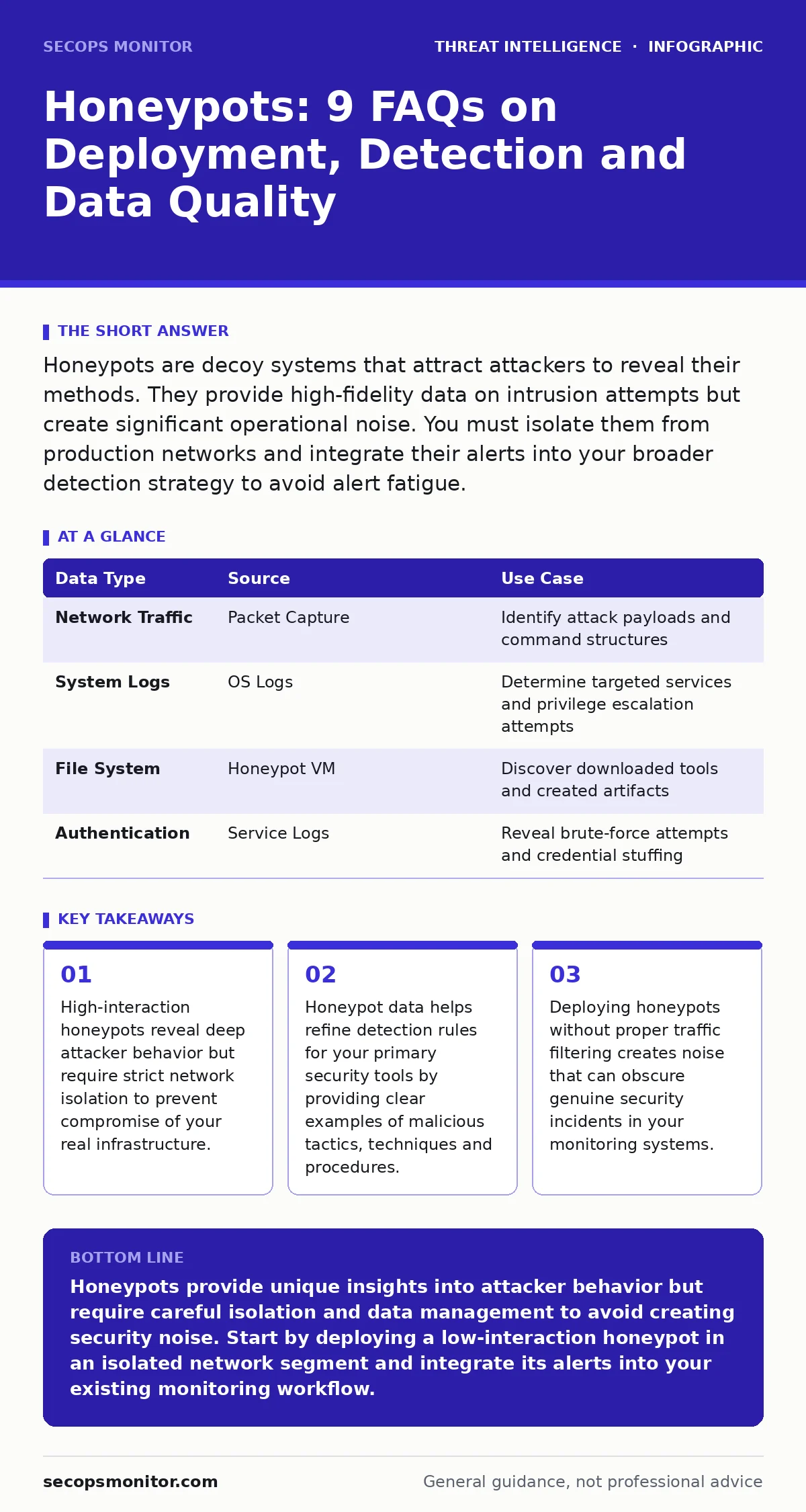
You should capture network traffic, system logs, and file system changes within the honeypot. Packet capture analysis of the network traffic reveals the commands and payloads used by the attacker. System logs show which services were targeted and how the attacker attempted to escalate privileges. File system changes indicate what tools the attacker downloaded or created. This comprehensive data helps you understand the full scope of the attack.
How do I analyze honeypot data to improve my security posture?
Review the collected data to identify common attack vectors and tools used against your organization. Map these findings to known frameworks like the Diamond Model of intrusion analysis to understand the attacker's infrastructure and capabilities. Use this intelligence to update your firewall rules, intrusion detection signatures, and access controls. This proactive approach strengthens your defenses against similar future attacks.
| Data Type | Source | Use Case |
|---|---|---|
| Network Traffic | Packet Capture | Identify attack payloads and command structures |
| System Logs | OS Logs | Determine targeted services and privilege escalation attempts |
| File System | Honeypot VM | Discover downloaded tools and created artifacts |
| Authentication | Service Logs | Reveal brute-force attempts and credential stuffing |
Can honeypots detect advanced persistent threats?
High-interaction honeypots are particularly effective at detecting advanced persistent threats because they allow attackers to spend more time within the environment. These threats often involve slow, methodical exploration that goes undetected in production systems. The honeypot captures this prolonged activity, revealing the attacker's long-term objectives and methods. This data is valuable for understanding sophisticated campaigns that evade traditional security controls.
What are the legal and ethical considerations of using honeypots?
You must ensure that your honeypot deployment complies with local laws regarding data collection and privacy. Avoid collecting personal data from legitimate users who may accidentally interact with the honeypot. Clearly define the scope of your honeypot program and ensure that it does not engage in active deception that could be construed as entrapment. Document your procedures and consult legal counsel to mitigate potential liabilities.
How do honeypots relate to other security detection methods?
Honeypots complement other security measures by providing context and early warning of attacks. They do not replace firewalls, intrusion detection systems, or endpoint protection. Instead, they enhance these tools by supplying high-quality threat intelligence. For example, data from honeypots can help refine detection rules for process injection attempts or DCSync attacks. This integrated approach creates a more resilient security posture.
How do I maintain a honeypot over time?
Regularly update the honeypot software and operating system to patch vulnerabilities that could be exploited. Monitor the honeypot for signs of compromise and reset it if necessary to ensure data integrity. Review the collected data periodically to identify trends and adjust your deployment strategy. This ongoing maintenance ensures that the honeypot remains an effective tool for threat detection.
Key takeaways
- High-interaction honeypots reveal deep attacker behavior but require strict network isolation to prevent compromise of your real infrastructure.
- Honeypot data helps refine detection rules for your primary security tools by providing clear examples of malicious tactics, techniques and procedures.
- Deploying honeypots without proper traffic filtering creates noise that can obscure genuine security incidents in your monitoring systems.
Honeypots provide unique insights into attacker behavior but require careful isolation and data management to avoid creating security noise. Start by deploying a low-interaction honeypot in an isolated network segment and integrate its alerts into your existing monitoring workflow.
Frequently asked questions
Can honeypots replace traditional firewalls?
No, honeypots are detection tools that provide data on attack methods, while firewalls are prevention tools that block unauthorized traffic. They serve different purposes and should be used together.
How do I know if my honeypot has been compromised?
Monitor for unexpected outbound connections, new user accounts, or modified system files within the honeypot. Any activity that deviates from expected attacker behavior may indicate a compromise.
Are honeypots effective against automated botnets?
Yes, honeypots can detect automated scans and attacks from botnets, providing data on their prevalence and methods. However, they may not reveal the full sophistication of targeted attacks.
Can I deploy honeypots in the cloud?
Yes, cloud environments are suitable for honeypot deployment, provided you configure network isolation correctly. Ensure that cloud security groups or firewalls prevent the honeypot from accessing other resources.
How this guide was produced: written by the SecOps Monitor editorial team with AI assistance, checked against the public references listed below, and reviewed when the facts change. See our editorial policy or report an error.