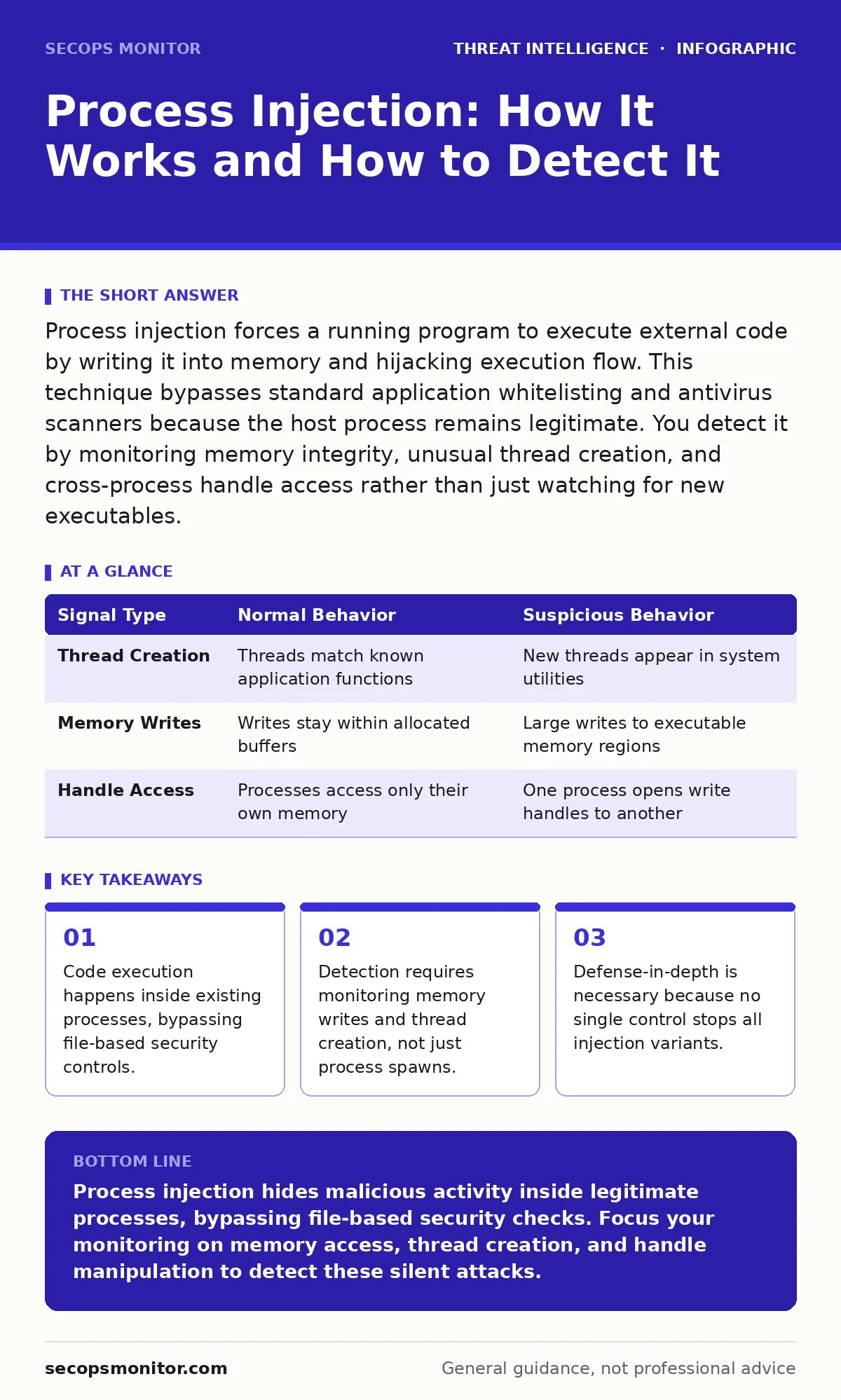
Process injection forces a running program to execute external code by writing it into memory and hijacking execution flow. This technique bypasses standard application whitelisting and antivirus scanners because the host process remains legitimate. You detect it by monitoring memory integrity, unusual thread creation, and cross-process handle access rather than just watching for new executables.
What Is Process Injection?
Process injection is a technique where an attacker writes malicious code into the memory space of a running process and forces that process to execute it. The target process, often a trusted system utility, becomes the vessel for the attack. This allows the malicious code to run with the permissions of the host process. Because the code never touches the disk as an executable file, traditional antivirus solutions often miss it entirely.
How Does Process Injection Bypass Security Controls?
Most endpoint protection relies on monitoring the creation of new processes. When a new executable starts, the security software checks its signature and behavior. Process injection bypasses this by reusing an already-running, authorized process. The security tool sees a legitimate program continuing its work. It does not see a new threat because no new file was launched. This is why file-based whitelisting fails against memory-based attacks.
What Are the Most Common Injection Techniques?
Attackers use several methods to inject code, each exploiting different Windows API functions. Remote Thread Injection creates a new thread in a target process to execute injected code. Hollowing replaces the code of a suspended process with malicious payload before resuming it. DLL Injection forces a process to load a malicious dynamic link library. Each method achieves the same goal: running code inside a trusted context. The choice depends on the defender’s detection capabilities and the attacker’s access level.
Why Is Detection So Difficult for Standard Tools?
Standard logging records when a process starts, stops, or creates a child process. These logs do not capture what happens inside the memory of a running process. If an attacker injects code into explorer.exe, the logs show only that the desktop environment is running. They do not show that a new thread is executing foreign instructions. Without memory inspection or advanced behavioral monitoring, the injection is invisible. This gap is why many breaches go undetected for long periods.
What Signals Indicate an Injection Attempt?
You must look for anomalies in process behavior rather than just process creation. Sudden changes in CPU usage by an idle process can indicate injected code. The creation of threads that do not match the process’s normal function is a strong indicator. Cross-process handle access, where one process opens a handle to another with write permissions, is a prerequisite for most injections. Combining these signals provides a reliable detection method.
| Signal Type | Normal Behavior | Suspicious Behavior |
|---|---|---|
| Thread Creation | Threads match known application functions | New threads appear in system utilities |
| Memory Writes | Writes stay within allocated buffers | Large writes to executable memory regions |
| Handle Access | Processes access only their own memory | One process opens write handles to another |
See also: Implement Deception Technology: A Step-by-Step Operational Guide · What Is Incident Triage: A Field Manual for First Response
How Does This Relate to Lateral Movement?
Once code is injected into a privileged process, the attacker gains that process’s permissions. This is often a step toward moving laterally across the network. The injected code can access sensitive data or authenticate to other systems. This technique complements other access methods, such as Active Directory attacks or DCSync attacks, by providing the initial foothold. Understanding the connection helps you prioritize alerts that involve privileged processes.
Can You Prevent Process Injection Entirely?
You cannot prevent all injection attempts because the underlying operating system features are required for legitimate software to function. However, you can raise the cost and difficulty for attackers. Enforcing the principle of least privilege limits the damage if injection occurs. Using virtualization-based security can isolate kernel memory from tampering. Regular updates patch vulnerabilities that facilitate injection. These measures reduce risk but do not eliminate it.
How Do You Investigate a Suspected Injection?
Investigation requires capturing the state of the process at the time of the alert. You need to analyze the memory dump to identify foreign code segments. Check the parent-child relationships to see if the process was spawned legitimately. Review the timeline of handle access to determine when the injection occurred. This forensic approach mirrors the steps used in packet capture analysis to reconstruct network events. Detailed logs are critical for this reconstruction.
What Is the Role of Behavior Analytics?
Behavior analytics looks for deviations from established baselines. If svchost.exe suddenly starts making network connections it never made before, the system flags it. This method detects the effect of the injection rather than the injection itself. It complements traditional logging by adding context to process actions. For a deeper understanding of how these behaviors fit into broader attack campaigns, review guides on tactics, techniques and procedures (TTPs).
How Does This Fit Into the Broader Threat Picture?
Process injection is rarely an end goal. It is a mechanism to achieve persistence, privilege escalation, or evasion. It often appears in campaigns involving advanced persistent threats who require long-term, hidden access. Mapping these techniques to frameworks like the Diamond Model of intrusion analysis helps you understand the attacker’s infrastructure and goals. This context turns isolated alerts into actionable intelligence.
What Are the Hidden Costs of Mitigation?
Implementing strict memory protection can impact system performance. Some legitimate applications rely on dynamic code generation and may break under heavy scrutiny. Balancing security with usability is a constant challenge. You must tune your detection rules to avoid false positives that disrupt business operations. This trade-off is a common theme in threat actor profiling, where understanding the adversary’s constraints helps you set appropriate defenses.
Key takeaways
- Code execution happens inside existing processes, bypassing file-based security controls.
- Detection requires monitoring memory writes and thread creation, not just process spawns.
- Defense-in-depth is necessary because no single control stops all injection variants.
Process injection hides malicious activity inside legitimate processes, bypassing file-based security checks. Focus your monitoring on memory access, thread creation, and handle manipulation to detect these silent attacks.
Frequently asked questions
Does process injection require admin rights?
It depends on the target process. Injecting into a user-level process requires user rights, while injecting into a system service requires administrative privileges.
Can antivirus software detect process injection?
Modern endpoint detection and response tools can detect it by monitoring behavior, but traditional signature-based antivirus often misses it because no new file is created.
Is process injection legal for software developers?
Legitimate software uses similar techniques for debugging and performance optimization, but attackers misuse these same APIs for malicious purposes.
How do I stop process injection on a server?
You cannot stop it entirely, but you can limit it by applying least privilege, disabling unnecessary services, and using memory integrity features.
How this guide was produced: written by the SecOps Monitor editorial team with AI assistance, checked against the public references listed below, and reviewed when the facts change. See our editorial policy or report an error.