
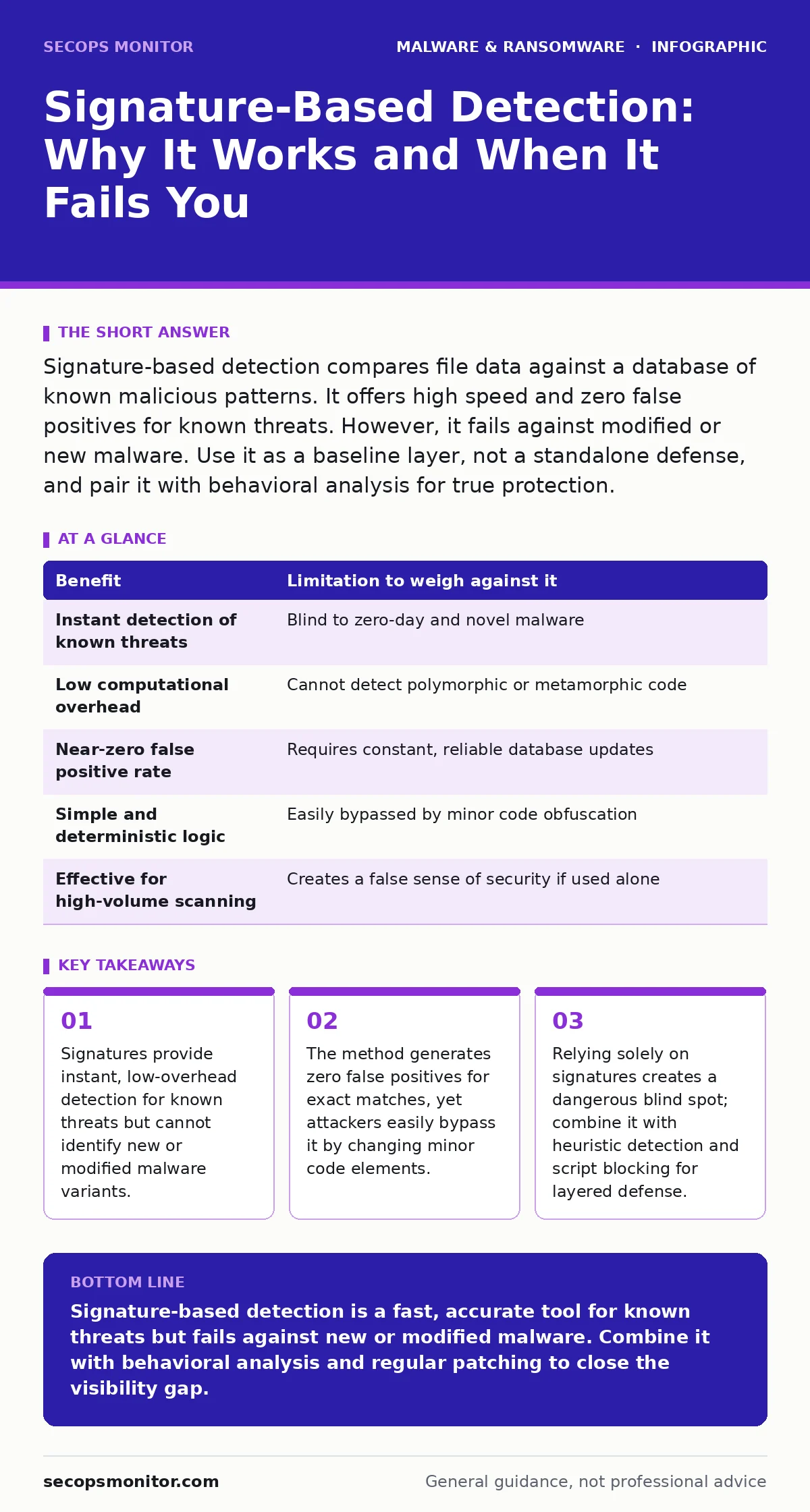
Signature-based detection compares file data against a database of known malicious patterns. It offers high speed and zero false positives for known threats. However, it fails against modified or new malware. Use it as a baseline layer, not a standalone defense, and pair it with behavioral analysis for true protection.
The Mechanics of Pattern Matching
Signature-based detection operates on a simple principle: comparison. The security tool extracts a unique string of characters, a hash, or a specific byte sequence from a file. It then checks this data against a centralized database of known malicious indicators. If the file matches an entry in the database, the system flags it as malware.
This method is deterministic. There is no ambiguity in the result. The file either matches the pattern or it does not. This clarity makes it one of the oldest and most widely deployed defenses in endpoint security. It works because attackers often reuse code or distribute identical copies of a payload across many victims.
Imagine a librarian who identifies banned books by their ISBN numbers. If the number matches, the book is removed. If the author reprints the book with a new number, the librarian misses it. This is the fundamental constraint of signature scanning. It relies entirely on prior knowledge of the threat.
Speed and Precision Advantages
The primary benefit of signature-based detection is performance. Comparing a file hash against a list is computationally inexpensive. The system can scan thousands of files per second without significant impact on CPU or memory usage. This efficiency allows organizations to scan large volumes of data, including email attachments and web downloads, in real time.
Precision is another strong advantage. Because the tool looks for an exact match, it rarely misidentifies legitimate software as malicious. False positives, where benign files are blocked, are uncommon with pure signature matching. This reliability reduces the administrative burden of investigating alerts. You can trust that a signature match indicates a genuine threat.
This predictability makes signature scanning ideal for high-throughput environments. Network gateways and email servers use it to filter traffic before it reaches endpoints. The low resource footprint ensures that security checks do not slow down business operations. It provides a stable, consistent baseline of protection.
The Blind Spot of Novelty
The most significant limitation of signature-based detection is its inability to identify new threats. A zero-day exploit, which is a vulnerability for which no patch or signature exists, will pass through this filter unnoticed. The attacker has not yet distributed the malware widely enough for vendors to create a signature.
Attackers also use polymorphism to defeat this method. Polymorphic malware changes its code structure every time it replicates, while maintaining the same core functionality. Each variant produces a different hash. Since the signature database only contains hashes of previously seen variants, the new copies remain invisible.
Imagine a thief who changes their face every time they enter a building. A security guard who relies on a photo ID list will never recognize them. This is how polymorphic engines work. They rewrite the code to evade static analysis. The signature scanner sees a new, unknown file and allows it to execute.
The Cost of Maintenance and Latency
Signature databases require constant updates. Vendors must analyze new malware samples, extract unique indicators, and distribute these updates to all endpoints. This process introduces latency. There is always a gap between when a threat emerges and when the signature becomes available.
During this window, the system is vulnerable. If an attacker releases a new ransomware strain, your endpoints remain unprotected until the next update cycle. This delay can be minutes or hours, which is often enough for an infection to spread. The reliance on external feeds also creates a dependency. If the update server is unreachable, the database becomes stale.
Maintenance also involves managing the database size. As the number of known threats grows, the signature file expands. Larger files require more memory to load and more time to scan. This trade-off between coverage and performance must be managed carefully. Too many signatures can slow down the scanning engine.
Weighing Benefits Against Limitations
| Benefit | Limitation to weigh against it |
|---|---|
| Instant detection of known threats | Blind to zero-day and novel malware |
| Low computational overhead | Cannot detect polymorphic or metamorphic code |
| Near-zero false positive rate | Requires constant, reliable database updates |
| Simple and deterministic logic | Easily bypassed by minor code obfuscation |
| Effective for high-volume scanning | Creates a false sense of security if used alone |
This table illustrates the trade-offs. You gain speed and accuracy for known items but sacrifice visibility into new ones. The decision to use signature scanning depends on your risk tolerance. If you accept the risk of novel attacks, the efficiency gains are significant. If you need protection against everything, this method alone is insufficient.
See also: Script Blocking Best Practices for Enterprise Security
When Signature Detection Is Worth It
Signature-based detection is worth implementing as a foundational layer. It handles the bulk of known malware efficiently. Using it for email filtering and web gateway scanning reduces the load on more complex security tools. It acts as a first line of defense, catching common threats before they reach the endpoint.
It is also valuable in environments with strict stability requirements. In industrial control systems or medical devices, false positives can cause operational disruption. The precision of signature matching ensures that only confirmed threats are blocked. This reliability is critical when downtime is unacceptable.
Suppose you manage a file server that stores public documents. You can use signature scanning to ensure that no known viruses are uploaded or downloaded. The low cost and high accuracy make it a practical choice for this specific use case. It provides a clear, auditable record of blocked threats.
When It Is Not Worth Relying On
Relying solely on signature detection is dangerous. It leaves you exposed to advanced persistent threats and custom malware. Attackers targeting high-value assets often write unique code that has no signature. In these scenarios, signature scanning provides no protection.
It is not worth using as the primary defense for endpoints handling sensitive data. Users on these systems are more likely to encounter targeted attacks. You need behavioral analysis and heuristic detection to identify suspicious activity. These methods look for actions, not just file content.
Consider a scenario where a user downloads a script that executes a reverse shell. If the script is unique, the signature scanner will miss it. The system will remain compromised until an analyst investigates anomalous network traffic. Relying on signatures here creates a critical gap. You must combine them with script blocking and network monitoring.
Integrating with Broader Defenses
Signature-based detection works best when combined with other methods. Heuristic detection analyzes code structure to identify suspicious patterns, even if the exact signature is unknown. This adds a layer of protection against modified malware.
Script blocking prevents the execution of untrusted scripts, reducing the attack surface for fileless malware. Since many modern attacks use scripts to deliver payloads, blocking them at the source is effective. This complements signature scanning, which often struggles with script-based attacks.
For persistent threats, consider bootkits that load before the operating system. Signature scanning at the file level cannot detect these. You need specialized tools that scan the master boot record. Similarly, immutable backups protect against ransomware by ensuring data cannot be altered or deleted. This provides recovery options even if detection fails.
Key takeaways
- Signatures provide instant, low-overhead detection for known threats but cannot identify new or modified malware variants.
- The method generates zero false positives for exact matches, yet attackers easily bypass it by changing minor code elements.
- Relying solely on signatures creates a dangerous blind spot; combine it with heuristic detection and script blocking for layered defense.
Signature-based detection is a fast, accurate tool for known threats but fails against new or modified malware. Combine it with behavioral analysis and regular patching to close the visibility gap.
Frequently asked questions
Can signature-based detection find ransomware?
It can detect known ransomware variants that have been added to the signature database. It will not detect new or customized ransomware strains until a signature is created and distributed.
How often should signature databases be updated?
Updates should occur as frequently as possible, ideally in real time. Delays in updating leave systems vulnerable to newly identified threats during the gap period.
What is the difference between signature and heuristic detection?
Signature detection matches exact patterns of known malware. Heuristic detection analyzes code behavior and structure to identify suspicious activity, allowing it to catch unknown or modified threats.
Does signature scanning slow down my computer?
It has a low resource footprint and generally does not cause noticeable slowdowns. However, large databases or high scan volumes can impact performance, so configuration matters.
How this guide was produced: written by the SecOps Monitor editorial team with AI assistance, checked against the public references listed below, and reviewed when the facts change. See our editorial policy or report an error.