
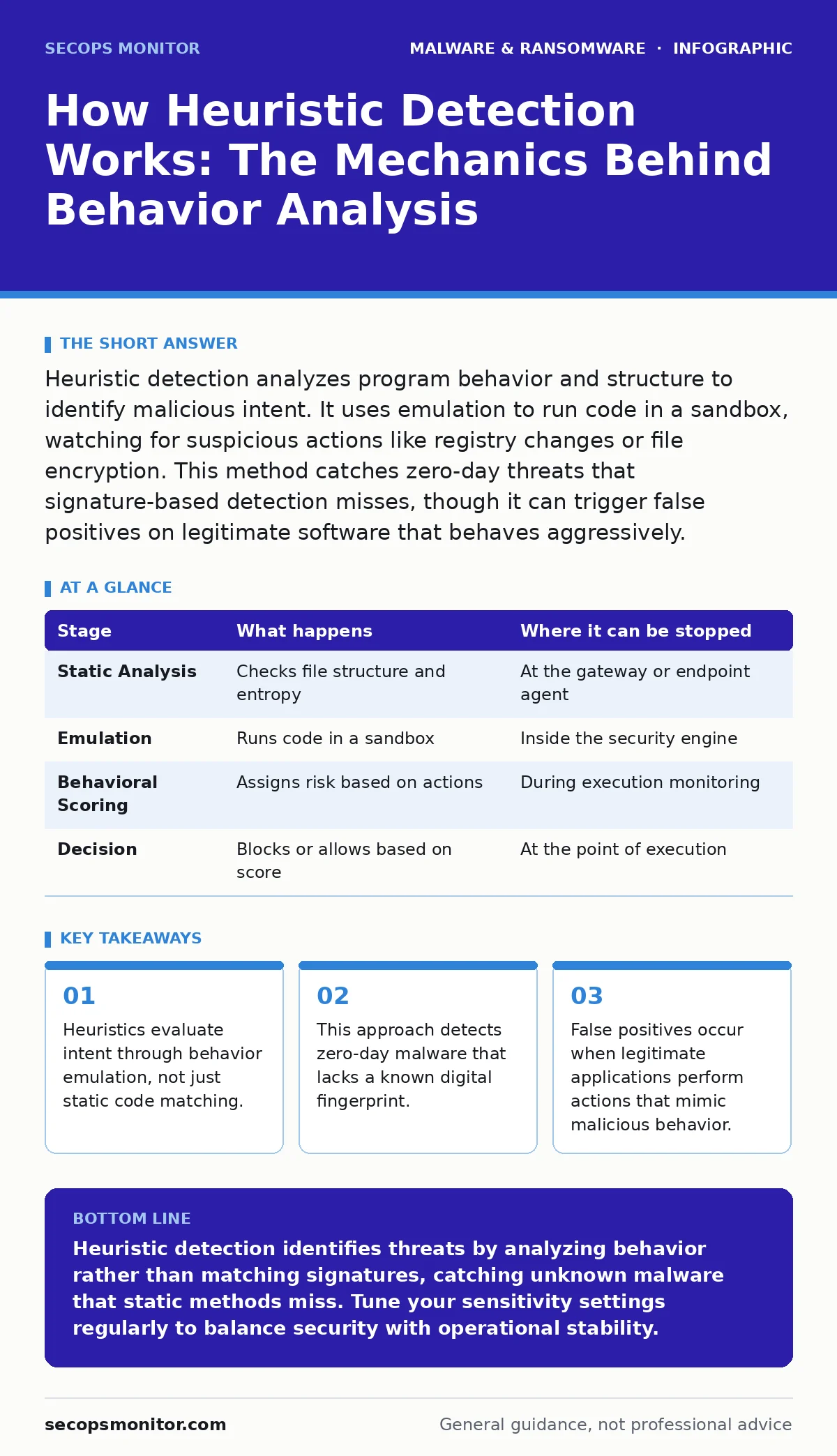
Heuristic detection analyzes program behavior and structure to identify malicious intent. It uses emulation to run code in a sandbox, watching for suspicious actions like registry changes or file encryption. This method catches zero-day threats that signature-based detection misses, though it can trigger false positives on legitimate software that behaves aggressively.
The Limitation of Static Matching
Traditional security relies on comparing file hashes against a database of known threats. This method, known as signature-based detection, works well for established malware variants. It fails completely against new code that has never been seen before.
Attackers modify their code slightly to change the hash. This simple evasion renders static matching useless for novel threats. You need a system that understands what code does, not just what it looks like.
Heuristic detection shifts the focus from identity to behavior. It asks whether a program acts like malware, regardless of its source. This shift allows you to block threats that have no prior record in any threat intelligence feed.
Stage 1: Static Analysis and Entropy Check
The process begins before the code executes. The security engine examines the file structure and composition. It looks for signs of packing or encryption, which often indicate an attempt to hide malicious logic.
High entropy in a file suggests compressed or encrypted data. Legitimate executables usually have predictable structures. Anomalous structures trigger a deeper inspection because they often conceal payloads from casual analysis.
This stage is fast but prone to error. Some legitimate installers use high compression rates. The system must decide whether to flag the file immediately or proceed to dynamic analysis.
Stage 2: Controlled Emulation and Sandboxing
If the static analysis raises suspicion, the file moves to an isolated environment. This sandbox mimics the operating system without risking the actual host. The security engine loads the binary and allows it to run in this controlled space.
The emulator intercepts system calls as the program executes. It watches for interactions with the file system, registry, and network stack. The goal is to observe the program's intent rather than its source code.
Imagine a program that attempts to modify system startup keys. In a sandbox, this action is recorded but not allowed to persist. The engine notes the behavior as a strong indicator of persistence mechanisms used by malware.
| Stage | What happens | Where it can be stopped |
|---|---|---|
| Static Analysis | Checks file structure and entropy | At the gateway or endpoint agent |
| Emulation | Runs code in a sandbox | Inside the security engine |
| Behavioral Scoring | Assigns risk based on actions | During execution monitoring |
| Decision | Blocks or allows based on score | At the point of execution |
Stage 3: Behavioral Scoring and Rule Matching
The emulation engine tracks every action the program takes. Each action is assigned a weight based on its potential harm. Creating a temporary file has low weight. Encrypting user documents has high weight.
The system accumulates these weights into a risk score. It compares the total score against predefined thresholds. If the score exceeds the limit, the program is classified as malicious.
This scoring system relies on context. A system administrator script might make heavy registry changes. The heuristic engine must distinguish between administrative tasks and malicious persistence.
Stage 4: The Decision and Mitigation
Once the score is calculated, the engine makes a final determination. If the behavior matches known malicious patterns, the program is blocked. The file is quarantined, and the event is logged for review.
If the score is ambiguous, the system may alert the administrator. This human-in-the-loop approach helps refine the heuristic rules over time. It reduces the friction of automated blocking.
False positives are the primary risk here. Legitimate software that behaves aggressively can be blocked. You must have a process to whitelist trusted applications quickly to avoid disrupting operations.
The Hidden Cost of False Positives
Heuristic detection is more sensitive than signature matching. This sensitivity is its greatest strength and its greatest weakness. It will flag legitimate software that performs unusual actions.
Imagine a legitimate application that injects code into other processes for debugging. To a heuristic engine, this looks like a process injection attack. The software is blocked, causing operational disruption.
You must balance security with usability. Tuning the sensitivity requires ongoing effort. Ignoring alerts leads to missed threats, while over-blocking leads to productivity loss.
Managing Edge Cases and Legitimate Tools
Some legitimate tools behave like malware by design. Remote management tools often modify system settings and install drivers. Antivirus software itself performs low-level system modifications.
Heuristic engines must be aware of these exceptions. They often maintain allow-lists for trusted publishers. This reduces noise but introduces a dependency on vendor trust.
If a trusted publisher is compromised, the allow-list becomes a vulnerability. This is why defense in depth is necessary. Heuristics alone are not enough. You need multiple layers of verification.
Integrating with Other Defense Layers
Heuristic detection works best when combined with other controls. It complements signature-based detection by covering the unknown threats that signatures miss. It provides a safety net for zero-day exploits.
However, it does not replace the need for other measures. For instance, immutable backups protect against ransomware encryption regardless of detection success. Script blocking reduces the attack surface for malicious macros.
Understanding how wiper malware operates can help refine heuristic rules. These threats often target data structures aggressively. Detecting this behavior early can prevent total data loss.
When heuristics fail, incident response plans must be ready. Reimaging infected computers is often the only reliable way to remove deeply embedded threats. Heuristics aim to prevent this scenario, but they cannot guarantee it.
The Role of Context in Modern Heuristics
Modern heuristic engines use context to improve accuracy. They consider the user's role, the application's reputation, and the time of day. A system update running at night is less suspicious than a similar process at midday.
This contextual awareness reduces noise. It allows the system to be more aggressive with unknown files from untrusted sources. It creates a dynamic security posture that adapts to the environment.
However, this complexity requires more resources. The engine must process more data to make decisions. This can impact system performance, especially on resource-constrained devices.
Conclusion on Detection Mechanics
Heuristic detection transforms security from a static database lookup into a dynamic behavioral analysis. It allows you to catch threats that have no known signature. This capability is vital for defending against modern, evolving malware.
You must accept the trade-off between sensitivity and accuracy. Tuning the system is an ongoing process. Combining heuristics with other controls provides a more resilient defense.
Understanding these mechanics helps you configure your security tools effectively. It ensures that you are protected against both known and unknown threats. This layered approach is the standard for modern cybersecurity.
Key takeaways
- Heuristics evaluate intent through behavior emulation, not just static code matching.
- This approach detects zero-day malware that lacks a known digital fingerprint.
- False positives occur when legitimate applications perform actions that mimic malicious behavior.
Heuristic detection identifies threats by analyzing behavior rather than matching signatures, catching unknown malware that static methods miss. Tune your sensitivity settings regularly to balance security with operational stability.
Frequently asked questions
How does heuristic detection differ from signature-based detection?
Signature-based detection matches files against a database of known hashes. Heuristic detection analyzes program behavior and structure to identify malicious intent, allowing it to catch new, unknown threats.
Can heuristic detection cause false positives with legitimate software?
Yes, legitimate applications that perform aggressive system modifications, such as remote management tools or debuggers, may trigger heuristic alerts. Proper tuning and allow-listing are required to mitigate this.
What is the impact of heuristic detection on system performance?
Heuristic analysis, especially sandboxing and emulation, consumes more CPU and memory resources than simple signature checks. This can slow down file execution, particularly on lower-end hardware.
How do attackers try to evade heuristic detection?
Attackers use techniques like obfuscation, packing, and slow execution to hide malicious behavior from emulators. They may also mimic legitimate system calls to lower their risk score during analysis.
How this guide was produced: written by the SecOps Monitor editorial team with AI assistance, checked against the public references listed below, and reviewed when the facts change. See our editorial policy or report an error.