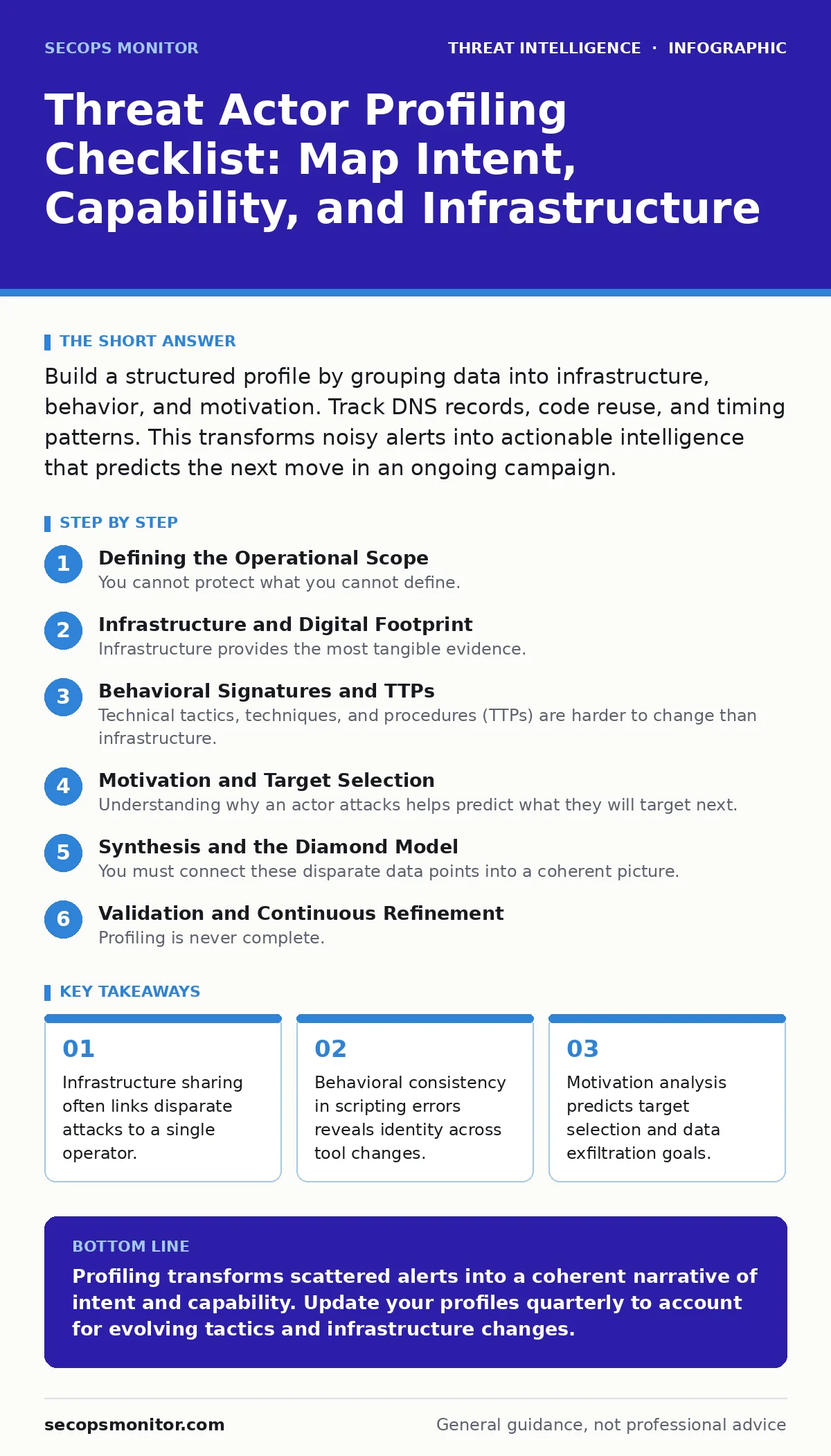
Build a structured profile by grouping data into infrastructure, behavior, and motivation. Track DNS records, code reuse, and timing patterns. This transforms noisy alerts into actionable intelligence that predicts the next move in an ongoing campaign.
Defining the Operational Scope
You cannot protect what you cannot define. Threat actor profiling moves beyond generic risk assessments to map the specific human and technical resources behind an attack. This process transforms raw log data into a narrative of intent and capability.
Use this checklist to structure your investigation. It is not a linear form but a dynamic framework. You will revisit these items as new data emerges from packet capture analysis or endpoint logs. The goal is to reduce uncertainty about who is attacking and how.
Infrastructure and Digital Footprint
Infrastructure provides the most tangible evidence. Attackers often reuse domains, IP ranges, or hosting providers due to cost or convenience. Tracking these assets reveals the scale of their operation.
- Domain registration metadata: Whois data can reveal registrant patterns or privacy services used by the group.
- IP address history: Past associations with other malicious campaigns indicate shared resources.
- Hosting provider type: Cloud services versus dedicated servers suggest budget and technical sophistication.
- Certificate transparency logs: SSL certificates often contain unique identifiers or misconfigurations.
- Malware command and control URLs: These endpoints reveal communication protocols and encryption methods.
This data helps you block entire networks rather than single IPs. It also aids in attribution when combined with other signals. Remember that attackers frequently discard infrastructure. You must correlate current assets with historical data to find the persistent thread.
Behavioral Signatures and TTPs
Technical tactics, techniques, and procedures (TTPs) are harder to change than infrastructure. An attacker’s habits in scripting, timing, and tool selection create a behavioral fingerprint. This consistency persists even when they switch malware variants.
- Scripting language quirks: Unique syntax errors or variable naming conventions in PowerShell or Bash.
- Tool modification patterns: Customized versions of open-source tools indicate specific development skills.
- Timing and rhythm: Consistent attack windows suggest automation or specific time zones.
- Lateral movement methods: Preference for DCSync attacks or pass-the-hash reveals internal knowledge.
- Data staging behavior: How data is compressed and cached before exfiltration shows operational discipline.
Analyzing these behaviors allows you to simulate the attack using adversary emulation. You can test your defenses against the specific methods this group prefers. This is more effective than generic penetration testing. It focuses your resources on the actual threat you face.
Motivation and Target Selection
Understanding why an actor attacks helps predict what they will target next. Financial gain, espionage, or hacktivism drive different operational choices. This context shapes your detection priorities.
- Primary objective: Data theft, disruption, or credential harvesting.
- Industry preference: Sector-specific targeting indicates specialized knowledge or tools.
- Geographic focus: Language barriers or regulatory environments influence target selection.
- Data sensitivity: Interest in intellectual property versus personal information.
- Political alignment: Ideological drivers often result in public claims or specific messaging.
This analysis connects technical data to strategic intent. It helps you prioritize alerts based on potential impact. A group seeking financial gain may focus on payment systems, while an espionage group targets research data. Your defensive posture must align with their goals.
Synthesis and the Diamond Model
You must connect these disparate data points into a coherent picture. The Diamond Model of intrusion analysis provides a framework for this synthesis. It links adversary, infrastructure, capability, and victim into a single event.
- Adversary identification: Confirmed or suspected group based on behavioral matches.
- Capability assessment: Technical skill level and available tools.
- Infrastructure mapping: Known domains, IPs, and hosting providers.
- Victim profile: Common characteristics across targeted organizations.
- Temporal correlation: Timeline of activities across multiple incidents.
This model prevents siloed analysis. It ensures you consider the relationship between the attacker’s tools and their goals. You can identify gaps in your monitoring by seeing which diamond facets remain empty. This holistic view supports long-term strategic defense planning.
See also: Diamond Model of Intrusion Analysis Explained Simply · What Is Incident Triage: A Field Manual for First Response
Validation and Continuous Refinement
Profiling is never complete. Attackers adapt, and your understanding must evolve. You must validate your hypotheses against new data regularly. False positives in attribution can lead to wasted resources.
- Cross-reference with open sources: Verify findings against public threat intelligence feeds.
- Internal correlation: Check if similar artifacts appear in other internal logs.
- Honeypot interaction: Use honeypots to observe attacker behavior in a controlled environment.
- Peer review: Have another analyst challenge your assumptions and evidence.
- Update frequency: Schedule regular reviews of the profile as new incidents occur.
This step ensures your profile remains accurate and actionable. It prevents you from clinging to outdated assumptions. Continuous refinement turns a static report into a living defensive asset. You stay ahead by treating profiling as a process, not a project.
Key takeaways
- Infrastructure sharing often links disparate attacks to a single operator.
- Behavioral consistency in scripting errors reveals identity across tool changes.
- Motivation analysis predicts target selection and data exfiltration goals.
Profiling transforms scattered alerts into a coherent narrative of intent and capability. Update your profiles quarterly to account for evolving tactics and infrastructure changes.
Frequently asked questions
How do I distinguish between a lone wolf and a state-sponsored group?
Look for resource intensity and tool sophistication. State actors often use custom, zero-day exploits and maintain persistent, diverse infrastructure, while lone wolves rely on commercial tools and public exploits.
Can I use this checklist for insider threats?
Yes, but focus heavily on behavioral signatures and motivation. Infrastructure data is less relevant as insiders use legitimate accounts, so timing and data access patterns become the primary indicators.
How this guide was produced: written by the SecOps Monitor editorial team with AI assistance, checked against the public references listed below, and reviewed when the facts change. See our editorial policy or report an error.