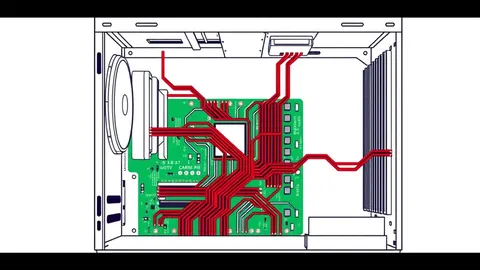
Memory-safe programming languages prevent buffer overflows and use-after-free errors by enforcing strict memory access rules during compilation. They shift security from runtime detection to compile-time prevention, reducing the attack surface for common exploits without requiring manual memory management.
The Library Book Analogy
Imagine a library where every book must be returned to a specific shelf before you can check out another. If you try to read a book that has already been shelved, the librarian stops you immediately. This prevents you from reading stale information or damaging the shelf structure. Memory-safe languages operate on this same principle of strict custody and return.
In traditional programming, the developer acts as the librarian. You decide when to allocate space and when to release it. If you forget to return a book, the shelf becomes cluttered. If you try to read a book after returning it, you encounter nonsense or chaos. Memory-safe languages automate this librarian role, ensuring no book is read after it is shelved and no shelf is overcrowded.
What Memory Safety Actually Means
Memory safety refers to the property where a program never accesses memory it does not own or has not been granted permission to access. This includes reading or writing data outside the bounds of an array or using a pointer to memory that has already been freed. These errors are known as memory corruption vulnerabilities.
Traditional languages like C and C++ give developers direct control over memory addresses. This flexibility allows for high performance but introduces significant risk. A single mistake in calculating an address can lead to a buffer overflow, where data spills into adjacent memory. This spill can overwrite critical control data, allowing an attacker to execute arbitrary code.
Memory-safe languages remove this direct control. They enforce rules that prevent these specific types of errors. The compiler checks your code before it runs, rejecting any attempt to access memory unsafely. This shifts the security boundary from runtime detection to compile-time prevention.
The Core Mechanisms
The primary mechanism behind memory safety is ownership. Every piece of data has exactly one owner. When the owner goes out of scope, the data is automatically cleaned up. This prevents memory leaks and use-after-free errors, where a program tries to access memory that has already been released.
Borrowing allows other parts of the code to access data without taking ownership. The compiler enforces strict rules on borrowing. You can have many read-only references or exactly one mutable reference at any given time. This prevents data races, where two processes try to change the same data simultaneously, leading to unpredictable behavior.
Lifetimes are another key concept. The compiler tracks how long a reference is valid. If you try to use a reference after the data it points to is destroyed, the code will not compile. This ensures that every pointer is valid for its entire duration of use.
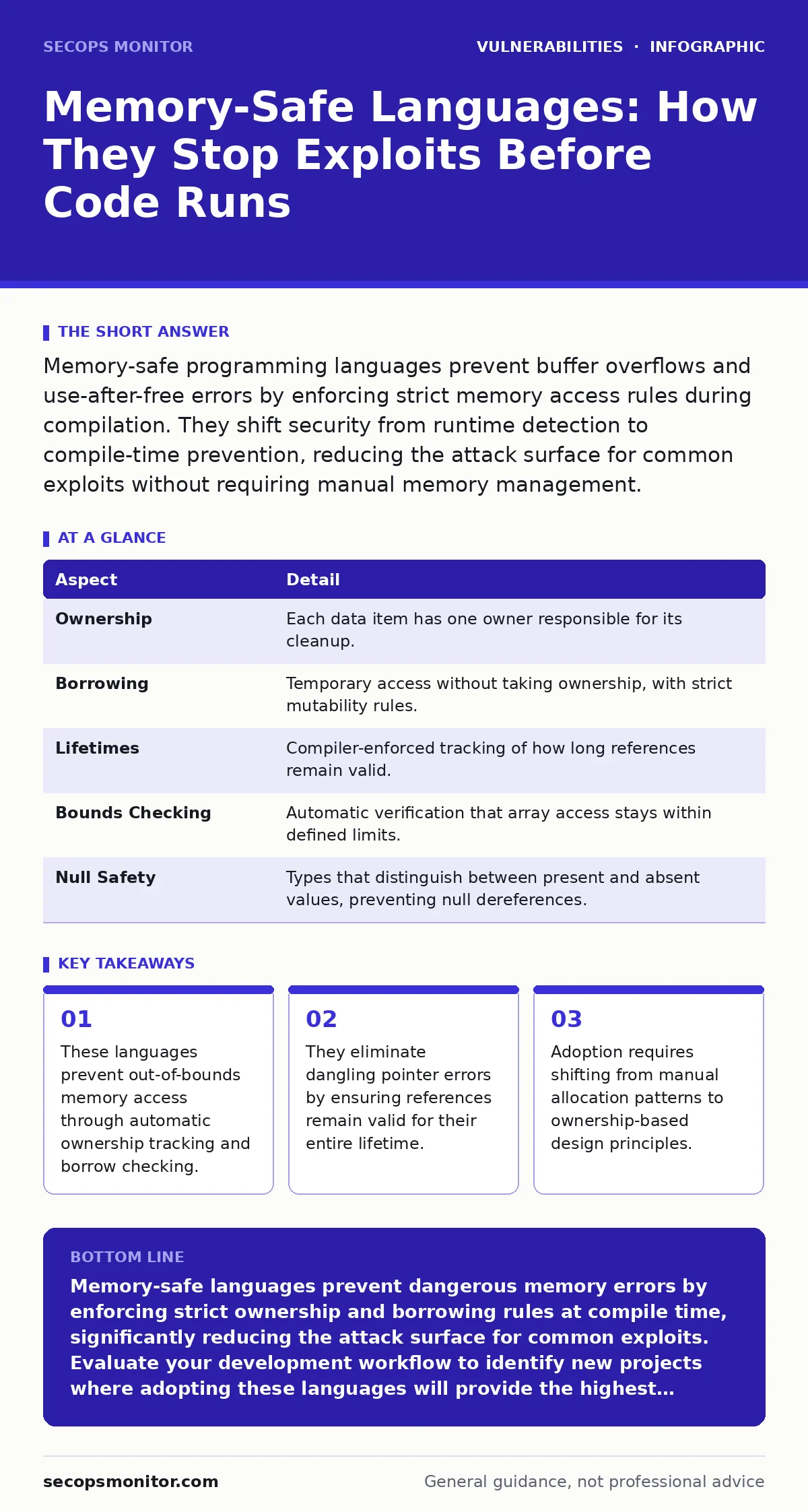
| Aspect | Detail |
|---|---|
| Ownership | Each data item has one owner responsible for its cleanup. |
| Borrowing | Temporary access without taking ownership, with strict mutability rules. |
| Lifetimes | Compiler-enforced tracking of how long references remain valid. |
| Bounds Checking | Automatic verification that array access stays within defined limits. |
| Null Safety | Types that distinguish between present and absent values, preventing null dereferences. |
Where It Fits in Defense
Memory-safe languages do not replace other security measures. They reduce the frequency of certain vulnerability types, but they do not eliminate all risks. Logic errors, authentication flaws, and configuration mistakes still occur. You must still practice a secure software development lifecycle to catch these issues.
By preventing memory corruption, these languages reduce the need for reactive emergency patching. Many high-severity vulnerabilities stem from memory errors. Removing this class of bugs reduces the volume of critical patches required after a release. This allows security teams to focus on more complex architectural issues.
They also complement dynamic application security testing (DAST). While DAST finds runtime issues, memory-safe languages prevent the underlying bugs from existing in the first place. This creates a stronger baseline. You are not just finding and fixing bugs; you are preventing them from being written.
Common Misconceptions
Many developers believe memory-safe languages are inherently slower. This is often true for simple benchmarks, but real-world performance depends on the workload. Modern compilers optimize memory-safe code aggressively. The overhead is often negligible compared to network latency or database queries.
Another misconception is that these languages are only for new projects. Refactoring existing code is possible, but it requires significant effort. You cannot simply rename the file extension. You must rewrite the logic to fit the ownership model. This is a long-term investment, not a quick fix.
Some assume that memory safety means total security. This is false. A memory-safe language cannot prevent a developer from writing logic that allows unauthorized access. It cannot stop a misconfigured server or a weak password policy. It only addresses memory-related errors.
The Trade-Offs
The primary trade-off is learning curve. Developers accustomed to manual memory management must unlearn old habits. They must think in terms of ownership and lifetimes rather than pointers and allocations. This requires a shift in mindset.
Debugging can also be different. Compile-time errors are helpful, but they can be verbose. Understanding why the compiler rejected a piece of code requires familiarity with the borrow checker. This can slow down initial development speed.
However, the long-term benefit is reduced technical debt. Fewer memory bugs mean less time spent on debugging and patching. The code is more predictable and easier to maintain. This leads to higher reliability and lower operational costs over time.
Integration with Other Practices
Memory-safe languages work best when combined with other security practices. Dependency updates remain critical. Even if your code is safe, the libraries you use might not be. You must monitor and update these dependencies regularly.
Static analysis tools can still be useful. They can catch issues that the compiler might miss, such as complex logic errors or security misconfigurations. They provide an additional layer of assurance.
Vulnerability severity ratings help prioritize fixes. When a vulnerability is found, you need to know how dangerous it is. Memory-safe languages reduce the number of high-severity memory bugs, but other vulnerabilities still need assessment.
Key takeaways
- These languages prevent out-of-bounds memory access through automatic ownership tracking and borrow checking.
- They eliminate dangling pointer errors by ensuring references remain valid for their entire lifetime.
- Adoption requires shifting from manual allocation patterns to ownership-based design principles.
- They fit into a layered defense strategy, reducing the need for reactive emergency patching.
Memory-safe languages prevent dangerous memory errors by enforcing strict ownership and borrowing rules at compile time, significantly reducing the attack surface for common exploits. Evaluate your development workflow to identify new projects where adopting these languages will provide the highest security return on investment.
Frequently asked questions
Do memory-safe languages prevent all types of security vulnerabilities?
No, they specifically prevent memory corruption errors like buffer overflows and use-after-free. They do not prevent logic errors, authentication flaws, or configuration mistakes.
Can I use memory-safe languages for high-performance systems?
Yes, modern compilers optimize memory-safe code effectively. While there may be some overhead, it is often negligible in real-world applications dominated by I/O or network latency.
How does this relate to router vulnerabilities?
Many router vulnerabilities stem from memory errors in firmware. Using memory-safe languages for firmware development would significantly reduce the risk of these specific exploits.
Is it worth refactoring legacy C code to a memory-safe language?
Refactoring is expensive and risky. It is often better to wrap legacy code in safe interfaces or rewrite critical components gradually, rather than a full immediate rewrite.
How this guide was produced: written by the SecOps Monitor editorial team with AI assistance, checked against the public references listed below, and reviewed when the facts change. See our editorial policy or report an error.