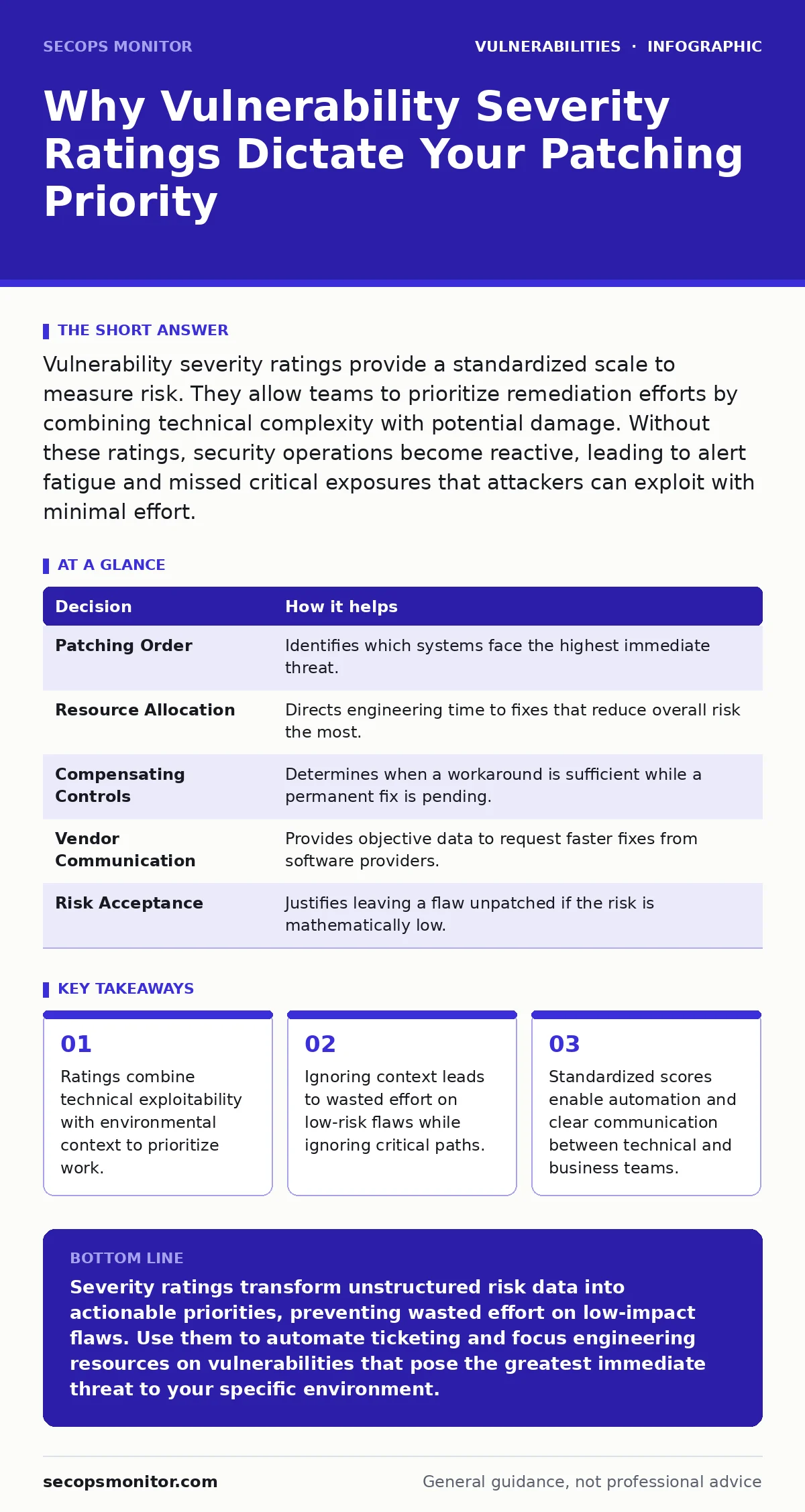
Vulnerability severity ratings provide a standardized scale to measure risk. They allow teams to prioritize remediation efforts by combining technical complexity with potential damage. Without these ratings, security operations become reactive, leading to alert fatigue and missed critical exposures that attackers can exploit with minimal effort.
The Illusion of Equal Risk
Every system has flaws. A web server might have a configuration error, a library might contain a logic bug, and the kernel might have a memory corruption issue. Treating these issues as equal risks is a strategic error. The cost of fixing a trivial information leak is rarely the same as patching a remote code execution flaw. You need a mechanism to distinguish between noise and signal.
Vulnerability severity ratings provide this distinction. They assign a numerical score to a weakness based on how difficult it is to exploit and how much damage it can cause. This score is not an opinion. It is a calculated value derived from standardized criteria. The most common standard is the Common Vulnerability Scoring System (CVSS). This framework breaks down risk into three groups: base, temporal, and environmental.
The base score measures the intrinsic characteristics of the vulnerability. It considers factors like attack vector, complexity, and privileges required. This score remains constant regardless of your specific environment. It tells you how dangerous the flaw is in a vacuum. The temporal score adjusts for the current state of fixes and exploits. The environmental score tailors the risk to your specific infrastructure.
Decisions Driven by Scores
You cannot patch everything at once. Resource constraints force you to choose. Severity ratings inform these choices by creating a hierarchy of urgency. They determine which systems get immediate attention and which can wait for the next maintenance window. This prioritization extends beyond just patching. It influences whether you implement a compensating control, such as a firewall rule, to mitigate the risk while a fix is developed.
Without a rating system, decisions often default to recency or noise. The most recent alert gets attention because it is fresh. This is inefficient. A high-severity flaw discovered last year may still be unpatched and actively exploited. A low-severity flaw discovered today may pose no real threat to your current architecture. Ratings anchor your decision-making in technical reality rather than administrative convenience.
| Decision | How it helps |
|---|---|
| Patching Order | Identifies which systems face the highest immediate threat. |
| Resource Allocation | Directs engineering time to fixes that reduce overall risk the most. |
| Compensating Controls | Determines when a workaround is sufficient while a permanent fix is pending. |
| Vendor Communication | Provides objective data to request faster fixes from software providers. |
| Risk Acceptance | Justifies leaving a flaw unpatched if the risk is mathematically low. |
What Happens Without Ratings
Imagine a team that receives a list of one hundred vulnerabilities. None have scores. The team spends three weeks fixing a cosmetic flaw in a public-facing dashboard because it was at the top of the list. Meanwhile, an unauthenticated remote code execution flaw in an internal management tool remains open. An attacker finds the management tool and gains full control of the network.
This scenario illustrates the hidden cost of unranked data. You waste effort on low-impact issues. You leave high-impact doors open. The psychological toll on the team is also significant. Alert fatigue sets in when every notification feels equally urgent. Eventually, the team stops responding to alerts altogether. This paralysis leaves the organization exposed to threats that require immediate action.
Severity ratings prevent this paralysis. They allow you to ignore the cosmetic flaw until there is capacity. They force you to address the remote code execution flaw first. This focus saves time and reduces the window of exposure for critical systems. It transforms security from a chaotic scramble into a managed process.
How Teams Use Ratings
Effective teams do not just read the scores. They use them to automate workflows. When a new vulnerability is published, scanning tools check the base score. If the score exceeds a threshold, the tool automatically creates a ticket. This ticket is assigned to the appropriate engineering group. The severity rating determines the priority level of the ticket. High scores trigger immediate notification. Low scores may be batched for weekly review.
This automation reduces the cognitive load on security analysts. They do not need to manually assess every new finding. They can focus on exceptions and complex cases. The ratings also facilitate communication with non-technical stakeholders. You can explain that a score of nine indicates a severe risk that requires emergency patching. A score of three indicates a minor issue that can be addressed in the next release cycle.
Integration with a secure software development lifecycle ensures that these ratings are considered early. Developers check dependencies during the build process. If a high-severity flaw is detected in a library, the build fails. This prevents vulnerable code from reaching production. It shifts the focus from remediation to prevention.
The Trap of Base Scores Alone
Base scores are useful, but they are incomplete. They do not account for your specific environment. A vulnerability with a high base score might be irrelevant if the affected software is not installed. Conversely, a vulnerability with a moderate base score might be critical if it affects a system that handles sensitive data. Relying solely on base scores leads to misaligned priorities.
You must calculate environmental scores. This involves adjusting the base score based on factors like the confidentiality, integrity, and availability requirements of your systems. A flaw that exposes data is more severe in a healthcare system than in a public blog. Environmental scoring captures this nuance. It ensures that the ratings reflect the actual risk to your organization.
Ignoring environmental context is a common mistake. It leads to teams patching systems that are not at risk while neglecting those that are. This misalignment wastes resources and leaves critical assets exposed. Always adjust scores to fit your specific infrastructure and business requirements.
See also: Implement DAST: Step-by-Step Dynamic Security Testing for Web Apps
Contextualizing with Testing
Severity ratings are static. They do not change unless the underlying vulnerability details change. Your environment, however, is dynamic. Systems are configured differently. Network segmentation changes. Access controls evolve. A vulnerability that was high-risk last month might be low-risk today due to a new firewall rule.
To keep ratings accurate, you must validate them with active testing. Dynamic application security testing (DAST) can confirm whether a vulnerability is exploitable in your specific deployment. If DAST cannot exploit a high-rated flaw, the effective risk is lower. This validation prevents unnecessary panic and wasted effort. It ensures that your remediation efforts focus on real, exploitable weaknesses.
Threat modeling provides another layer of context. It helps you understand how an attacker might interact with your systems. By combining threat models with severity ratings, you can identify attack paths that are most likely to succeed. This proactive approach strengthens your defense posture. It moves you from reactive patching to strategic risk management.
Beyond the Score
Severity ratings are a tool, not a solution. They help you prioritize, but they do not eliminate risk. You must still implement proper controls. You must monitor for exploitation attempts. You must update your systems regularly. Ratings give you clarity, but they do not do the work for you.
Understanding the limitations of ratings is key. They are estimates. They are based on general assumptions. Your specific risk may differ. Always combine ratings with your own judgment and context. Use them to guide your decisions, not to replace them. This balanced approach ensures that you remain secure without being overwhelmed by data.
Key takeaways
- Ratings combine technical exploitability with environmental context to prioritize work.
- Ignoring context leads to wasted effort on low-risk flaws while ignoring critical paths.
- Standardized scores enable automation and clear communication between technical and business teams.
Severity ratings transform unstructured risk data into actionable priorities, preventing wasted effort on low-impact flaws. Use them to automate ticketing and focus engineering resources on vulnerabilities that pose the greatest immediate threat to your specific environment.
Frequently asked questions
How often should severity ratings be updated?
Ratings are updated when new information about the vulnerability becomes available, such as exploit code or patches. Check for updates regularly, especially for high-severity issues.
Can severity ratings be trusted completely?
No. They are estimates based on general criteria. Always consider your specific environment and business context. Use them as a guide, not an absolute truth.
What is the difference between base, temporal, and environmental scores?
Base scores measure intrinsic risk. Temporal scores adjust for current fix status. Environmental scores tailor the risk to your specific infrastructure and requirements.
How do severity ratings help with dependency updates?
They help you decide which dependencies to update first. High-severity flaws in widely used libraries require immediate attention to prevent widespread impact.
How this guide was produced: written by the SecOps Monitor editorial team with AI assistance, checked against the public references listed below, and reviewed when the facts change. See our editorial policy or report an error.