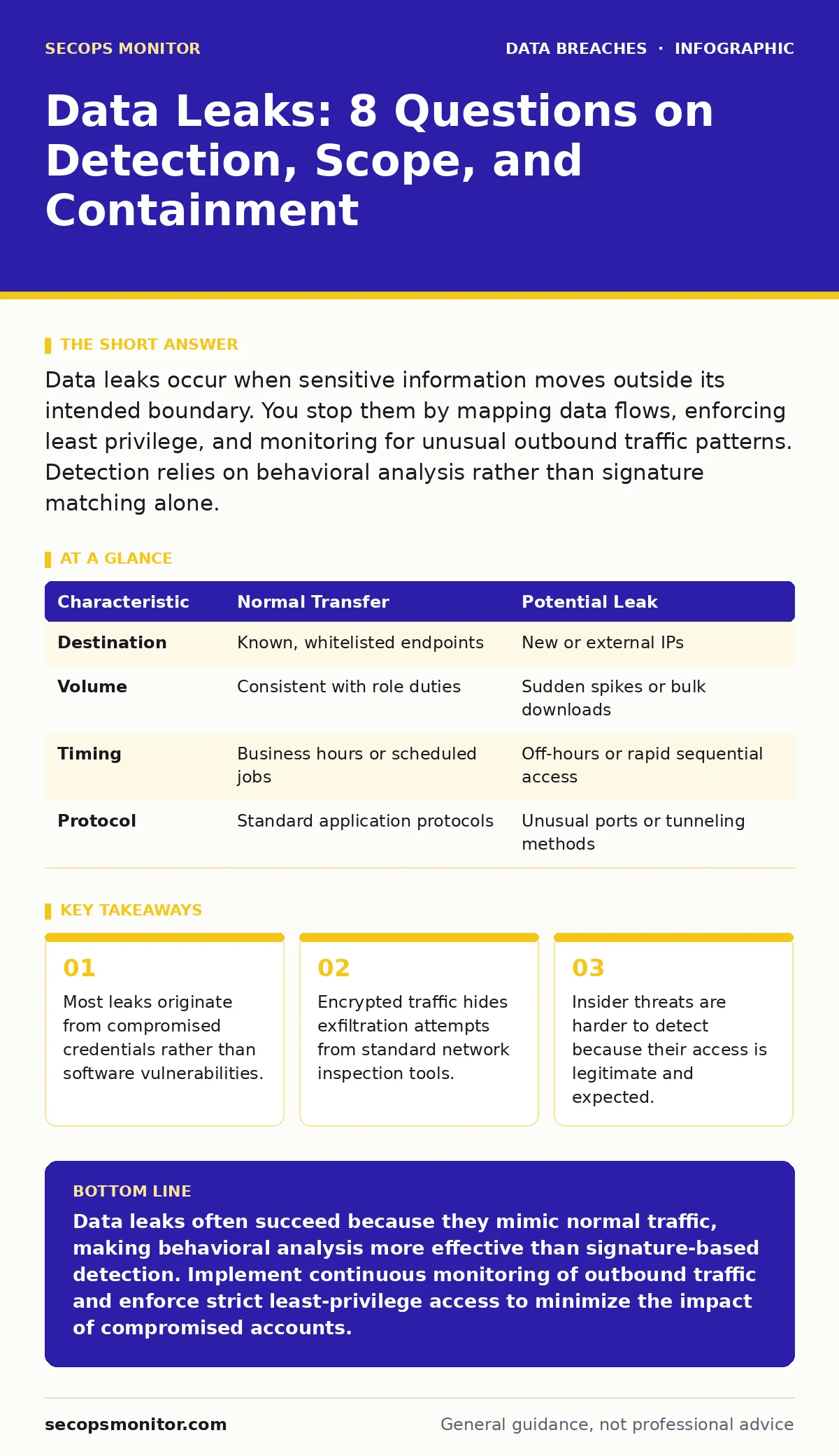
Data leaks occur when sensitive information moves outside its intended boundary. You stop them by mapping data flows, enforcing least privilege, and monitoring for unusual outbound traffic patterns. Detection relies on behavioral analysis rather than signature matching alone.
What exactly constitutes a data leak?
A data leak is any unauthorized transfer of information from a system to an unintended recipient or location. This definition includes accidental uploads to public repositories, misconfigured cloud storage buckets, and intentional theft by malicious actors. It is not limited to large-scale breaches; a single employee emailing a customer spreadsheet to the wrong address is also a leak. The core issue is the loss of confidentiality, regardless of the method used.
How do you distinguish a leak from normal data transfer?
You distinguish a leak by analyzing the context and volume of the data movement against established baselines. Normal transfers follow predictable patterns, such as scheduled backups to known storage locations or API calls between authenticated services. A leak often involves unusual destinations, atypical file formats, or volumes that exceed standard operational requirements. Behavioral analytics tools flag these deviations by comparing current activity to historical norms.
| Characteristic | Normal Transfer | Potential Leak |
|---|---|---|
| Destination | Known, whitelisted endpoints | New or external IPs |
| Volume | Consistent with role duties | Sudden spikes or bulk downloads |
| Timing | Business hours or scheduled jobs | Off-hours or rapid sequential access |
| Protocol | Standard application protocols | Unusual ports or tunneling methods |
Why do traditional firewalls fail to stop leaks?
Traditional firewalls inspect headers and ports, not the content or context of the payload. They allow traffic if it matches an allowed rule, such as outbound HTTPS on port 443. Since most modern exfiltration uses standard web protocols, the firewall sees only legitimate-looking traffic. The data itself is often encrypted, hiding the sensitive content from deep packet inspection. This creates a blind spot where stolen data exits freely under the guise of normal web browsing.
How can you detect exfiltration over encrypted channels?
You detect exfiltration over encrypted channels by monitoring metadata and behavioral anomalies rather than decrypting the content. Look for connections to new domains, unusual data sizes, or frequent connections to low-reputation IP addresses. Certificate transparency logs can reveal if a new, untrusted certificate is being used to establish secure connections. Metadata analysis examines the structure of the traffic, such as packet sizes and timing, which can reveal patterns consistent with data theft even when the payload is unreadable.
Are insiders the primary source of data leaks?
Insiders are a significant source of leaks because they possess legitimate access and knowledge of security controls. Unlike external attackers, they do not need to bypass perimeter defenses or guess passwords. Their activity often blends with normal job functions, making it difficult for automated systems to flag. However, accidental leaks by well-meaning staff often outnumber malicious insider actions. Misconfigured permissions and lack of awareness contribute heavily to these unintentional disclosures.
See also: What Is Ransomware Protection: How to Stop Encryption Attacks
Does role-based access control prevent all leaks?
Role-based access control limits what users can see and do based on their job function, reducing the attack surface. It does not prevent leaks from users who legitimately need access to sensitive data. If a user with appropriate permissions decides to steal data, or if their account is compromised, RBAC alone offers no protection. You must combine RBAC with monitoring and anomaly detection to catch misuse. Access rights should be reviewed regularly to ensure they remain necessary.
How do you contain a leak once it is detected?
Containment begins by isolating the compromised account or system to stop further data movement. Revoke active sessions and change credentials immediately to prevent the attacker from maintaining access. Block the specific IP addresses or domains involved in the exfiltration at the network perimeter. Then, preserve logs and evidence for forensic analysis. Refer to your incident communication plans to coordinate with legal and public relations teams before making external statements.
What is the impact of oversharing on social media?
Oversharing on social media provides attackers with the personal details needed to craft convincing phishing attacks or guess passwords. Photos with background details, check-ins, and job announcements reveal routines, locations, and organizational structures. This information helps attackers tailor social engineering attempts to bypass security awareness training. It turns public profiles into reconnaissance tools for targeting specific employees or systems.
How does data sovereignty affect leak response?
Data sovereignty laws dictate where data must be stored and processed based on its origin or the user's location. A leak involving data subject to strict sovereignty laws requires immediate notification to specific regulatory bodies. Failure to comply can result in severe legal penalties beyond the immediate loss of data. You must understand the jurisdictional requirements for each data type before an incident occurs. Ignorance of these laws does not exempt an organization from liability.
Can dark web monitoring prevent leaks?
Dark web monitoring cannot prevent leaks, but it can alert you when stolen data appears for sale or discussion. It serves as an early warning system for breaches that have already occurred. By detecting your organization's data on underground markets, you can verify the scope of a breach and initiate response procedures faster. It does not stop the initial exfiltration, so it should complement, not replace, preventive controls like compliance audits and access reviews.
Key takeaways
- Most leaks originate from compromised credentials rather than software vulnerabilities.
- Encrypted traffic hides exfiltration attempts from standard network inspection tools.
- Insider threats are harder to detect because their access is legitimate and expected.
Data leaks often succeed because they mimic normal traffic, making behavioral analysis more effective than signature-based detection. Implement continuous monitoring of outbound traffic and enforce strict least-privilege access to minimize the impact of compromised accounts.
Frequently asked questions
How do I know if my API keys have leaked?
Search public code repositories and paste sites for your specific key strings. Rotate any keys found immediately and monitor for unauthorized usage in your cloud provider logs.
What is the difference between a leak and a breach?
A breach is the unauthorized entry into a system, while a leak is the unauthorized exit of data. A breach can occur without a leak if no data is stolen, but a leak always implies a prior breach or misconfiguration.
Should I encrypt all data to stop leaks?
Encryption protects data at rest and in transit, making stolen data harder to use. However, it does not prevent the data from leaving the network. You still need access controls and monitoring to prevent unauthorized extraction.
How often should I review access permissions?
Review permissions quarterly or whenever an employee changes roles. Stale permissions are a common cause of accidental leaks, as former employees or users with changed duties retain access to sensitive resources.
How this guide was produced: written by the SecOps Monitor editorial team with AI assistance, checked against the public references listed below, and reviewed when the facts change. See our editorial policy or report an error.