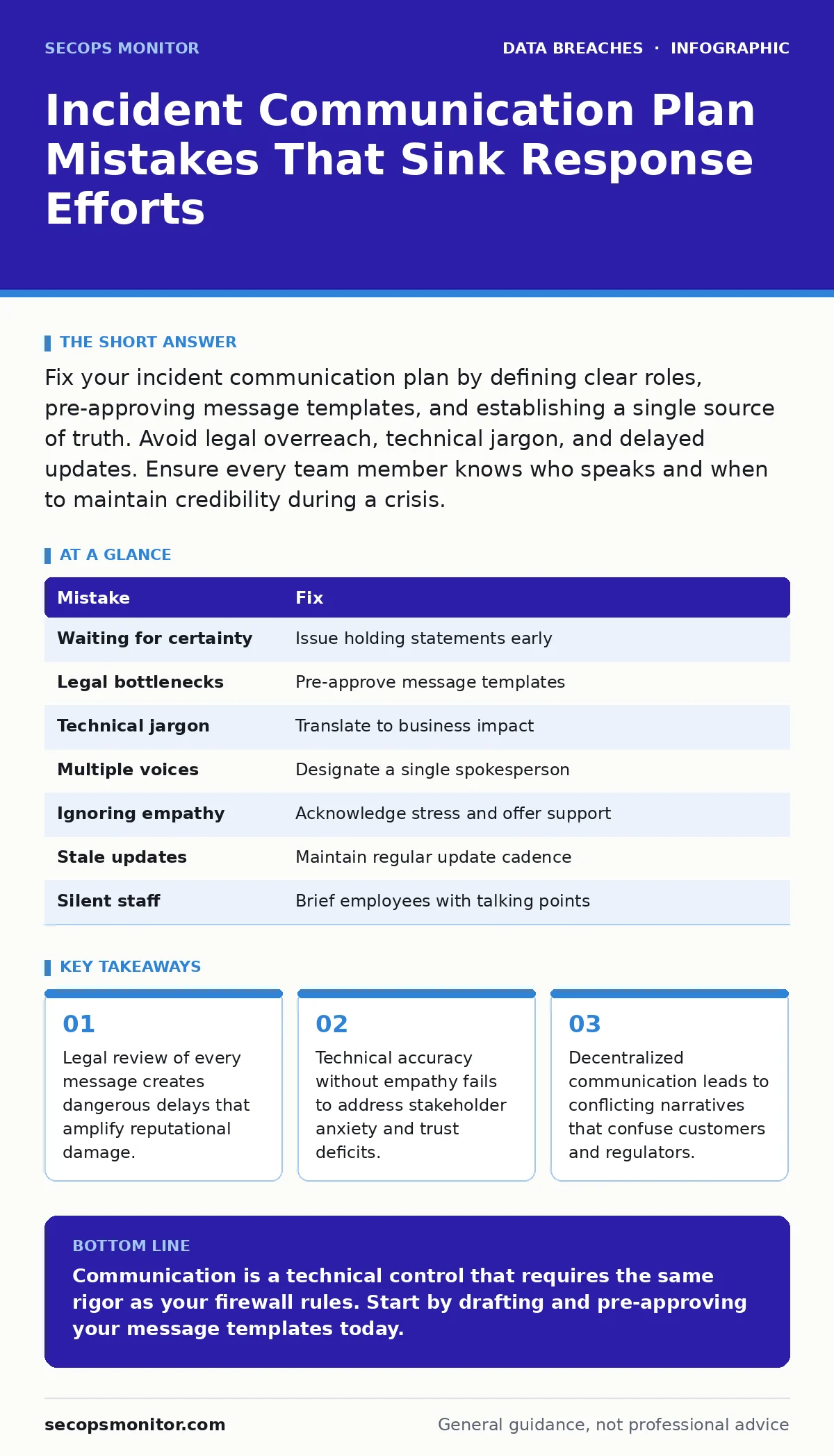
Fix your incident communication plan by defining clear roles, pre-approving message templates, and establishing a single source of truth. Avoid legal overreach, technical jargon, and delayed updates. Ensure every team member knows who speaks and when to maintain credibility during a crisis.
Mistake 1: Waiting for Technical Certainty Before Communicating
Why it hurts: Silence is interpreted as incompetence or concealment. When you wait until the root cause is fully identified, the void fills with speculation. Stakeholders assume the worst because you have not provided any context. This delay erodes trust before you even begin to explain the situation.
The fix: Issue a holding statement within the first few hours. Acknowledge that an anomaly has been detected and that an investigation is underway. Specify when the next update will arrive. This manages expectations and stops rumors from gaining traction while your team works.
Mistake 2: Letting Legal Review Bottleneck Every Message
Why it hurts: Legal teams prioritize risk mitigation over clarity. They often redact necessary details or delay releases to ensure absolute liability protection. This creates a vacuum of information that frustrates customers and journalists. The resulting messages are often vague and unhelpful, damaging credibility.
The fix: Pre-approve a library of message templates with legal counsel before an incident occurs. These templates should cover common scenarios and leave placeholders for specific facts. During an incident, your communications team fills in the facts using the pre-approved structure. This speeds up release times without sacrificing legal safety.
Mistake 3: Using Technical Jargon with Non-Technical Audiences
Why it hurts: Explaining a vector in terms of code execution or memory corruption confuses most readers. It signals that you are talking to peers, not to the people affected. Customers want to know if their data is safe, not how the exploit worked. Jargon creates distance and increases anxiety rather than alleviating it.
The fix: Translate technical findings into business impacts. State what data was accessed, what actions you are taking, and what the reader should do. Use plain language that a high school graduate can understand. Save the technical deep dive for a separate document for auditors or technical partners.
Mistake 4: Having Multiple Voices Speak Simultaneously
Why it hurts: When different departments issue conflicting statements, you lose control of the narrative. Engineering might say the system is secure, while customer support says it is not. This inconsistency makes your organization look disorganized and untrustworthy. It also gives attackers material to exploit in social engineering attempts.
The fix: Designate a single spokesperson or a small core team for all external communications. All other staff must direct inquiries to this central point. Internal updates should flow from this team to prevent misinformation. This ensures consistency across all channels and platforms.
Mistake 5: Ignoring the Human Element of the Breach
Why it hurts: People are affected by stress and uncertainty, not just data loss. A purely factual update feels cold and dismissive. Stakeholders need to feel that you understand their concern and are taking responsibility. Ignoring empathy leads to long-term brand damage and customer churn.
The fix: Include expressions of regret and commitment to resolution in your messages. Acknowledge the inconvenience and anxiety caused by the incident. Offer concrete support, such as dedicated help desks or monitoring services. This builds rapport and shows that you value the relationship beyond the transaction.
See also: Chain of Custody: Preserve Evidence Integrity During Breaches · Cloud Incident Response: 7 Mistakes That Escalate Breaches
Mistake 6: Failing to Update as the Situation Evolves
Why it hurts: An incident is a dynamic event, not a static one. New findings emerge, and the scope may change. Sticking to an initial statement that becomes outdated makes you look incompetent. Stakeholders expect transparency about changes in understanding or impact.
The fix: Establish a regular cadence for updates, even if there is no new information. State clearly that the investigation is ongoing and the previous facts remain true. If new information emerges, update all channels immediately. This maintains engagement and trust throughout the lifecycle of the incident.
Mistake 7: Neglecting Internal Communication Channels
Why it hurts: Employees are your first line of defense and your worst liability if uninformed. If staff do not know what is happening, they cannot answer customer questions accurately. They may inadvertently leak sensitive information or contradict official statements. This amplifies the chaos and extends the incident duration.
The fix: Create a parallel communication stream for employees. Provide them with talking points and FAQs before external release. Ensure they know who to contact for questions. This aligns your workforce and prevents accidental misinformation from spreading.
| Mistake | Fix |
|---|---|
| Waiting for certainty | Issue holding statements early |
| Legal bottlenecks | Pre-approve message templates |
| Technical jargon | Translate to business impact |
| Multiple voices | Designate a single spokesperson |
| Ignoring empathy | Acknowledge stress and offer support |
| Stale updates | Maintain regular update cadence |
| Silent staff | Brief employees with talking points |
Key takeaways
- Legal review of every message creates dangerous delays that amplify reputational damage.
- Technical accuracy without empathy fails to address stakeholder anxiety and trust deficits.
- Decentralized communication leads to conflicting narratives that confuse customers and regulators.
Communication is a technical control that requires the same rigor as your firewall rules. Start by drafting and pre-approving your message templates today.
Frequently asked questions
How soon should I notify regulators after an incident?
Timing depends on jurisdiction and data type, but many frameworks require notification within seventy-two hours of awareness. Check your specific legal obligations for the regions you operate in.
Should I disclose the attack vector publicly?
Generally, no. Detailed technical disclosures can help attackers replicate the method. Share high-level impact information with customers and reserve technical specifics for trusted partners or post-incident reports.
Who owns the communication plan?
Ownership typically lies with the CISO or Incident Commander, but it requires collaboration from legal, PR, and HR. The plan must be integrated into your broader incident response procedures.
How do I handle misinformation on social media?
Monitor channels for false claims and correct them promptly with factual statements. Avoid engaging in arguments. Refer users to your official incident page for verified information. See our guide on oversharing on social media for more on digital hygiene.
How this guide was produced: written by the SecOps Monitor editorial team with AI assistance, checked against the public references listed below, and reviewed when the facts change. See our editorial policy or report an error.