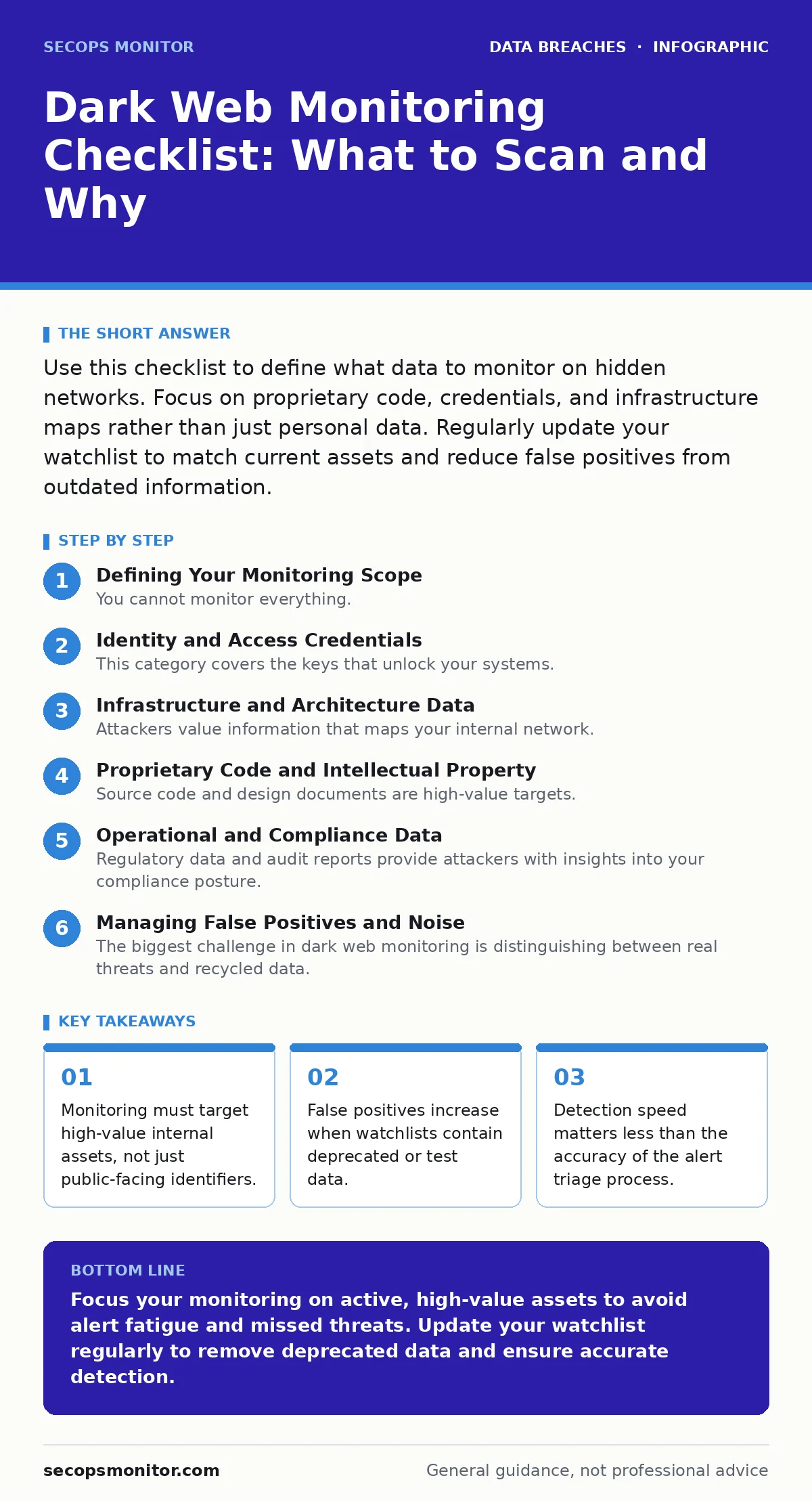
Use this checklist to define what data to monitor on hidden networks. Focus on proprietary code, credentials, and infrastructure maps rather than just personal data. Regularly update your watchlist to match current assets and reduce false positives from outdated information.
Defining Your Monitoring Scope
You cannot monitor everything. The dark web consists of hidden services, private forums, and paste sites where stolen data appears in fragmented forms. If you cast too wide a net, you drown in noise. You must define what constitutes a critical breach for your specific environment. This decision dictates which tools you deploy and how you allocate analyst time.
Imagine a company that monitors only email addresses. They miss the exfiltration of their proprietary database schema. The schema allows attackers to reconstruct the entire data structure without needing the actual records. This is a silent loss that often goes unnoticed for months. Your monitoring strategy must reflect the actual value of your internal data, not just what is easily searchable.
Identity and Access Credentials
This category covers the keys that unlock your systems. It is not enough to watch for compromised passwords. You must track the context in which those credentials appear. A password listed in a generic breach database carries less risk than one found in a private trading forum with associated IP addresses.
- Primary admin usernames: These accounts have elevated privileges and can bypass standard controls.
- Service account credentials: Automated services often use static passwords that never expire.
- Multi-factor authentication secrets: Backup codes or seed phrases allow bypass of secondary verification.
- API keys and tokens: These grant programmatic access to cloud resources and third-party services.
- Certificate private keys: Leaked keys allow attackers to impersonate your services securely.
Infrastructure and Architecture Data
Attackers value information that maps your internal network. This data reduces the time needed for lateral movement. When you see your internal IP ranges or domain structures for sale, the clock starts ticking. You are no longer dealing with a theoretical threat. The adversary has a blueprint.
- Internal IP address ranges: These reveal the size and structure of your private networks.
- Domain controller names: Knowing these allows targeted attacks on identity management services.
- Database server locations: Physical or logical locations help attackers plan direct access attempts.
- Network diagrams and topology maps: These show how systems connect and where defenses are weak.
- Cloud storage bucket names: Public or semi-public buckets often contain sensitive configuration files.
Refer to our guide on data leaks to understand how internal documents often escape through careless sharing before they hit the dark web.
Proprietary Code and Intellectual Property
Source code and design documents are high-value targets. Unlike passwords, code does not expire quickly. An attacker who obtains your source code can build persistent backdoors or reverse-engineer your security controls. This type of theft is difficult to detect through traditional intrusion detection systems.
- Source code repositories: Git history often contains hard-coded secrets and credentials.
- Algorithm designs and logic flows: These reveal how your security decisions are made programmatically.
- Cryptographic implementations: Custom crypto is often flawed and can be broken if the code is public.
- Configuration scripts: Infrastructure-as-code files reveal default settings and security parameters.
- Internal documentation and wikis: These often contain explanations of security bypasses or workarounds.
See the guide on chain of custody to understand how to preserve evidence if you find your code for sale, ensuring it remains admissible for legal action.
Operational and Compliance Data
Regulatory data and audit reports provide attackers with insights into your compliance posture. If they know which controls are failing or which systems are out of scope, they can target those weaknesses. This information turns a random attack into a surgical strike.
- Audit findings and reports: These highlight known vulnerabilities that have not been patched.
- Compliance certificates: These confirm which systems are in scope for regulation.
- Employee directories and org charts: These aid in social engineering and phishing campaigns.
- Vendor contract details: These may contain security requirements that reveal your defensive posture.
- Incident response plans: Knowing your playbook allows attackers to evade detection during an attack.
Review the section on compliance audits to ensure your monitoring aligns with your regulatory obligations.
See also: Lost Devices: 7 Mistakes That Leak Data and How to Fix Them · Secure file sharing for business: control access and prevent leaks
Managing False Positives and Noise
The biggest challenge in dark web monitoring is distinguishing between real threats and recycled data. Old breaches are resold repeatedly. If your watchlist contains data from a breach that happened years ago, you will receive constant alerts for events that have already passed. This leads to alert fatigue and missed real incidents.
You must regularly prune your watchlist. Remove data for employees who have left, systems that are decommissioned, and credentials that have been rotated. Keep your monitoring focused on active, high-value assets. This reduces noise and ensures your team responds to genuine threats.
Integration with Incident Response
Finding data on the dark web is not the end of the process. It is the beginning of an investigation. You must have a clear path from detection to containment. If you find your API keys for sale, you need a process to revoke them immediately. This process should be documented and tested.
Connect your monitoring alerts to your incident communication plans. Ensure that the right teams are notified when specific types of data are found. Do not wait for a full breach to confirm the leak. Proactive containment is always more effective than reactive cleanup.
Key takeaways
- Monitoring must target high-value internal assets, not just public-facing identifiers.
- False positives increase when watchlists contain deprecated or test data.
- Detection speed matters less than the accuracy of the alert triage process.
Focus your monitoring on active, high-value assets to avoid alert fatigue and missed threats. Update your watchlist regularly to remove deprecated data and ensure accurate detection.
Frequently asked questions
How often should I check the dark web for my data?
Continuous monitoring is ideal, but if resources are limited, daily scans are the minimum for high-value assets.
Can I monitor the dark web myself?
Manual monitoring is difficult and risky. It requires specialized knowledge and tools to access and parse hidden services safely.
What is the difference between dark web and deep web?
The deep web is any content not indexed by search engines, like private databases. The dark web requires specific software to access and is often used for illegal activities.
Should I monitor for employee personal data?
Only if it is linked to your corporate systems. Personal data alone is low value unless it can be used to bypass multi-factor authentication.
How this guide was produced: written by the SecOps Monitor editorial team with AI assistance, checked against the public references listed below, and reviewed when the facts change. See our editorial policy or report an error.