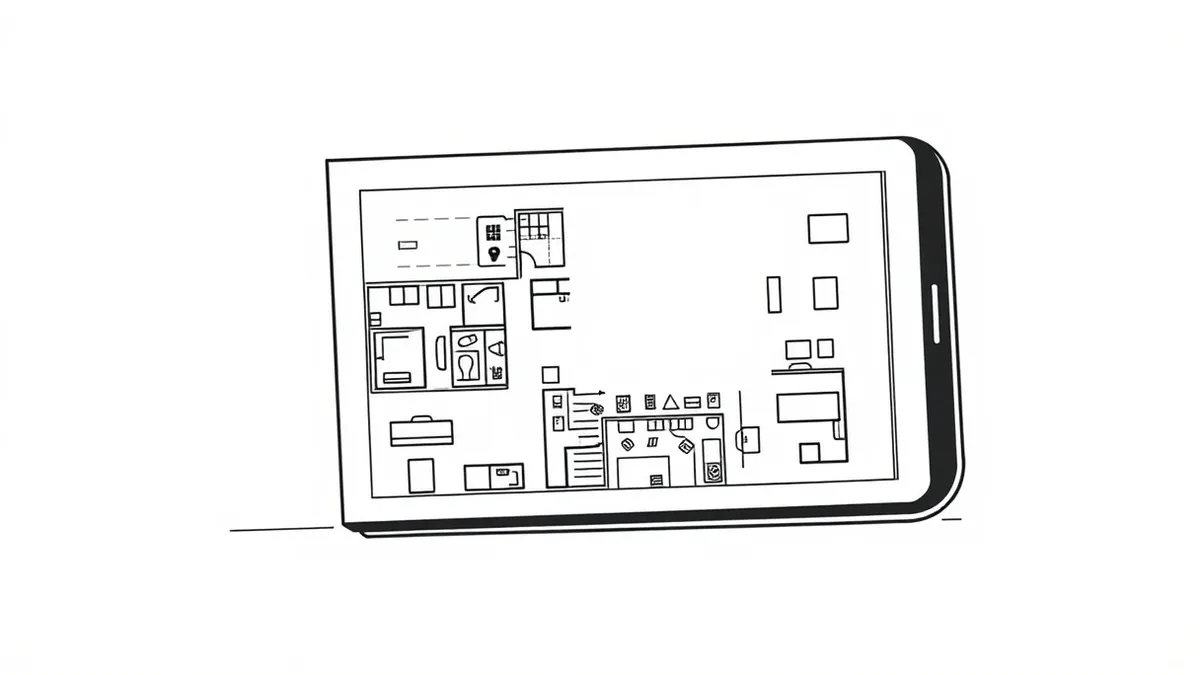
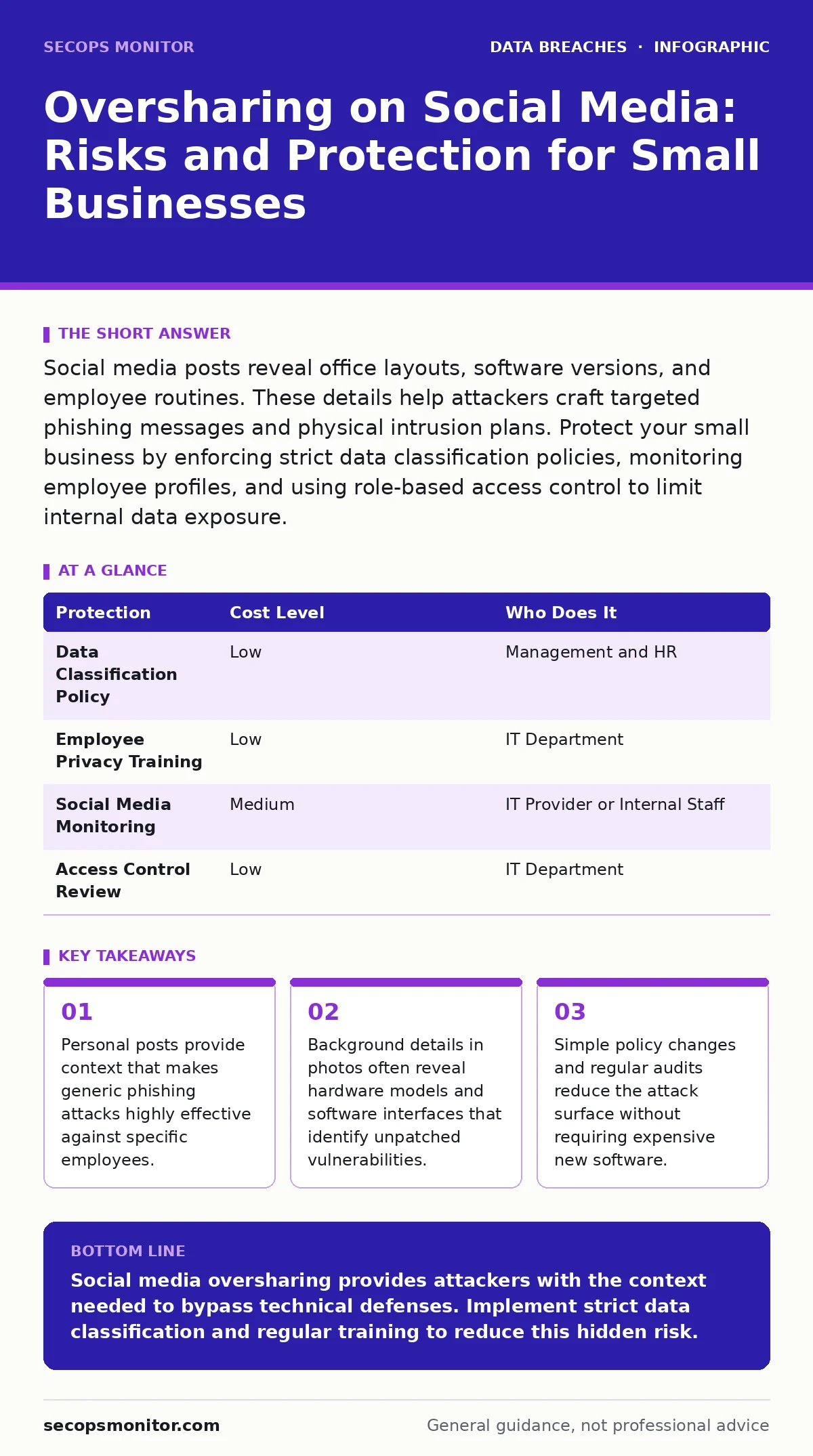
Social media posts reveal office layouts, software versions, and employee routines. These details help attackers craft targeted phishing messages and physical intrusion plans. Protect your small business by enforcing strict data classification policies, monitoring employee profiles, and using role-based access control to limit internal data exposure.
The Context Gap in Security
Imagine a ten-person accounting firm. The owner posts a photo of their new desk setup on social media. The image is clear. It shows a sticky note with a username, a monitor displaying a specific project management tool, and a badge hanging on the chair.
This is not just a casual mistake. It is a data leak. The post provides an attacker with three distinct pieces of intelligence. They know the software you use, which helps them find known vulnerabilities. They know a valid username, which reduces the effort needed to guess a password. They know a specific employee’s workflow, which aids in crafting a convincing phishing email.
Security tools often focus on the network perimeter. They check for open ports and weak encryption. They rarely check the public internet for images of your office. This creates a blind spot. Attackers do not need to hack your firewall if they can walk in with the information already in hand.
Why Small Organizations Are Exposed
Small businesses often operate with fewer formal boundaries between personal and professional life. Employees may post work achievements without realizing they reveal client names or project timelines. This casual sharing creates a digital footprint that is easy to map.
Large organizations have dedicated security teams to scrub social media for sensitive information. Small teams rarely have this resource. They rely on individual judgment. Human judgment is inconsistent. One employee may understand the risk of posting a conference badge. Another may not see the danger in sharing a screenshot of a code repository.
This inconsistency is the primary vulnerability. An attacker only needs one weak link. If one employee shares a document with sensitive data, the protection for the other nine is irrelevant. The context provided by personal lives allows attackers to tailor their approach. They can impersonate a colleague, a client, or a vendor with high accuracy because they have seen the real interactions.
The Mechanics of Social Engineering
Attackers use the information from social media to build a profile. This process is called open-source intelligence, or OSINT. They combine public posts with data breaches to create a detailed map of your organization.
This map includes names, roles, relationships, and preferences. An attacker can see that the finance manager loves golf and follows a specific tournament. They can then send an email that appears to come from the tournament organizer, asking for a payment for a sponsorship. The email looks legitimate because it aligns with the manager’s interests and uses correct internal terminology observed in other posts.
This is why technical controls alone fail. A strong password does not stop an employee from clicking a link that looks familiar. A firewall does not block an email that comes from a valid server. The attack bypasses the technology by targeting the human element. The more personal context available, the higher the success rate of these attacks.
Low-Cost Protections for Small Teams
You do not need expensive software to mitigate these risks. The most effective measures are procedural. Start by defining what information is public and what is private. This is data classification. Every piece of data needs a label.
Label data as public, internal, confidential, or restricted. Public data can be shared anywhere. Internal data stays within the company. Confidential and restricted data never leave the secure environment. This clarity helps employees make quick decisions. They do not have to guess whether a photo is safe to post. They check the label.
Implement role-based access control to ensure employees only see the data they need for their job. If an employee does not need access to client financial records, they should not have it. This limits the damage if their account is compromised. It also reduces the amount of sensitive data available on their devices, which might be photographed.
| Protection | Cost Level | Who Does It |
|---|---|---|
| Data Classification Policy | Low | Management and HR |
| Employee Privacy Training | Low | IT Department |
| Social Media Monitoring | Medium | IT Provider or Internal Staff |
| Access Control Review | Low | IT Department |
What to Ask an IT Provider
When you hire an IT provider, do not just ask about backups and antivirus. Ask about their approach to information disclosure. You need to know how they handle the human side of security.
- How do you help us identify what data is being exposed publicly?
- Can you review our public digital presence for sensitive information?
- What training do you provide on recognizing social engineering attempts?
- How do you ensure our data classification labels are enforced technically?
- Do you monitor for lost and stolen devices that might contain unsecured data?
These questions force the provider to think beyond the server rack. They must address the workflow and the culture. A provider who cannot answer these questions is only managing hardware. They are not managing risk.
See also: Phishing Defined: Anatomy of the Attack and Risk Reduction · Breach Dwell Time Explained: How Long Attackers Hide in Your Network
The Hidden Cost of Convenience
There is a trade-off when you allow casual social media use. Convenience increases engagement and brand visibility. Security decreases as the attack surface grows. You must accept this trade-off consciously.
Ignoring the risk is not an option. The cost of a breach far exceeds the benefit of a viral post. Attackers are patient. They collect small pieces of information over months. They wait for the right moment to strike. By the time you realize the damage, the context has already been gathered.
Consider the impact on your compliance audits. If you handle regulated data, oversharing can violate legal requirements. This leads to fines and loss of trust. The effort to clean up a breach includes legal fees, notification costs, and remediation. These costs are predictable if you invest in prevention now.
Building a Resilient Culture
Culture drives behavior. If leadership posts sensitive details, employees will follow suit. You must model the behavior you expect. Review your own posts before publishing. Ask yourself if an attacker would find value in this image or text.
Regularly update your incident communication plans. Include scenarios for data leaks via social media. Define who speaks to the public and what they say. Speed matters. A delayed response allows the narrative to be controlled by the attacker or the media.
Use dark web monitoring to check if your employees’ credentials or personal data have appeared in public breaches. This data can be used to target your team. Knowing this early allows you to reset passwords and increase monitoring. It turns reactive panic into proactive management.
Key takeaways
- Personal posts provide context that makes generic phishing attacks highly effective against specific employees.
- Background details in photos often reveal hardware models and software interfaces that identify unpatched vulnerabilities.
- Simple policy changes and regular audits reduce the attack surface without requiring expensive new software.
Social media oversharing provides attackers with the context needed to bypass technical defenses. Implement strict data classification and regular training to reduce this hidden risk.
Frequently asked questions
How do I know if my employees are oversharing?
You cannot monitor every post due to privacy laws. Instead, use automated tools to scan public pages for keywords related to your business, such as your domain name or project codes.
Should we ban social media use for staff?
A total ban is difficult to enforce and may hurt morale. It is better to educate staff on what constitutes a risk and enforce consequences for policy violations.
What is the first step after discovering a leak?
Contain the exposure by removing the content if possible. Then, assess what information was revealed and whether it compromises any accounts or systems. Update your access controls immediately.
Can insurance cover breaches caused by social media?
Cyber insurance may cover financial losses, but policies vary. Many exclude losses due to negligence or failure to follow standard security practices, such as data classification.
How this guide was produced: written by the SecOps Monitor editorial team with AI assistance, checked against the public references listed below, and reviewed when the facts change. See our editorial policy or report an error.