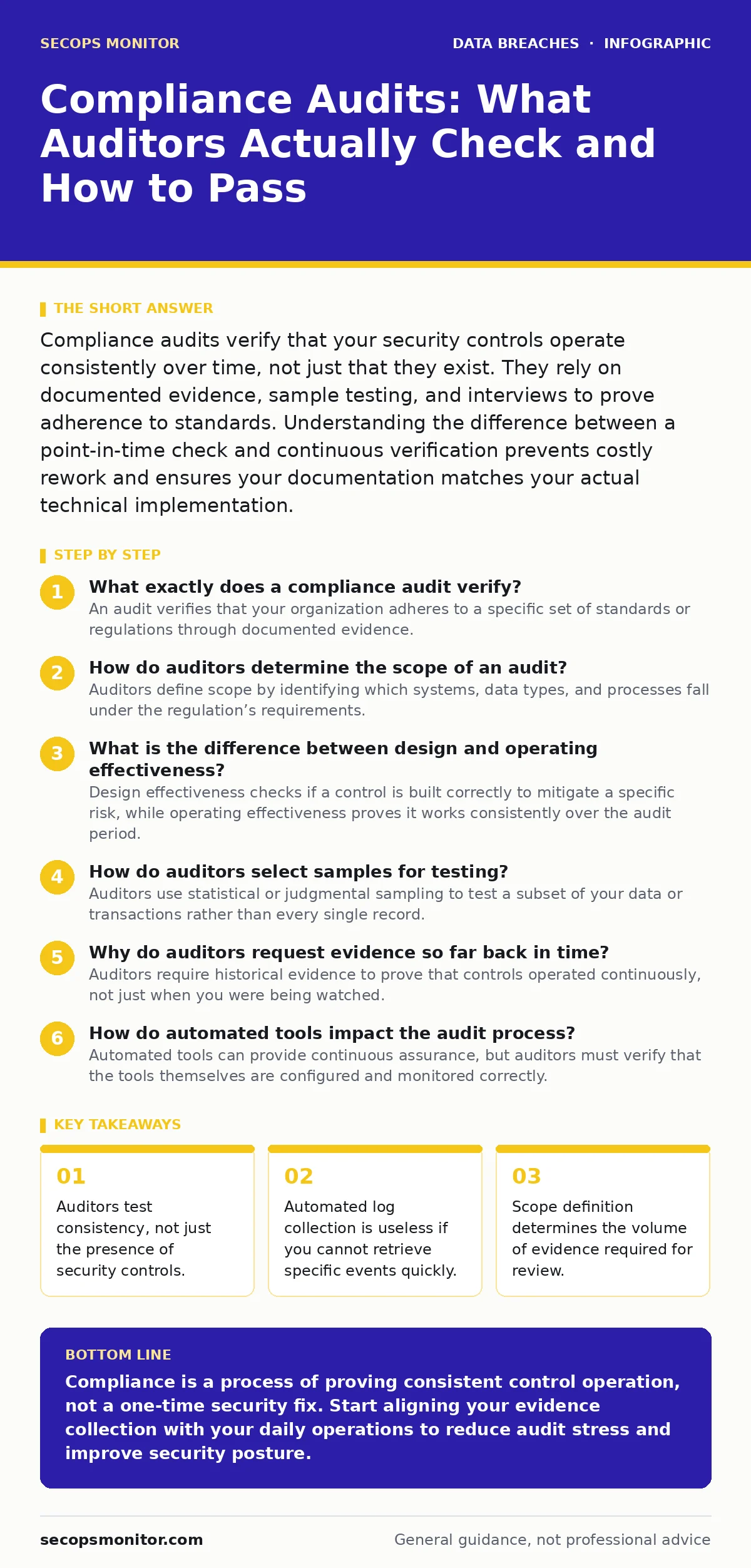
Compliance audits verify that your security controls operate consistently over time, not just that they exist. They rely on documented evidence, sample testing, and interviews to prove adherence to standards. Understanding the difference between a point-in-time check and continuous verification prevents costly rework and ensures your documentation matches your actual technical implementation.
What exactly does a compliance audit verify?
An audit verifies that your organization adheres to a specific set of standards or regulations through documented evidence. It does not measure how secure your systems are in an absolute sense, but rather whether you follow the rules you claimed to follow. The auditor checks if your controls are designed correctly and if they operate effectively over time.
How do auditors determine the scope of an audit?
Auditors define scope by identifying which systems, data types, and processes fall under the regulation’s requirements. This process often relies on your own documentation, such as network diagrams and data flow maps. If your documentation is vague, auditors will assume the widest possible scope, increasing the workload and risk of findings.
What is the difference between design and operating effectiveness?
Design effectiveness checks if a control is built correctly to mitigate a specific risk, while operating effectiveness proves it works consistently over the audit period. You can have a perfectly designed firewall that is rarely updated, which fails the operating test. Auditors need evidence that the control functioned as intended throughout the entire review window, not just on the day of the inspection.
How do auditors select samples for testing?
Auditors use statistical or judgmental sampling to test a subset of your data or transactions rather than every single record. They look for patterns, anomalies, or high-risk items to include in their sample. If your sample fails, they may expand the sample size or assume the control is broken, leading to a major finding. Consistency in your processes reduces the variance auditors see, making sampling more favorable.
Why do auditors request evidence so far back in time?
Auditors require historical evidence to prove that controls operated continuously, not just when you were being watched. This prevents organizations from temporarily tightening security just for the audit window. You must maintain logs and records for the entire period covered by the audit, which often exceeds the standard retention period for operational data.
See also: Password Reuse Myths: What Actually Weakens Your Security Posture · Lost Devices: 7 Mistakes That Leak Data and How to Fix Them
How do automated tools impact the audit process?
Automated tools can provide continuous assurance, but auditors must verify that the tools themselves are configured and monitored correctly. They will check the configuration of your logging agents and the integrity of the data pipeline. If the tool is misconfigured, the evidence it produces is invalid, regardless of how much data it collects.
What happens if an auditor finds a gap in controls?
A gap results in a finding, which requires a remediation plan and often a follow-up review. The severity depends on the risk associated with the missing control and the potential impact on data or operations. Minor gaps may be accepted with a compensating control, but major gaps can lead to a failed audit or loss of certification.
How can we prepare for the evidence collection phase?
Start by mapping your controls to the specific requirements of the standard you are auditing against. Ensure that your documentation is up to date and that you can retrieve logs and records quickly. Practice retrieving evidence for common controls before the auditor arrives. This reduces the stress of the audit and demonstrates maturity in your security operations.
| Control Type | Evidence Example | Frequency | Retention |
|---|---|---|---|
| Access Review | Signed approval forms | Quarterly | 1 year |
| Patch Management | Patch deployment logs | Monthly | 1 year |
| Incident Response | Post-incident reports | Per incident | 2 years |
| Data Encryption | Configuration screenshots | Annual | 1 year |
Does passing an audit mean we are secure?
No, passing an audit means you comply with a specific set of rules, not that you are immune to threats. Compliance is a baseline, not a guarantee of security. You can be compliant and still be vulnerable to zero-day exploits or social engineering. Compliance focuses on process and documentation, while security focuses on risk and resilience.
How do we handle third-party vendor audits?
You are responsible for ensuring your vendors meet the same standards you do, especially if they handle your data. This often requires reviewing their audit reports or conducting your own assessments. If a vendor fails, it can reflect poorly on your own compliance status.
What is the role of continuous monitoring in audits?
Continuous monitoring allows you to provide real-time evidence of control operation, reducing the burden of manual evidence collection. It also helps you detect deviations from expected behavior before an auditor does. Auditors increasingly accept automated reports as valid evidence if they are trustworthy and immutable.
How do we manage audit fatigue?
Audit fatigue occurs when you face multiple audits from different standards. You can mitigate this by aligning your controls across frameworks and using a single set of evidence for multiple audits. This reduces duplication of effort and allows your team to focus on improving security rather than gathering paperwork.
| Framework | Focus Area | Overlap with Others |
|---|---|---|
| PCI DSS | Payment data | High overlap with ISO 27001 |
| HIPAA | Health data | Specific privacy controls |
| SOC 2 | Trust principles | Broad overlap with many |
| GDPR | Data protection | Privacy-focused |
Key takeaways
- Auditors test consistency, not just the presence of security controls.
- Automated log collection is useless if you cannot retrieve specific events quickly.
- Scope definition determines the volume of evidence required for review.
Compliance is a process of proving consistent control operation, not a one-time security fix. Start aligning your evidence collection with your daily operations to reduce audit stress and improve security posture.
Frequently asked questions
How far back do auditors look for evidence?
Auditors typically look back one year, but some regulations require longer retention periods. Check the specific standard you are auditing against for exact requirements.
Can we use automated tools to gather evidence?
Yes, but you must prove the tools are configured correctly and the data is intact. Auditors will test the reliability of the automated system.
What if we cannot find evidence for a control?
You will likely receive a finding. Document the gap, create a remediation plan, and implement a compensating control if possible to mitigate risk.
How do we handle scope changes during an audit?
Communicate immediately with the auditor. If the scope changes, the evidence requirements may change. Adjust your documentation and data collection accordingly.
How this guide was produced: written by the SecOps Monitor editorial team with AI assistance, checked against the public references listed below, and reviewed when the facts change. See our editorial policy or report an error.