
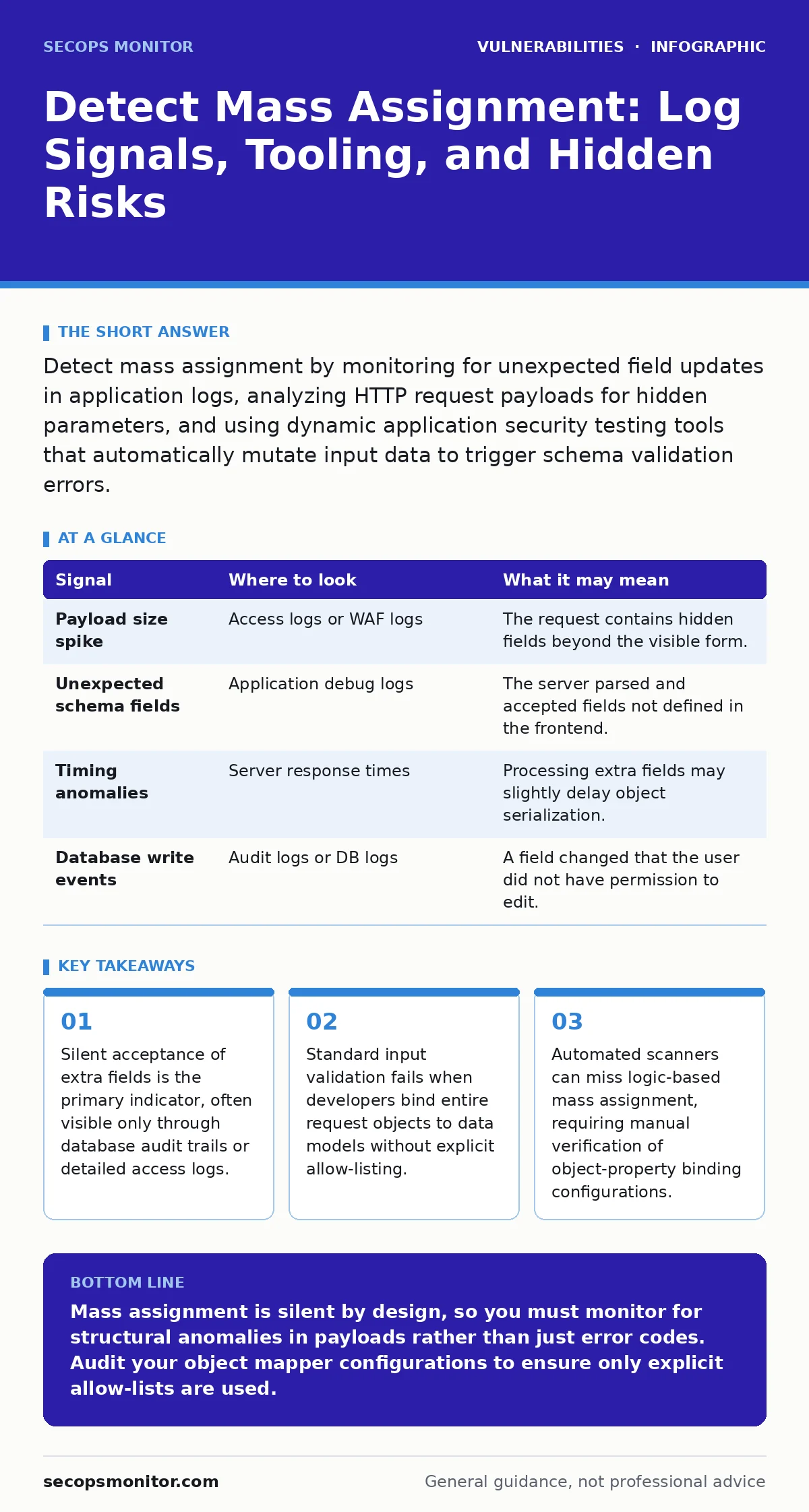
Detect mass assignment by monitoring for unexpected field updates in application logs, analyzing HTTP request payloads for hidden parameters, and using dynamic application security testing tools that automatically mutate input data to trigger schema validation errors.
The Silent Binding Mechanism
Mass assignment occurs when an application accepts input from a user and directly binds it to a data object without verifying which fields are permitted. This happens when code maps an HTTP request payload to a database record or internal object in one step. The server processes the data silently, updating fields the user never intended to touch. You might not see an error message because the operation succeeds. The danger lies in the assumption that the user only provides the fields displayed in the interface.
Imagine a user profile update form that only shows "Email" and "Phone Number." The backend code might accept the entire JSON payload and bind it to the User object. If the User object also contains an "isAdmin" boolean, the server updates that field if the attacker includes it in the JSON. The application works exactly as programmed, which makes this vulnerability invisible to standard error monitoring.
Identifying Anomalies in Application Logs
Logs are your first line of defense, but you must look beyond HTTP 200 status codes. A successful mass assignment attack returns the same success code as a legitimate request. You need to inspect the payload size and structure relative to the expected form fields. Look for requests that contain significantly more data than the corresponding UI form suggests.
| Signal | Where to look | What it may mean |
|---|---|---|
| Payload size spike | Access logs or WAF logs | The request contains hidden fields beyond the visible form. |
| Unexpected schema fields | Application debug logs | The server parsed and accepted fields not defined in the frontend. |
| Timing anomalies | Server response times | Processing extra fields may slightly delay object serialization. |
| Database write events | Audit logs or DB logs | A field changed that the user did not have permission to edit. |
Check your application logs for JSON or form-data payloads that include keys not present in the source code of the webpage. If you see a key like "role" or "permissions" in a request for a password change, flag it immediately. These logs often capture the raw input before the application processes it, giving you the clearest view of the attempt.
Leveraging Dynamic Testing Tools
Static analysis tools often miss mass assignment because the issue lies in runtime behavior, not just code syntax. Dynamic application security testing (DAST) tools are better suited for this because they interact with the running application. These tools send mutated requests to endpoints to see how the server reacts.
You should configure your DAST tool to fuzz input fields by adding arbitrary key-value pairs. If the tool adds a field like "test_field=123" and the server responds with a schema validation error, your application is likely protected. If the server returns a 200 OK and the field appears in the response or database, you have a vulnerability. This testing approach reveals how the object mapper handles unexpected data.
Inspecting Object Mapper Configurations
Many modern frameworks use object-relational mappers or data binding libraries to simplify code. These tools are convenient but dangerous if configured with default settings. The default behavior in many frameworks is to bind all accessible properties of an object to the incoming request data. You must explicitly tell the mapper which fields are safe to update.
Review the configuration files for your data binding library. Look for settings that define "ignored properties" or "allowed properties." If the configuration lists ignored fields, you are relying on a deny-list. This approach is fragile because new fields added to the object will be accepted by default. An allow-list is safer because it only permits known safe fields. Any new field requires explicit approval.
Common Blind Spots in Detection
Developers often focus on input validation for format and length, ignoring the structure of the data. They assume that if the email format is correct, the data is safe. This is a fundamental misunderstanding of how mass assignment works. The issue is not the value of the data, but the presence of the field itself.
Another blind spot is nested objects. If your application accepts a complex JSON structure, an attacker can inject data into nested properties. For example, a user profile might have an "Address" object. An attacker could send a request that includes an "Address" object with an extra "billing_status" field. Standard validation might check the top-level fields but ignore the nested structure.
The Role of Secure Development Practices
Preventing mass assignment requires a shift in how you write data handling code. You should adopt practices from a secure software development lifecycle that emphasizes explicit data mapping. Instead of binding the whole request object, map each field individually. This approach is more verbose but eliminates the risk of accidental field exposure.
Threat modeling exercises should include a review of all data binding points. Identify where external input meets internal data structures. Ask whether the application can distinguish between user-provided data and system-managed data. If the answer is no, you have a structural vulnerability. This review process helps catch issues before they reach production.
Integrating with Broader Security Efforts
Mass assignment detection does not exist in a vacuum. It connects to how you manage dependencies and update your software. If you use third-party libraries for data binding, you must keep them updated. Dependency updates often include security patches that change default binding behaviors.
Consider how this vulnerability interacts with other risks. If an attacker gains elevated privileges through mass assignment, they might exploit other weaknesses. Understanding vulnerability severity ratings helps you prioritize this issue against others. While mass assignment might seem low risk in isolation, it can be the entry point for complete system compromise.
Imagine an attacker uses mass assignment to change their user role to "admin." Once elevated, they can access sensitive data or modify system configurations. This chain of events shows why detecting the initial injection is critical. It is not just about one field; it is about the trust model of your application.
Key takeaways
- Silent acceptance of extra fields is the primary indicator, often visible only through database audit trails or detailed access logs.
- Standard input validation fails when developers bind entire request objects to data models without explicit allow-listing.
- Automated scanners can miss logic-based mass assignment, requiring manual verification of object-property binding configurations.
Mass assignment is silent by design, so you must monitor for structural anomalies in payloads rather than just error codes. Audit your object mapper configurations to ensure only explicit allow-lists are used.
Frequently asked questions
How do I know if my framework is vulnerable to mass assignment?
Check the documentation for your specific framework's data binding or object mapper. Look for default settings that bind all properties. If the default is to accept all input, you are vulnerable unless you configure an allow-list.
Can Web Application Firewalls stop mass assignment attacks?
Standard WAF rules often miss mass assignment because the traffic looks like normal API usage. You need custom rules that inspect JSON schemas or form structures to detect unexpected fields. Generic SQL injection rules will not catch this.
Is mass assignment a risk in REST APIs?
Yes, REST APIs are highly susceptible because they typically return JSON data. If the API endpoint accepts a JSON object and updates a database record directly, it is a prime target. Always validate the JSON structure against a strict schema.
How does this differ from SQL Injection?
SQL injection involves manipulating query syntax to execute commands. Mass assignment involves manipulating data structure to update fields you shouldn't touch. Mass assignment does not require knowledge of the database schema, only the object structure exposed by the application.
How this guide was produced: written by the SecOps Monitor editorial team with AI assistance, checked against the public references listed below, and reviewed when the facts change. See our editorial policy or report an error.