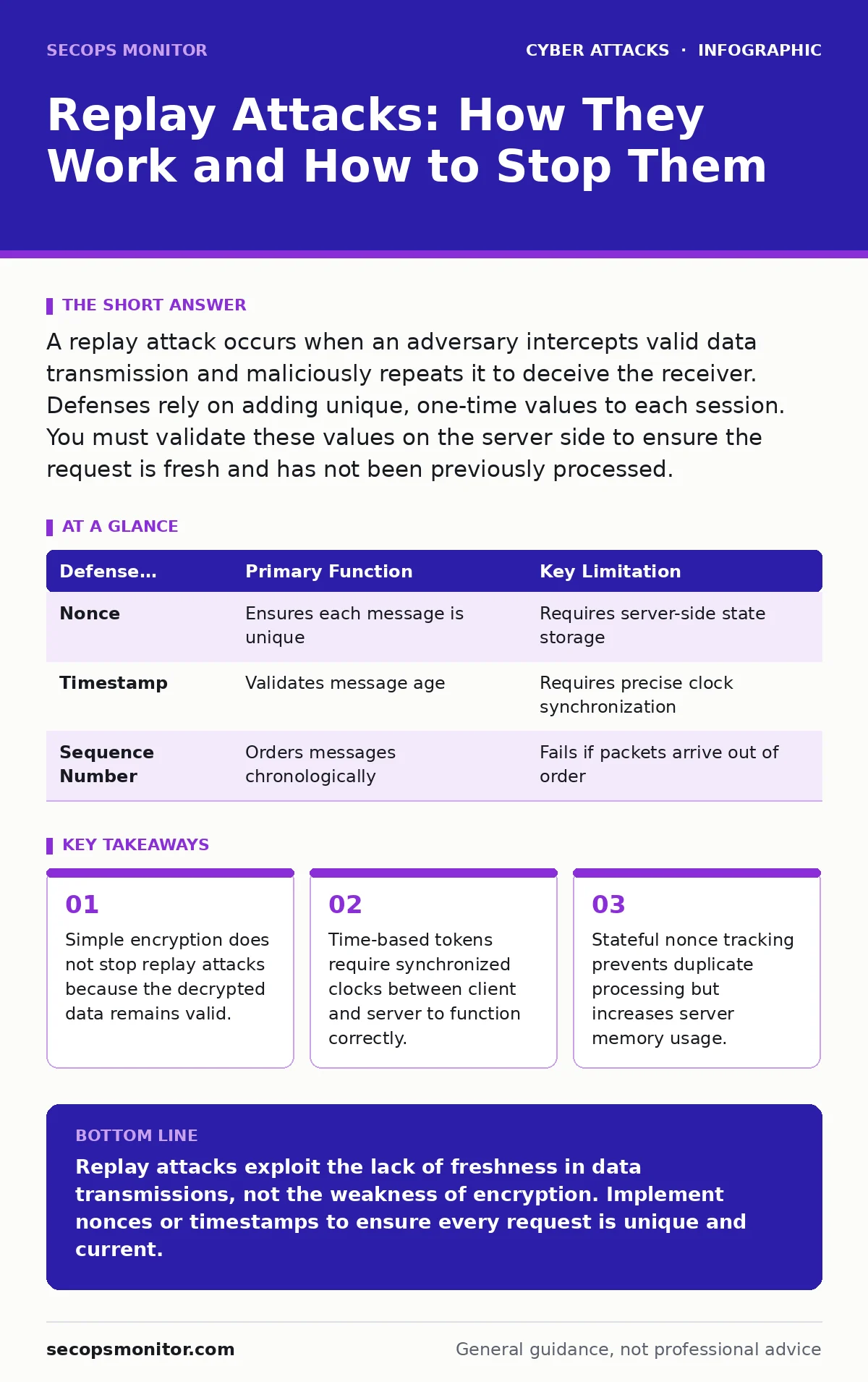
A replay attack occurs when an adversary intercepts valid data transmission and maliciously repeats it to deceive the receiver. Defenses rely on adding unique, one-time values to each session. You must validate these values on the server side to ensure the request is fresh and has not been previously processed.
What exactly is a replay attack?
An attacker captures a stream of legitimate data and resends it to the target system. The system processes the repeated data as if it were a new, original request. This exploits the fact that many protocols do not distinguish between a first-time transmission and a duplicate. The attacker does not need to decrypt the data; they only need to copy and paste it.
Imagine a digital handshake where you show your ID card. If the guard does not record that you already showed it, you can show the same card again later to gain unauthorized entry. The validity of the credential remains unchanged, but the context of its use has shifted from legitimate to malicious.
Does strong encryption prevent replay attacks?
No, encryption alone does not stop replay attacks. Encryption protects the confidentiality of the data, ensuring only authorized parties can read it. It does not guarantee the freshness or uniqueness of the message. An attacker can capture an encrypted token and resend it without ever knowing the plaintext content.
This is a common misconception among those who believe that AES or RSA solves all transmission risks. You must add a layer of integrity and freshness on top of encryption. Without this layer, the encrypted payload is just a sealed envelope that can be delivered multiple times to the same recipient.
How do nonces stop replay attacks?
A nonce is a number used only once in a cryptographic communication. The server generates a unique value and sends it to the client. The client includes this value in their next request, proving the request is current and tied to that specific session. The server verifies the nonce has not been used before and then marks it as consumed.
This mechanism breaks the replay loop. If an attacker captures the request, the nonce inside it is now invalid for future use. The server rejects any subsequent attempt using that same number. This forces the attacker to find a new valid nonce, which they cannot generate without knowing the server’s secret algorithm.
| Defense Mechanism | Primary Function | Key Limitation |
|---|---|---|
| Nonce | Ensures each message is unique | Requires server-side state storage |
| Timestamp | Validates message age | Requires precise clock synchronization |
| Sequence Number | Orders messages chronologically | Fails if packets arrive out of order |
What role does time play in defense?
Timestamps add an expiration window to every message. The server checks the time embedded in the request against its own clock. If the difference exceeds a small threshold, the server rejects the message. This limits the window of opportunity for an attacker to capture and resend the data.
However, this approach introduces a hidden cost: clock synchronization. If the client and server clocks drift apart, legitimate requests may be rejected as expired. This creates friction for users and increases support tickets. You must use protocols like NTP to keep systems aligned, adding complexity to your infrastructure.
Why can’t I just use a sequence number?
Sequence numbers assign a progressive integer to each message. The server expects the next number in the series and rejects anything else. This is simple to implement and requires minimal storage. It works well for continuous streams of data, such as video or sensor readings.
The edge case here is network instability. If a packet is lost or delayed, the sequence breaks. The server may reject a valid late-arriving packet because the number no longer matches the expected next value. This leads to false positives where legitimate traffic is dropped. You need a sliding window mechanism to handle minor out-of-order arrivals, which complicates the logic.
See also: What Is Ransomware Protection: How to Stop Encryption Attacks
How do replay attacks affect authentication?
During login, an attacker might capture the encrypted password hash or token. If the system accepts this token without checking for prior use, the attacker can log in as the user. This bypasses the need to crack the password. The attacker essentially steals the session key rather than the credentials themselves.
This is distinct from a dictionary attacks scenario, where the attacker tries many passwords. Here, the attacker has the correct key but uses it at the wrong time or context. Implementing mutual authentication, where both client and server prove their identity using fresh nonces, mitigates this risk.
What is the hidden cost of stateful defenses?
Tracking nonces or sequence numbers requires the server to remember past interactions. This is a stateful process. For high-traffic systems, storing millions of recent nonces consumes significant memory and CPU resources. You must implement efficient data structures and expiration policies to manage this load.
If you scale horizontally, sharing this state across multiple servers becomes difficult. A request handled by Server A must be rejected by Server B if it was already processed. This requires a centralized cache or database, introducing latency and a single point of failure. Stateless designs are preferred for scalability, forcing you to rely more heavily on timestamps.
Can man-in-the-middle attacks enable replays?
Yes, a man-in-the-middle attacker intercepts traffic between two parties. They do not necessarily alter the data; they simply record it. Later, they inject the recorded data into the communication stream. This is particularly effective in wireless networks where signals are broadcast and easier to capture.
Securing the transport layer with TLS is standard practice, but you must also protect the application layer logic. Even with TLS, if the application accepts repeated commands, the attacker can replay them. This is why security awareness training for developers is critical; they must understand that encryption is not a silver bullet.
How do I test for replay vulnerabilities?
You can simulate a replay by capturing a valid request using a proxy tool. Then, resend that exact request multiple times. Observe how the server responds. If it accepts the duplicate and performs the action again, your system is vulnerable. This simple test reveals flaws in your session management logic.
Automate this testing in your CI/CD pipeline. Do not rely on manual checks. Integrate tests that verify nonce uniqueness and timestamp validity. This ensures that new code deployments do not introduce replay weaknesses. Regular testing is part of good cyber hygiene, keeping your defenses sharp against evolving tactics.
What about distributed systems and replays?
In distributed environments, ensuring a message is processed exactly once is complex. Network partitions can cause a message to be sent to multiple nodes. Each node might process it as a new request. This leads to duplicate transactions or actions, such as double charging a user.
You need idempotency keys. These are unique identifiers generated by the client for each action. The server checks if this key has been processed before. If yes, it returns the previous result without re-executing the action. This shifts the burden of uniqueness to the client, reducing server state requirements.
Key takeaways
- Simple encryption does not stop replay attacks because the decrypted data remains valid.
- Time-based tokens require synchronized clocks between client and server to function correctly.
- Stateful nonce tracking prevents duplicate processing but increases server memory usage.
Replay attacks exploit the lack of freshness in data transmissions, not the weakness of encryption. Implement nonces or timestamps to ensure every request is unique and current.
Frequently asked questions
Is HTTPS enough to stop replay attacks?
HTTPS encrypts the connection but does not prevent the application layer from accepting duplicate requests. You must implement nonce or timestamp checks within your application logic.
How long should a timestamp window be?
The window should be as short as possible, typically a few seconds, to minimize the attacker's opportunity. Balance this against network latency to avoid rejecting legitimate requests.
Can a nonce be reused if the session expires?
No, a nonce is strictly single-use. Once consumed, it must be discarded. Reusing it defeats the purpose of preventing replay, even in a new session.
Do replay attacks work on IoT devices?
Yes, many IoT devices have weak session management. Attackers can capture commands to unlock doors or disable alarms. Firmware updates often include nonce support to mitigate this.
How this guide was produced: written by the SecOps Monitor editorial team with AI assistance, checked against the public references listed below, and reviewed when the facts change. See our editorial policy or report an error.