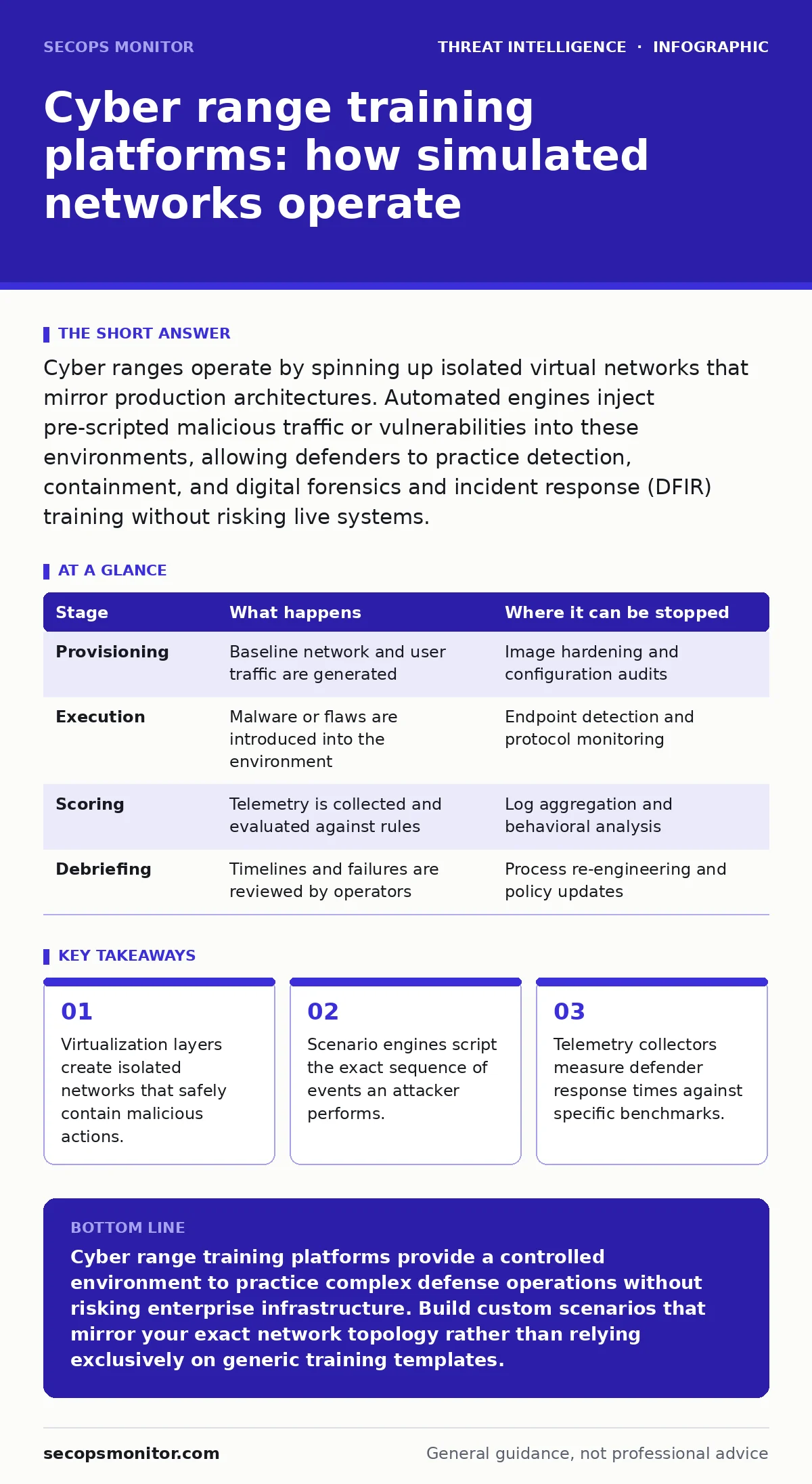
Cyber ranges operate by spinning up isolated virtual networks that mirror production architectures. Automated engines inject pre-scripted malicious traffic or vulnerabilities into these environments, allowing defenders to practice detection, containment, and digital forensics and incident response (DFIR) training without risking live systems.
How Cyber Ranges Mirror Production Networks
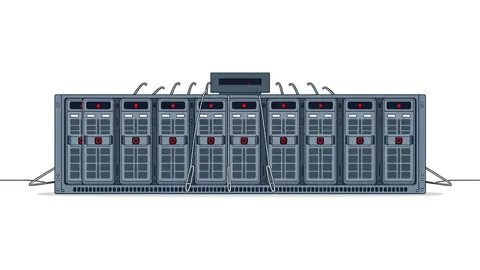
Cyber range training platforms replicate enterprise architectures by running multiple virtual machines connected through software-defined switches. Software-defined switches are virtual networking components that route traffic between simulated workstations and servers based on programmable rules. This architecture allows training environments to mimic complex corporate domains, complete with domain controllers, user endpoints, and external facing web applications.
Virtualization platforms isolate the entire training network from the public internet using hypervisor firewalls. A hypervisor is software that creates and runs virtual machines on physical hardware. Network isolation ensures that malicious actions performed during an exercise cannot escape into production systems.
The Mechanics of Automated Scenario Engines
Scenario engines drive the progression of exercises by executing pre-programmed operational steps automatically. Operational steps represent the actions an adversary takes, such as scanning ports, dumping credentials, or moving laterally across the network. These engines rely on state machines to determine when the environment should react to defender interventions.
State machines are programming logic constructs that change the system state based on specific inputs or conditions. When a defender isolates a compromised workstation, the state machine registers the defense and adjusts the automated attacker behavior accordingly. This dynamic response prevents static training paths and forces operators to adapt their tactics in real time.
Stage 1: Environment Provisioning
Environment provisioning builds the baseline network topology and populates it with simulated user activity. Automated scripts deploy operating systems, configure directory services, and generate background network traffic to simulate normal business operations. Background traffic creates noise, forcing defenders to locate threats hidden inside routine administrative chatter.
Baseline provisioning relies on golden images, which are pre-configured disk templates containing specific operating system settings and software packages. Attackers in the scenario frequently exploit known vulnerabilities residing within these golden images. Preparation mistakes during this stage can leave intentional flaws unstable, causing the simulation to crash before training begins.
Stage 2: Attack Execution and Flaw Exploitation
Attack execution injects malicious behaviors into the provisioned network through scripted routines or active adversary simulation. The attacker profile relies on misconfigured permissions, weak protocol implementations, or unpatched software packages to gain initial access. Once inside, the automated routines attempt privilege escalation to compromise the central domain controller.
Flaw exploitation succeeds because the underlying code permits unauthorized actions under specific environmental conditions. Defenders often study similar mechanics during threat intelligence briefings to understand how adversaries chain vulnerabilities together. Interruption at this stage requires rapid identification of unauthorized process creation or abnormal network authentication requests.
Stage 3: Telemetry Collection and Scoring
Telemetry collection gathers every log entry, packet capture, and command execution generated during the exercise. Telemetry collectors are background monitoring agents that stream operational data to a centralized logging database. Scoring engines analyze this incoming stream against a rubric of correct defensive actions.
Scoring engines calculate performance metrics by evaluating whether defenders mitigated the threat within established time limits. Hidden costs emerge when telemetry overhead consumes excessive hypervisor resources, slowing down the simulated workstations and altering normal user behavior. Accurate scoring depends entirely on precise timestamp synchronization across every virtual machine in the range.
See also: AS-REP Roasting: How Pre-Auth Bypass Steals Kerberos Tickets · Diamond Model of Intrusion Analysis Explained Simply
Stage 4: Debriefing and Analysis
Debriefing reconstructs the timeline of the exercise using centralized logs and system state snapshots. Facilitators guide operators through the attack chain to examine where defensive controls failed or succeeded. This review often incorporates principles from the Diamond Model of intrusion analysis to categorize adversary capabilities and infrastructure.
Analysis sessions transform raw telemetry into actionable lessons for enterprise defense teams. The hidden value of a cyber range lies in this post-exercise review, where operators discover the non-obvious consequences of their defensive configurations. Participants leave with a clear understanding of how small operational oversights allow attackers to persist undetected.
| Stage | What happens | Where it can be stopped |
|---|---|---|
| Provisioning | Baseline network and user traffic are generated | Image hardening and configuration audits |
| Execution | Malware or flaws are introduced into the environment | Endpoint detection and protocol monitoring |
| Scoring | Telemetry is collected and evaluated against rules | Log aggregation and behavioral analysis |
| Debriefing | Timelines and failures are reviewed by operators | Process re-engineering and policy updates |
Limitations of Simulated Training Environments
Simulated environments cannot fully replicate the unpredictable nature of human adversaries operating inside live networks. Real attackers modify their tactics dynamically when encountering unexpected defenses, whereas scenario engines follow rigid execution paths. Relying solely on scripted ranges can leave defenders unprepared for novel techniques that deviate from standard training matrices.
Training platforms also struggle to duplicate the psychological stress and organizational friction of a genuine crisis. Operators in a range know they are participating in an exercise, which alters their decision-making process compared to an actual security incident. Effective training programs acknowledge these limitations by combining simulated exercises with unannounced tabletop drills.
Key takeaways
- Virtualization layers create isolated networks that safely contain malicious actions.
- Scenario engines script the exact sequence of events an attacker performs.
- Telemetry collectors measure defender response times against specific benchmarks.
Cyber range training platforms provide a controlled environment to practice complex defense operations without risking enterprise infrastructure. Build custom scenarios that mirror your exact network topology rather than relying exclusively on generic training templates.
Frequently asked questions
How do cyber range training platforms create realistic background traffic?
Scripted bots and automated user simulation tools generate routine web browsing, email traffic, and file sharing to mimic normal employee behavior.
Can a cyber range platform run on a single physical server?
Hypervisors allow a single powerful machine to host dozens of interconnected virtual machines required for a small training network.
What stops users from breaking the underlying virtualization host during an exercise?
Virtual network switches and strict hypervisor permission boundaries isolate the training topology from the underlying management infrastructure.
How do scoring engines handle unexpected defender actions that still solve the problem?
Advanced ranges use state-based evaluation rather than rigid command matching to award points based on security outcomes rather than specific steps.
How this guide was produced: written by the SecOps Monitor editorial team with AI assistance, checked against the public references listed below, and reviewed when the facts change. See our editorial policy or report an error.