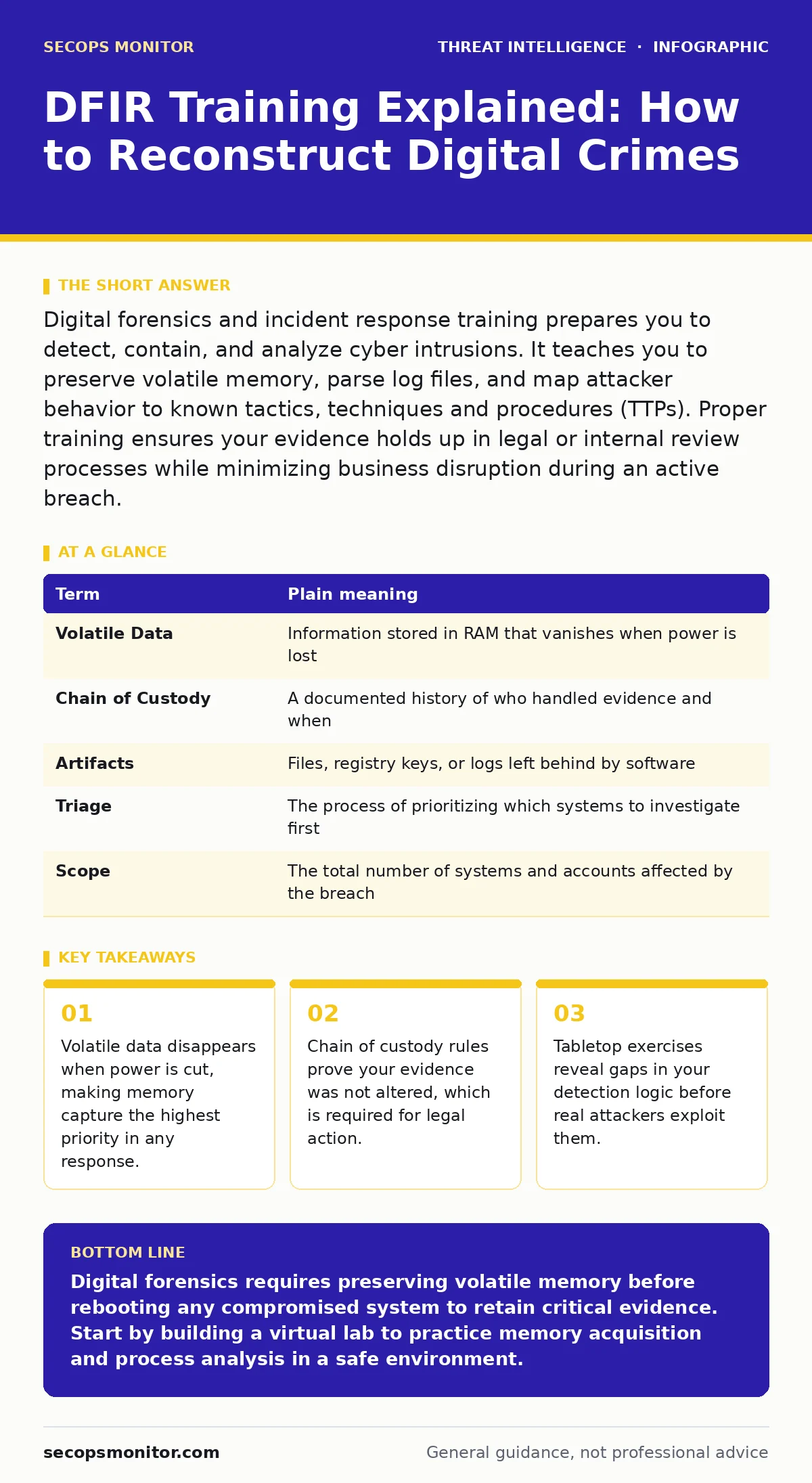
Digital forensics and incident response training prepares you to detect, contain, and analyze cyber intrusions. It teaches you to preserve volatile memory, parse log files, and map attacker behavior to known tactics, techniques and procedures (TTPs). Proper training ensures your evidence holds up in legal or internal review processes while minimizing business disruption during an active breach.
The Crime Scene Analogy
Imagine a physical burglary in your home. The police do not sweep the floor immediately. They photograph every footprint, collect dust particles, and interview neighbors. If you wipe the counter before the investigators arrive, you destroy the evidence. Digital forensics and incident response training teaches you to treat a compromised server like that crime scene. The digital equivalent of footprints are log entries. The dust particles are temporary memory files. Wiping the counter is rebooting the server. You must preserve the state of the system before you attempt to fix it.
Core Concepts and Terminology
DFIR combines two distinct disciplines. Forensics focuses on the past: what happened, who did it, and how. Response focuses on the present and future: stopping the bleeding and preventing recurrence. Understanding the difference prevents common errors. You cannot respond effectively if you do not know the scope of the intrusion. You cannot conduct forensics if you have already altered the evidence. The following table defines the terms you will encounter in training programs.
| Term | Plain meaning |
|---|---|
| Volatile Data | Information stored in RAM that vanishes when power is lost |
| Chain of Custody | A documented history of who handled evidence and when |
| Artifacts | Files, registry keys, or logs left behind by software |
| Triage | The process of prioritizing which systems to investigate first |
| Scope | The total number of systems and accounts affected by the breach |
The Volatility Hierarchy
The first lesson in DFIR training is the order of operations. You must collect data based on how quickly it disappears. This is known as the volatility hierarchy. Network connections vanish instantly. Process lists disappear when programs close. Memory contents are lost on reboot. Disk files remain for years. If you shut down a compromised machine to stop an attack, you lose the memory contents. Those contents often hold the decryption keys, the attacker's command history, or the malware in executable form. You sacrifice long-term disk evidence to save short-term memory evidence. This trade-off is unavoidable in many scenarios.
Reconstructing Attacker Behavior
Once you have preserved the data, you must interpret it. This is where threat actor profiling becomes relevant. You are not just looking for malware signatures. You are looking for human behavior. Attackers follow patterns. They often use specific tools that leave unique fingerprints. By mapping your findings to known tactics, techniques and procedures (TTPs), you can identify the group responsible. This helps you predict their next move. If they used a specific credential dumping tool, they are likely trying to escalate privileges. You can then focus your containment efforts on that specific vector.
Practical Detection Limitations
Training must address the limits of your tools. Log tampering is a common countermeasure used by sophisticated attackers. If an attacker deletes event logs, your standard monitoring tools will show nothing. This creates a false sense of security. DFIR training teaches you to look for gaps in the timeline. A missing hour of logs is as significant as a malicious entry. You must also understand protocol-level attacks. For example, AS-REP roasting allows attackers to request password hashes without triggering standard authentication logs. If your training does not cover these edge cases, you will miss the intrusion until it is too late.
See also: Heap Overflow Response: Containment, Recovery, and Prevention Steps · Breach Dwell Time Explained: How Long Attackers Hide in Your Network
Building a Response Muscle
Theory is useless without practice. You must test your skills in a safe environment. Cyber range training platforms provide isolated networks where you can simulate breaches without risking production data. These environments allow you to practice the entire lifecycle: detection, containment, eradication, and recovery. You will make mistakes. You might delete critical evidence. You might fail to isolate the infected host quickly enough. These failures are valuable. They reveal the blind spots in your procedures. Regular practice turns panic into protocol.
First Steps for Beginners
You do not need a degree to start. You need a methodical approach. Follow these steps to begin your DFIR journey.
- Set up a virtual lab. Install two virtual machines. One will be your forensic workstation, and the other will be your target. Keep the forensic workstation offline until you are ready to analyze data.
- Learn to capture memory. Install a trusted memory acquisition tool on your forensic workstation. Practice dumping the RAM of your target machine. Verify the hash of the dump to ensure integrity.
- Analyze process lists. Use command-line tools to list running processes on the target. Compare this list to a baseline of known good processes. Identify any unusual executables or hidden processes.
Integrating Analysis Frameworks
As you advance, you will need a structure for your findings. The Diamond Model of intrusion analysis provides a framework to link attackers to their infrastructure, capabilities, and victims. This model helps you move from a single alert to a full narrative. You can also deepen your technical skills by studying packet capture analysis. This allows you to see the raw data moving across the network. It reveals exfiltration attempts that host-based logs might miss. Understanding these frameworks turns raw data into actionable intelligence.
Key takeaways
- Volatile data disappears when power is cut, making memory capture the highest priority in any response.
- Chain of custody rules prove your evidence was not altered, which is required for legal action.
- Tabletop exercises reveal gaps in your detection logic before real attackers exploit them.
Digital forensics requires preserving volatile memory before rebooting any compromised system to retain critical evidence. Start by building a virtual lab to practice memory acquisition and process analysis in a safe environment.
Frequently asked questions
How do I know if my evidence is admissible in court?
Your evidence is admissible only if you maintain a strict chain of custody. This means documenting every person who handled the evidence, when they handled it, and what they did. Any break in this chain can render the evidence unusable for legal proceedings.
Can I use cloud tools for DFIR training?
Yes, but you must be careful with data privacy. Cloud platforms often have shared underlying infrastructure. Ensure your training data is fully isolated and that you have permission to simulate attacks. Do not use production cloud accounts for practice.
What is the difference between DFIR and threat hunting? Q: Is DFIR training necessary if I have automated security tools?
Automated tools reduce noise but cannot replace human judgment. They may miss novel attacks or context-specific anomalies. DFIR training teaches you to interpret the output of these tools and to investigate when the automation fails or produces false positives.
How often should I practice DFIR skills?
You should practice at least quarterly. Attack techniques evolve rapidly. Skills degrade without use. Regular tabletop exercises and lab work ensure you remain proficient in both manual analysis and the use of new tools.
How this guide was produced: written by the SecOps Monitor editorial team with AI assistance, checked against the public references listed below, and reviewed when the facts change. See our editorial policy or report an error.