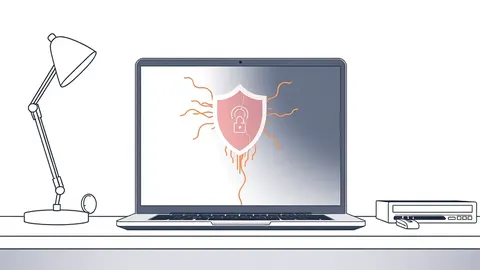
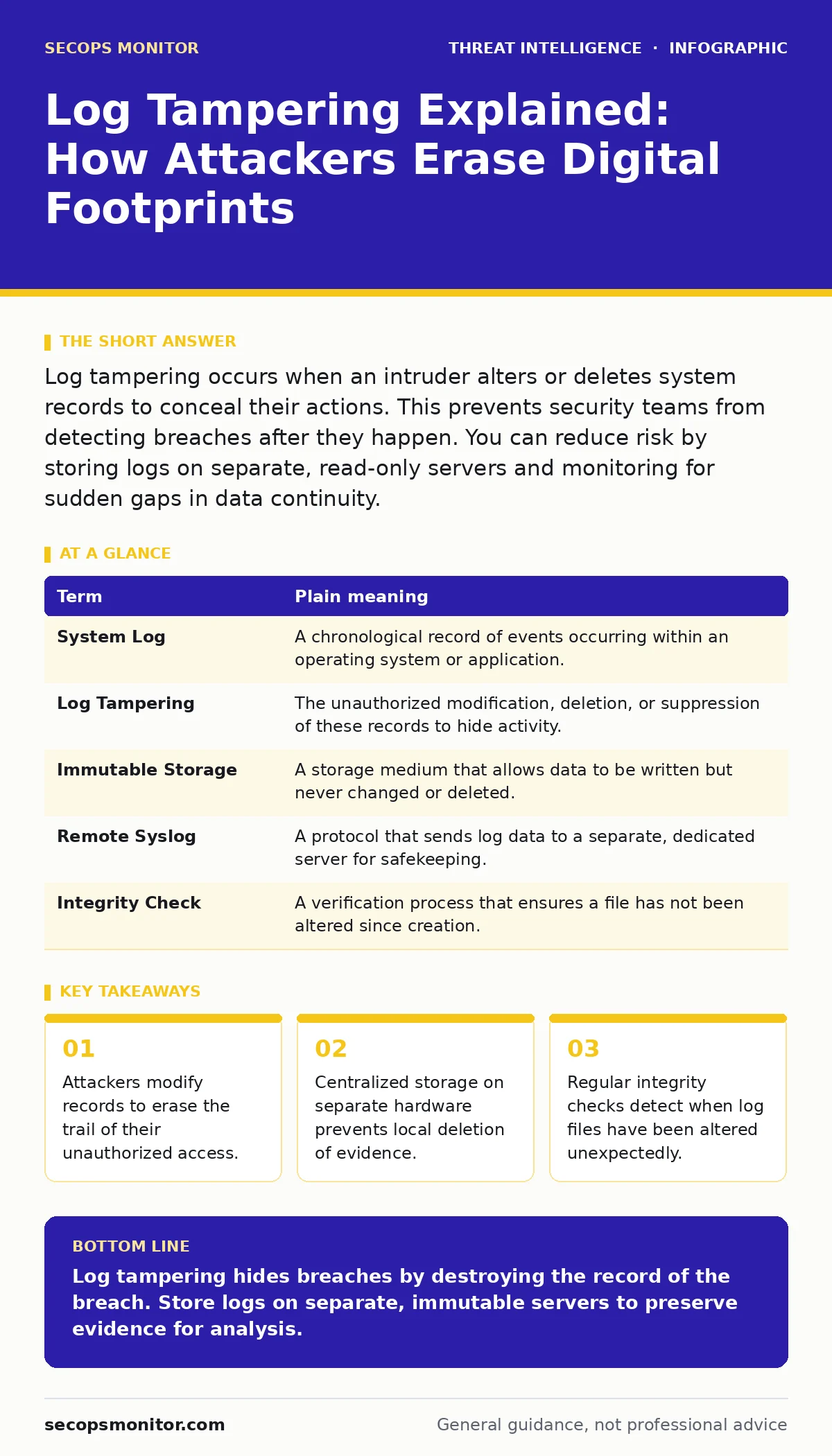
Log tampering occurs when an intruder alters or deletes system records to conceal their actions. This prevents security teams from detecting breaches after they happen. You can reduce risk by storing logs on separate, read-only servers and monitoring for sudden gaps in data continuity.
The Ledger Metaphor for System Records
Imagine a bank where the teller writes every transaction in a leather-bound ledger. This book serves as the single source of truth for all money movement. If a thief steals cash from the register, they also grab the ledger. They erase the line item showing the withdrawal. The bank later reviews the book and sees no missing money. The theft is invisible because the record of the theft no longer exists. System logs function exactly like this ledger.
Core Terms and Definitions
Understanding the mechanics requires clear definitions of the components involved. These terms describe how data is recorded and how it can be compromised.
| Term | Plain meaning |
|---|---|
| System Log | A chronological record of events occurring within an operating system or application. |
| Log Tampering | The unauthorized modification, deletion, or suppression of these records to hide activity. |
| Immutable Storage | A storage medium that allows data to be written but never changed or deleted. |
| Remote Syslog | A protocol that sends log data to a separate, dedicated server for safekeeping. |
| Integrity Check | A verification process that ensures a file has not been altered since creation. |
Why Attackers Alter Records
Threat actors do not always want to steal data immediately. Often, they seek persistent access. To maintain this access without detection, they must hide their initial entry point. Modifying logs removes the evidence of unauthorized login or privilege escalation. This allows them to move laterally through the network. They can perform tasks like DCSync attacks to harvest credentials without triggering alerts based on historical data analysis.
The Hidden Cost of Local Logging
Many systems store logs locally on the same machine they monitor. This creates a critical vulnerability. If an attacker gains administrative rights on that machine, they control the logs. They can delete entries or overwrite them with fake data. This is a common tactic used by advanced persistent threats to maintain long-term access. Local logs provide no protection against an insider with high privileges.
Protecting Evidence with Remote Storage
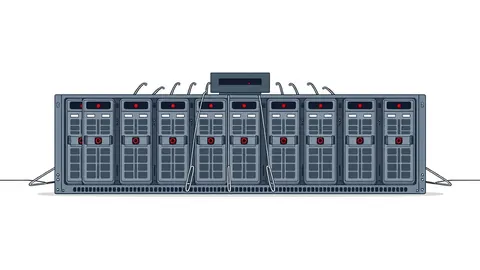
The most effective defense against log tampering is separation of duties. Send all log data to a remote server immediately upon creation. This server should be on a different network segment. It should have strict access controls. Only authorized security personnel can view or modify settings on this collector. If the primary system is compromised, the remote logs remain intact. This preserves the chain of evidence for incident triage.
See also: Process Injection: How It Works and How to Detect It · AS-REP Roasting: How Pre-Auth Bypass Steals Kerberos Tickets
Detecting Gaps and Anomalies
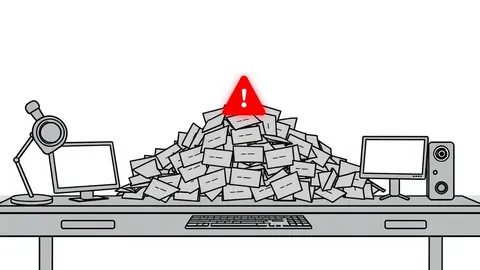
Even with remote storage, attackers may disrupt the connection. They might stop the logging service on the source machine. This creates a gap in the timeline. Security tools must monitor for these gaps. A sudden stop in log flow is as suspicious as a deleted entry. Automated alerts should trigger when expected log streams cease. This allows teams to investigate before the attacker consolidates their foothold.
Simple Safety Habits for Users
You can contribute to security hygiene even without administrative access. Keep your software updated to patch logging vulnerabilities. Report unusual system behavior to your IT team immediately. Do not ignore error messages that suggest logging failures. These small actions help maintain the integrity of the overall security posture.
Immediate Verification Steps
Take these three steps to verify your log security posture today.
- Check if your system sends logs to a remote server. If logs stay local, you are vulnerable to tampering.
- Verify that log files have read-only permissions for standard users. Only the logging service should write to them.
- Ensure that log retention policies prevent automatic deletion of old records. Keep history for forensic analysis.
Conclusion of Defense Strategy
Log tampering is a sophisticated technique used to evade detection. It relies on the destruction of evidence rather than the creation of noise. By separating log storage from the source system, you break the attacker's ability to hide. Regular monitoring for gaps ensures that silence is treated as an alert. This approach aligns with standard adversary emulation practices used to test defenses.
Key takeaways
- Attackers modify records to erase the trail of their unauthorized access.
- Centralized storage on separate hardware prevents local deletion of evidence.
- Regular integrity checks detect when log files have been altered unexpectedly.
Log tampering hides breaches by destroying the record of the breach. Store logs on separate, immutable servers to preserve evidence for analysis.
Frequently asked questions
Can antivirus software detect log tampering?
Antivirus focuses on known malware signatures. It often misses the specific administrative commands used to delete or modify log files. Behavioral monitoring is more effective.
What is the difference between log injection and tampering?
Log injection adds fake entries to confuse analysts. Tampering removes or alters existing entries to hide truth. Both aim to disrupt incident response and compromise threat intelligence accuracy.
How do honeypots help with log integrity?
Honeypots generate logs for systems that should never be accessed. Any log entry from a honeypot indicates a breach. This provides undeniable proof of compromise, regardless of tampering elsewhere.
Do cloud services prevent log tampering?
Cloud providers offer centralized logging, but configuration is key. You must enable write-once storage and restrict access. Misconfigured cloud logs can still be altered by compromised user accounts.
How this guide was produced: written by the SecOps Monitor editorial team with AI assistance, checked against the public references listed below, and reviewed when the facts change. See our editorial policy or report an error.