Threat actors range from criminal syndicates seeking profit to state-sponsored groups aiming for espionage. Each type uses distinct tactics, techniques and procedures (TTPs) driven by their goals. Knowing the difference helps you prioritize alerts and allocate security resources where they matter most.
What is a threat actor?
A threat actor is any individual, group, or organization that initiates actions intended to harm digital systems, data, or services. This definition covers everyone from a lone hacker trying to break into a router to a coordinated nation-state intelligence agency. The term does not imply a specific skill level or geographic origin. It simply describes the source of malicious intent. You must distinguish the actor from the method. A script kiddie and a state intelligence officer might both use a phishing email, but their follow-up actions differ wildly. Understanding the actor helps you predict the end game.
Types of threat actors
Different motivations create different behaviors. You can categorize these actors by what they want to achieve.
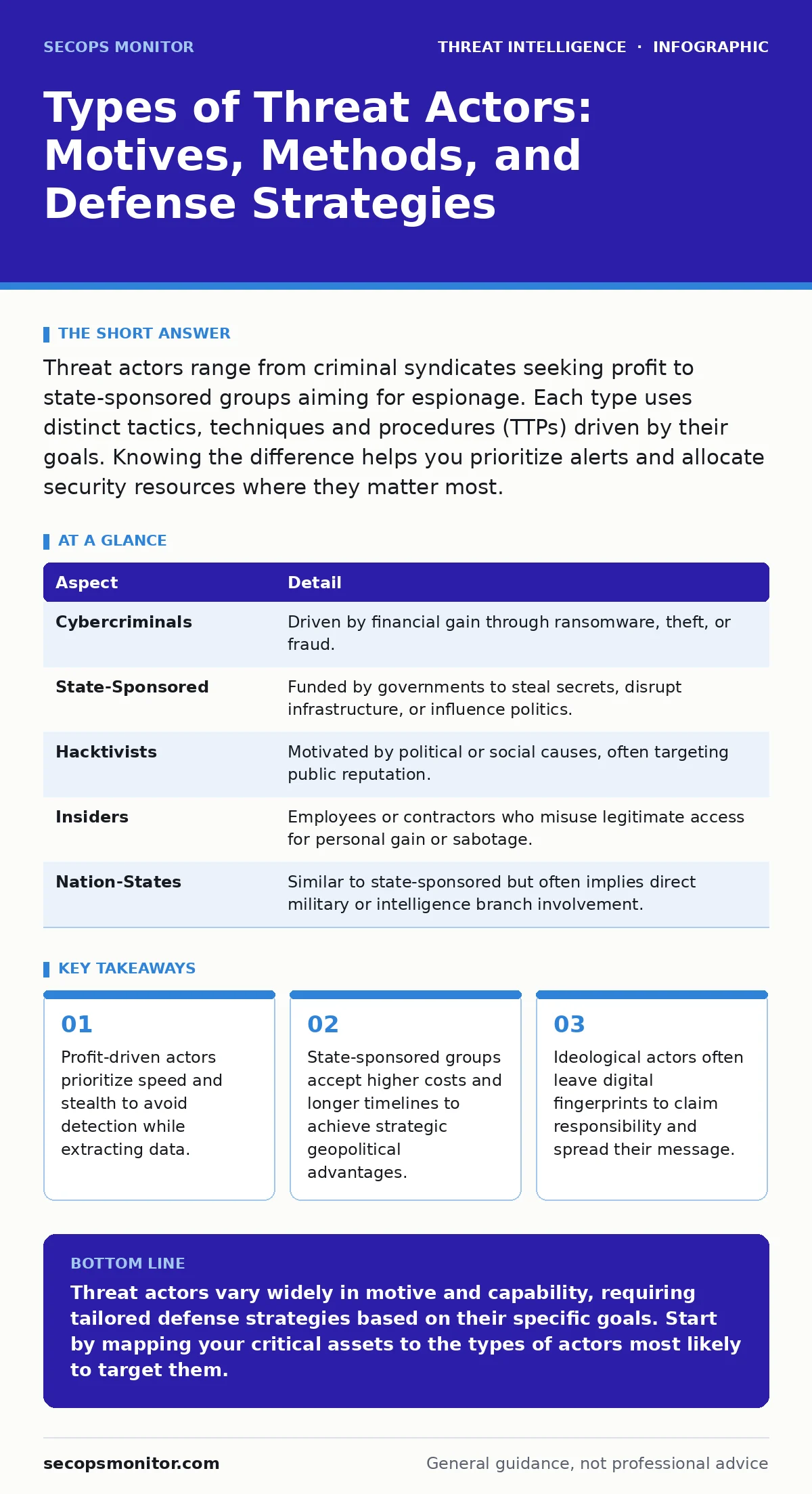
| Aspect | Detail |
|---|---|
| Cybercriminals | Driven by financial gain through ransomware, theft, or fraud. |
| State-Sponsored | Funded by governments to steal secrets, disrupt infrastructure, or influence politics. |
| Hacktivists | Motivated by political or social causes, often targeting public reputation. |
| Insiders | Employees or contractors who misuse legitimate access for personal gain or sabotage. |
| Nation-States | Similar to state-sponsored but often implies direct military or intelligence branch involvement. |
Profit-driven actors operate like businesses. They want maximum return on investment. They target systems that hold credit cards, health records, or proprietary code. They move quickly and often use automated tools. State-sponsored actors operate like intelligence agencies. They have unlimited budgets and time. They target research institutions, defense contractors, and government networks. They are patient and willing to wait months for the right moment to exfiltrate data.
How threat actor profiling works
You cannot defend against an unknown enemy. Threat actor profiling involves analyzing the digital footprints left behind during an attack. This process looks at the tools used, the language in ransom notes, the time of day attacks occur, and the specific data targeted. By connecting these dots, you build a picture of who is attacking you. This is not about guessing. It is about evidence. For example, if an attacker uses a specific custom encryption tool known to a certain group, you can infer their background. This helps you anticipate their next steps. If a group usually targets financial data, you should monitor your payment databases closely.
What people usually get wrong
Many organizations assume that all attacks are random. This is a dangerous misconception. Most attacks are targeted. Another common error is focusing only on external threats. Insiders pose a significant risk because they already have access. They do not need to bypass firewalls. They simply use their credentials. People also confuse the tool with the actor. Just because an attack uses a common exploit does not mean it was a low-skill attacker. Sophisticated groups often use simple tools to blend in with normal traffic. You must look at the context, not just the technical signature.
The hidden costs of misidentification
Misidentifying an actor leads to wasted resources. If you treat a hacktivist attack like a state-sponsored campaign, you may overreact and disrupt business operations. If you treat a state-sponsored attack like a simple virus, you may miss a deep compromise. The cost is not just financial. It is operational. A wrong assessment can delay incident triage by hours or days. During that time, the attacker continues to move laterally. You lose the element of surprise. The attacker knows you are reacting to the wrong threat. This gives them time to cover their tracks or escalate their privileges.
See also: AS-REP Roasting: How Pre-Auth Bypass Steals Kerberos Tickets
Tactics, techniques and procedures (TTPs)
TTPs describe how an actor behaves. Tactics are the high-level goals, such as initial access or persistence. Techniques are the specific methods used to achieve those goals, such as phishing or password spraying. Procedures are the detailed steps and tools used. Tracking TTPs is more valuable than tracking indicators of compromise like IP addresses. IP addresses change. TTPs remain consistent. An actor will reuse their preferred methods. By mapping TTPs to known groups, you can detect new attacks even if they use different tools. This approach aligns with the Diamond Model of intrusion analysis, which links adversaries to assets and capabilities.
Defending against diverse motives
Your defense strategy must adapt to the actor. Against profit-driven criminals, speed is key. You must isolate infected systems and restore from backups quickly. Against state-sponsored actors, depth is key. You must monitor for subtle anomalies and assume breach. You need to implement strict least privilege access. Regular adversary emulation helps you test your defenses against sophisticated tactics. This involves simulating real-world attacks to find gaps. You should also review your process injection defenses. Many advanced groups use this technique to hide malicious code inside legitimate processes. Do not rely on perimeter defenses alone. Assume the attacker is already inside.
The role of insider threats
Insiders are unique because they bypass many security controls. They know the network layout. They know the backup schedules. They know which accounts have high privileges. Detecting them requires monitoring for unusual behavior, not just malicious activity. An employee downloading large amounts of data at midnight is suspicious. An employee accessing files unrelated to their job is suspicious. You must balance security with privacy. Over-monitoring can damage morale and trust. Clear policies and regular training help mitigate this risk. Employees should understand that their access is a privilege, not a right.
Connecting the dots
Threat intelligence is not a static report. It is a continuous process. You must update your understanding of actors as they evolve. Groups change their tactics. They merge. They split. You must stay informed about the broader landscape. This does not mean reading every news article. It means focusing on intelligence that applies to your industry and technology stack. If you host financial data, financial sector threats are relevant. If you host research data, espionage threats are relevant. Tailor your intelligence gathering to your specific risk profile. This keeps your defenses sharp and relevant.
Advanced persistent threats
Advanced persistent threats (APTs) are a subset of state-sponsored actors. They are characterized by their longevity and stealth. They maintain access to a network for extended periods. They move slowly to avoid detection. They often target specific individuals or systems. Defending against APTs requires a multi-layered approach. You must segment your network. You must monitor for lateral movement. You must assume that some compromise will succeed. The goal is to limit the damage and detect the intrusion early. This requires a culture of security awareness and technical rigor.
Final considerations
Understanding types of threat actors is not an academic exercise. It is a practical necessity. Each actor has different goals, resources, and methods. Your defenses must reflect this diversity. You cannot use a one-size-fits-all approach. You must tailor your strategy to the specific risks you face. This means investing in the right tools and training the right people. It means accepting that you cannot stop every attack. It means focusing on detection and response. By knowing who is coming, you can prepare for what they will do.
Key takeaways
- Profit-driven actors prioritize speed and stealth to avoid detection while extracting data.
- State-sponsored groups accept higher costs and longer timelines to achieve strategic geopolitical advantages.
- Ideological actors often leave digital fingerprints to claim responsibility and spread their message.
Threat actors vary widely in motive and capability, requiring tailored defense strategies based on their specific goals. Start by mapping your critical assets to the types of actors most likely to target them.
Frequently asked questions
How do I know if an attacker is state-sponsored?
Look for long-term persistence, high-level targeting of intellectual property, and the use of custom, undetectable tools rather than commercial malware.
Can a single actor change their type?
Yes, groups may shift from hacktivism to criminal activity if funding dries up, or vice versa, depending on their financial needs and political climate.
What is the first step in threat actor profiling?
Collect and analyze all available data from the incident, including logs, network traffic, and artifacts, to identify unique behavioral patterns.
Do I need a dedicated team for this?
Small organizations can use open-source intelligence and managed detection services, while larger enterprises should invest in dedicated threat intelligence analysts.
How this guide was produced: written by the SecOps Monitor editorial team with AI assistance, checked against the public references listed below, and reviewed when the facts change. See our editorial policy or report an error.