
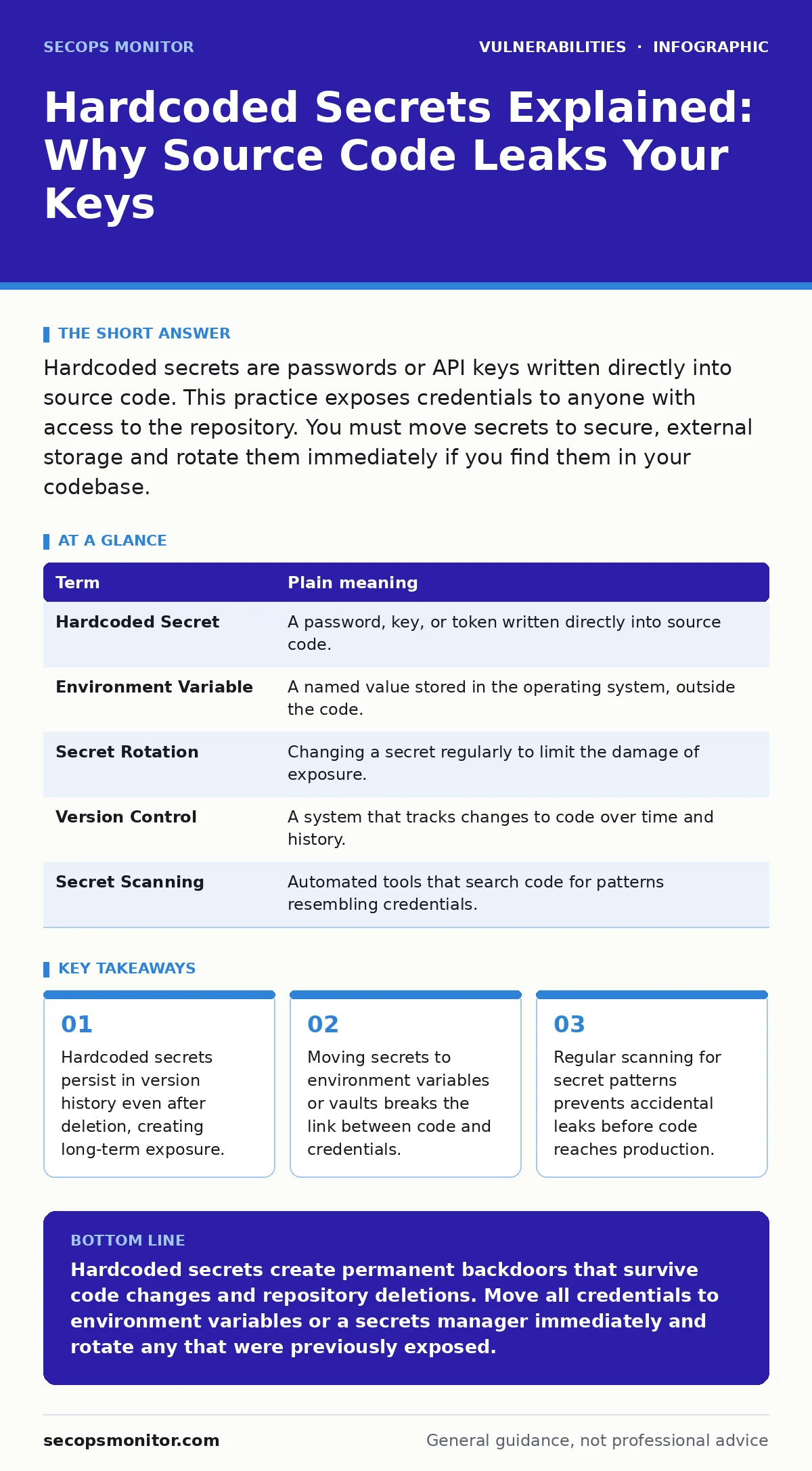
Hardcoded secrets are passwords or API keys written directly into source code. This practice exposes credentials to anyone with access to the repository. You must move secrets to secure, external storage and rotate them immediately if you find them in your codebase.
The House Key Analogy
Imagine you build a house. You install a lock on the front door. Instead of giving a unique key to each tenant, you hide a spare key inside the door frame. Every person who enters the house can find that spare key. If a tenant leaves, they keep a copy of that hidden key. The lock remains the same, but the security is broken because the method of entry is embedded in the structure itself. Hardcoded secrets work the same way. The credential is part of the application logic, not separate from it.
This approach fails because the code travels everywhere. Developers copy it. Servers host it. Users download it. The "spare key" moves with the house. You cannot revoke access by changing the lock if the key is molded into the door frame. You must remove the key from the frame and store it in a safe.
Key Terms Defined
Understanding the mechanics requires precise definitions. These terms appear in security audits and code reviews. Knowing them helps you spot issues early.
| Term | Plain meaning |
|---|---|
| Hardcoded Secret | A password, key, or token written directly into source code. |
| Environment Variable | A named value stored in the operating system, outside the code. |
| Secret Rotation | Changing a secret regularly to limit the damage of exposure. |
| Version Control | A system that tracks changes to code over time and history. |
| Secret Scanning | Automated tools that search code for patterns resembling credentials. |
Why Hardcoding Fails
Hardcoding seems convenient at first. The code works everywhere without extra configuration. This convenience hides a severe structural flaw. When code is shared, the secret travels with it. Public repositories expose these secrets to the entire internet. Private repositories expose them to every employee. A single leak compromises the entire system.
The danger extends beyond current access. Version control systems keep history. Deleting a secret from the current file does not remove it from the past. The secret remains in the repository history. Anyone with read access can view older versions. They can find the deleted secret. This makes remediation difficult and long-lasting. You must treat version history as a public record.
Impact on Ordinary Users
You might not write code, but you use applications. These applications contain secrets. When developers hardcode credentials, your data becomes vulnerable. Attackers extract these secrets from the application files. They use them to access databases or admin panels. Your personal information, messages, and financial records are at risk.
This affects mobile apps and desktop software too. Attackers reverse-engineer applications to find embedded keys. They bypass encryption and access sensitive data. You cannot fix this yourself. You rely on developers to secure their code. You should prefer vendors who follow strict security practices. Check for regular updates and transparent security policies.
Simple Safety Habits
Developers must change how they store credentials. Start by separating configuration from code. Use environment variables for secrets. These variables live in the server or user environment. The code reads them at runtime. The secret never touches the source file.
Imagine the house key again. Instead of hiding it in the frame, you give each tenant a unique key. You store the master key in a bank vault. The tenants cannot find the master key. If a tenant loses their key, you change the lock. The other tenants are unaffected. This is secret isolation.
Implement secret scanning in your development pipeline. These tools check every commit for patterns like passwords or API keys. They block commits that contain secrets. This prevents leaks before they happen. Combine this with dynamic application security testing (DAST) to find secrets in running applications.
Try This Now
Check your current projects for hardcoded secrets. Follow these three steps to improve security immediately.
- Search your codebase for common secret patterns. Look for strings resembling passwords, keys, or tokens. Use grep or integrated search tools. Review any matches carefully. Determine if they are real secrets or dummy values.
- Move found secrets to environment variables. Update the code to read from these variables. Remove the hardcoded values from the source files. Commit this change to version control. Ensure the variables are set correctly in all environments.
- Rotate exposed secrets immediately. Change the password or key that was hardcoded. Invalidate the old secret. Monitor logs for unauthorized access using the old secret. This limits the damage from any past exposure.
Long-Term Security Strategy
Hardcoded secrets are a symptom of poor configuration management. Fix the root cause by adopting a secrets management solution. These tools store, encrypt, and distribute secrets securely. They integrate with applications and infrastructure. They provide audit logs and access controls.
You should also review your dependency updates. Third-party libraries may contain secrets or vulnerabilities. Keep dependencies current to reduce risk. Consider memory-safe programming languages to prevent other types of leaks. Combine these practices for a stronger security posture.
Regularly audit your code. Use automated tools and manual reviews. Train your team on secure coding practices. Make secret management a standard part of the development process. This reduces the likelihood of future leaks. It builds a culture of security awareness.
Conclusion on Hardcoded Secrets
Hardcoding secrets is a dangerous shortcut. It exposes credentials to unauthorized access. The risk persists in version history and distributed code. Moving secrets to external storage fixes the issue. Rotating exposed credentials limits damage. Adopting secure habits prevents future leaks.
You must treat secrets as sensitive data. They require special handling and protection. Do not embed them in code. Use environment variables or vaults. Scan for secrets regularly. Rotate them frequently. This approach protects your applications and users.
Key takeaways
- Hardcoded secrets persist in version history even after deletion, creating long-term exposure.
- Moving secrets to environment variables or vaults breaks the link between code and credentials.
- Regular scanning for secret patterns prevents accidental leaks before code reaches production.
Hardcoded secrets create permanent backdoors that survive code changes and repository deletions. Move all credentials to environment variables or a secrets manager immediately and rotate any that were previously exposed.
Frequently asked questions
How do I find hardcoded secrets in my code?
Use secret scanning tools that search for patterns like passwords and API keys. Run these scans in your continuous integration pipeline to catch them early.
Can I use a .env file for secrets?
.env files are better than hardcoding, but they are still files. They can be accidentally committed. Use a dedicated secrets manager for production environments.
What if I already committed a secret to GitHub?
Rotate the secret immediately. It is still in the repository history. Consider using tools to scrub the history, but assume the secret is compromised.
Do encrypted secrets in code help?
Encryption adds a layer, but the decryption key is also in the code. This is not true security. Store secrets externally and decrypt them at runtime.
How this guide was produced: written by the SecOps Monitor editorial team with AI assistance, checked against the public references listed below, and reviewed when the facts change. See our editorial policy or report an error.