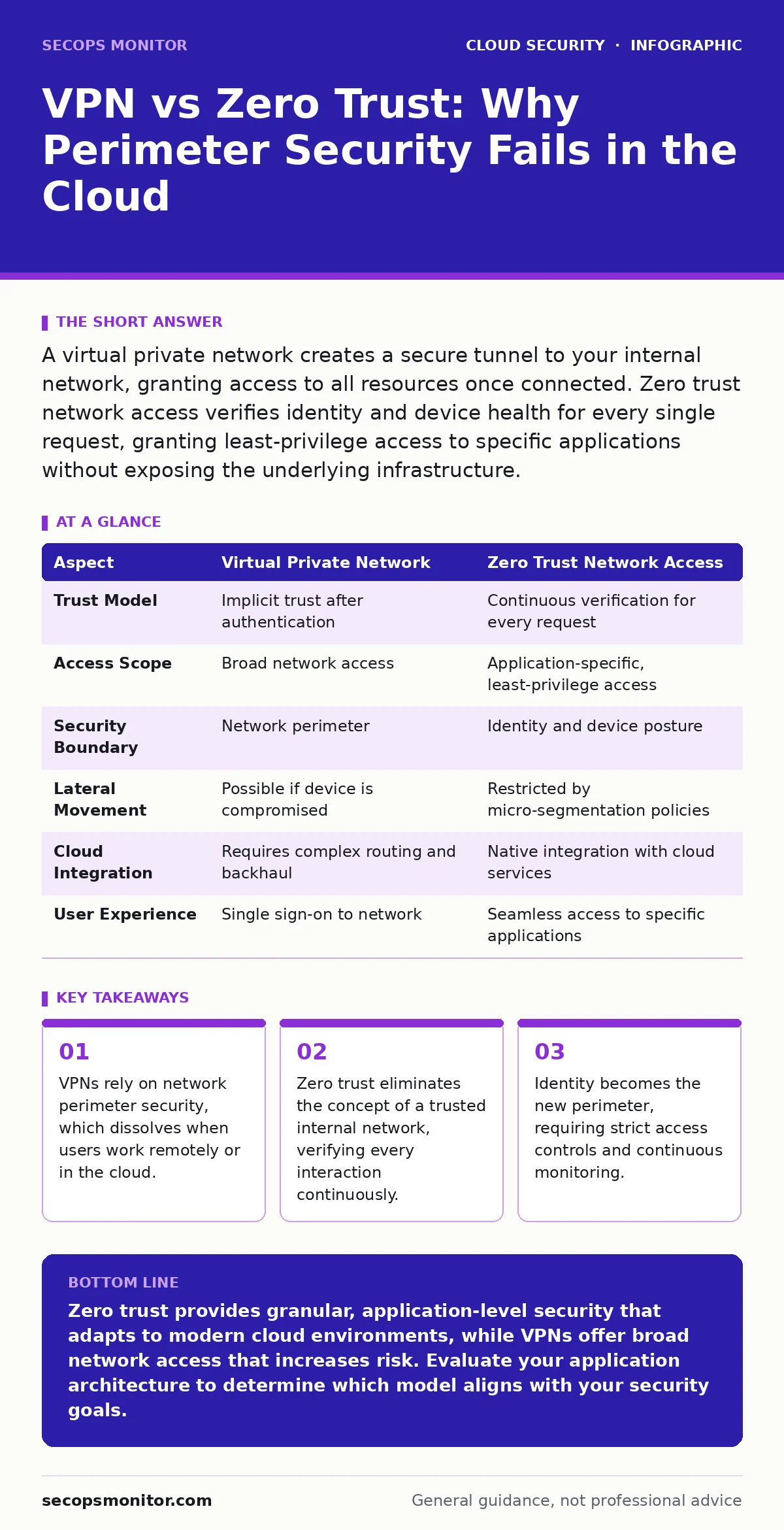
A virtual private network creates a secure tunnel to your internal network, granting access to all resources once connected. Zero trust network access verifies identity and device health for every single request, granting least-privilege access to specific applications without exposing the underlying infrastructure.
The Perimeter Is No Longer Defensible
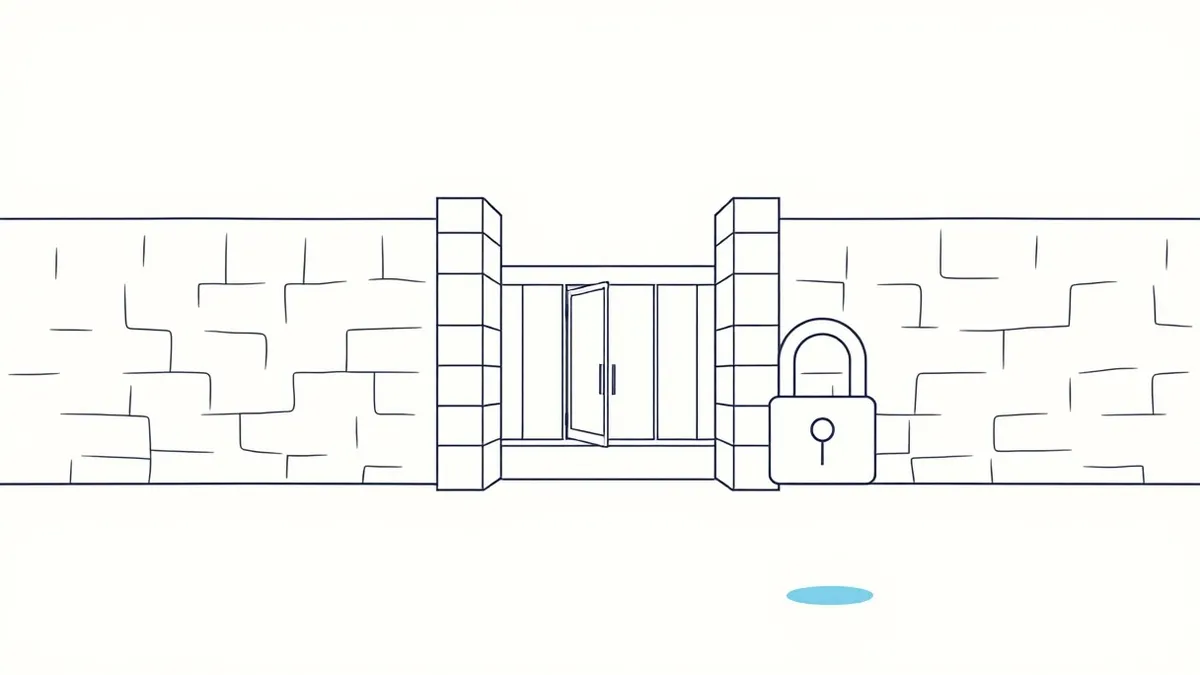
Imagine a castle with a single large gate. Once you pass through that gate, you can walk anywhere inside the walls. This is how a virtual private network operates. It creates an encrypted tunnel between your device and the corporate network. Once authenticated, you are effectively inside the corporate LAN. You can reach any server or application that the network allows, regardless of whether you actually need to access them for your job.
Zero trust network access operates on a different principle. It assumes that no user or device is trustworthy by default, even if they are inside the network. Every request for access is treated as if it originates from an untrusted source. The system verifies identity, device health, and context for each specific application access. You do not enter a network; you connect to specific services with limited permissions.
How VPNs Create Hidden Attack Surfaces
When you connect via a VPN, your device receives an internal IP address. This places your machine on the same logical segment as other corporate systems. If your device is compromised by malware, that malware now has direct lateral movement capabilities. It can scan for open ports and attempt to exploit vulnerabilities on internal servers. The encryption protects data in transit, but it does not protect the network from insider threats or compromised credentials.
This model also struggles with modern cloud environments. Many applications now reside in public cloud platforms rather than on-premises servers. Routing all traffic through a central VPN concentrator creates latency and bottlenecks. It forces traffic to backhaul to a central location, even if the user and the application are geographically close. This inefficiency degrades user experience and increases infrastructure costs.
Zero Trust Enforces Least Privilege
Zero trust architecture shifts the focus from network location to identity and context. Instead of connecting to a network, you connect to an application. The gateway intercepts requests and validates them against policy engines. These policies consider factors such as user role, device posture, and time of day. If your device lacks the required security patches, access is denied regardless of your password strength.
This approach limits the blast radius of any security incident. If an attacker steals credentials, they can only access the specific applications those credentials permit. They cannot scan the broader network for other vulnerabilities. This containment is critical for managing risk in environments with extensive identity sprawl, where numerous accounts and services interact across hybrid infrastructures.
Comparing Security Models
The following table highlights the structural differences between these two approaches.
| Aspect | Virtual Private Network | Zero Trust Network Access |
|---|---|---|
| Trust Model | Implicit trust after authentication | Continuous verification for every request |
| Access Scope | Broad network access | Application-specific, least-privilege access |
| Security Boundary | Network perimeter | Identity and device posture |
| Lateral Movement | Possible if device is compromised | Restricted by micro-segmentation policies |
| Cloud Integration | Requires complex routing and backhaul | Native integration with cloud services |
| User Experience | Single sign-on to network | Seamless access to specific applications |
When to Choose Each Approach
Choosing the right model depends on your infrastructure and risk tolerance.
- Choose a VPN when:
- You need to access legacy on-premises applications that do not support modern authentication protocols.
- Your workforce primarily works from a single physical location with minimal remote work.
- You require simple, low-cost connectivity for temporary contractors without long-term access needs.
- Choose Zero Trust when:
- Your applications are distributed across multiple cloud providers and on-premises data centers.
- You need to restrict access based on dynamic risk factors like device health or location.
- You aim to reduce the attack surface by eliminating broad network access privileges.
See also: Cloud Ransomware Explained: How Attacks Reach Your Data · MFA Misconceptions That Leave Cloud Accounts Exposed
Where the Models Overlap
These two models are not mutually exclusive in all scenarios. Many organizations use them together during a transition period. A VPN might provide initial connectivity to a gateway, which then enforces zero trust policies for specific applications. However, this hybrid approach still carries the risks of the VPN model if the gateway is misconfigured.
Both models rely heavily on strong authentication. Multi-factor authentication is a baseline requirement for both. Without it, neither model can effectively verify user identity. Additionally, both require ongoing monitoring and logging to detect anomalies. The difference lies in how they handle access after authentication is complete.
The Role of Identity and Device Health
In a zero trust model, the device itself becomes a security asset. The system checks for encryption, updated operating systems, and the presence of security agents. If a device fails these checks, access is denied or restricted. This prevents compromised devices from accessing sensitive data.
Identity management becomes the core of security. Role-based access control ensures users only see what they need. This reduces the risk of accidental data exposure. For complex environments, integrating with Kubernetes RBAC can help manage access to containerized applications securely. This granular control is difficult to achieve with traditional network-based security models.
Key takeaways
- VPNs rely on network perimeter security, which dissolves when users work remotely or in the cloud.
- Zero trust eliminates the concept of a trusted internal network, verifying every interaction continuously.
- Identity becomes the new perimeter, requiring strict access controls and continuous monitoring.
Zero trust provides granular, application-level security that adapts to modern cloud environments, while VPNs offer broad network access that increases risk. Evaluate your application architecture to determine which model aligns with your security goals.
Frequently asked questions
Can I use zero trust for on-premises applications?
Yes, zero trust gateways can be deployed on-premises to intercept and verify requests to internal applications.
Does zero trust replace firewalls?
No, zero trust complements firewalls by adding identity and context-based verification to network traffic.
Is zero trust more expensive than a VPN?
Initial implementation costs are higher due to complexity, but long-term risk reduction and cloud efficiency can offset expenses.
How does zero trust handle guest access?
Zero trust policies can define specific, limited access for guests, ensuring they cannot reach internal resources.
How this guide was produced: written by the SecOps Monitor editorial team with AI assistance, checked against the public references listed below, and reviewed when the facts change. See our editorial policy or report an error.