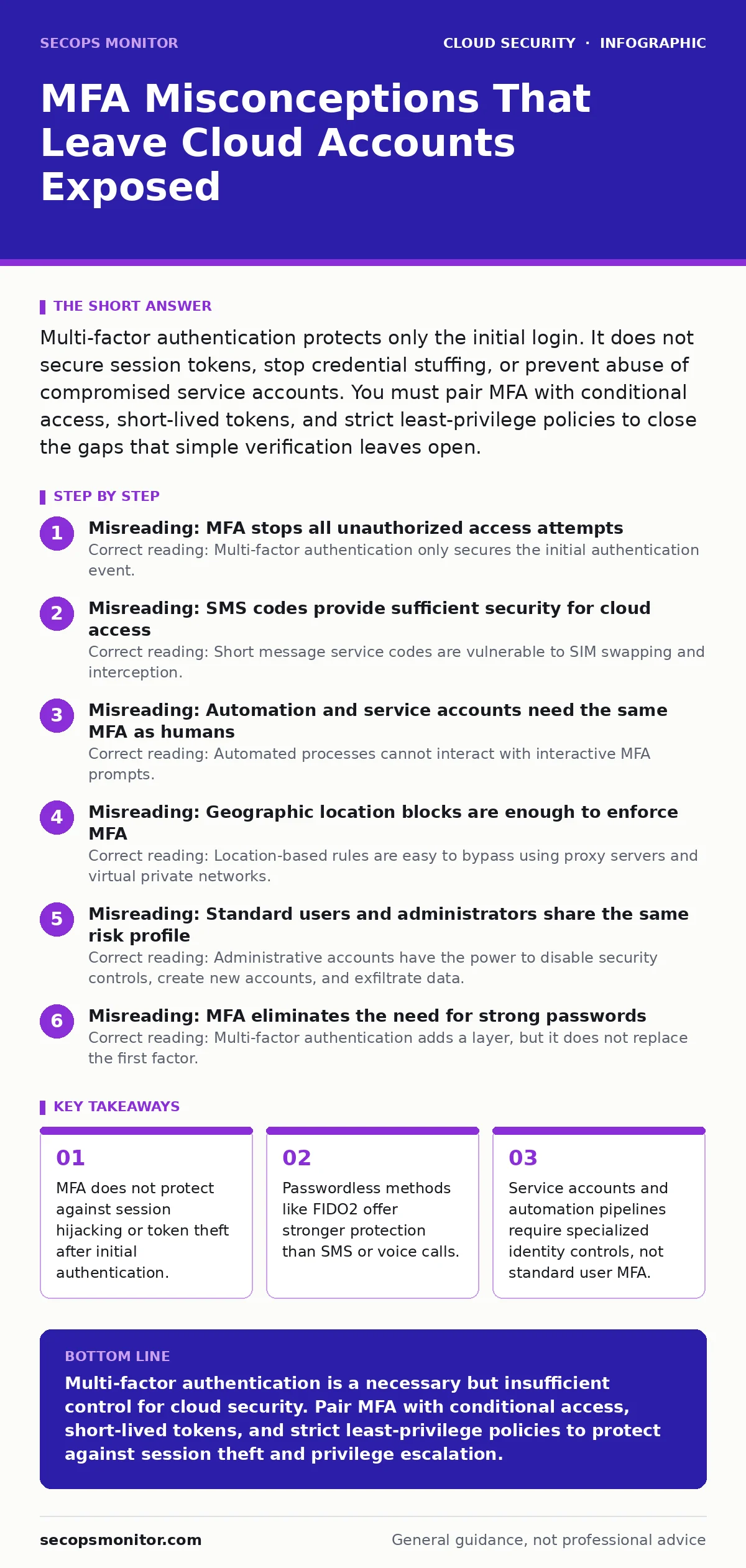
Multi-factor authentication protects only the initial login. It does not secure session tokens, stop credential stuffing, or prevent abuse of compromised service accounts. You must pair MFA with conditional access, short-lived tokens, and strict least-privilege policies to close the gaps that simple verification leaves open.
Misreading: MFA stops all unauthorized access attempts
Correct reading: Multi-factor authentication only secures the initial authentication event. It proves that the person logging in possesses something they know, something they have, or something they are. Once that proof is accepted, the system issues a session token. An attacker who steals that token gains full access without triggering another MFA prompt. Session fixation and token theft remain common attack vectors. You must treat the session as a separate security boundary. Implement short token lifespans and refresh token rotation to limit the damage of a stolen session.
Misreading: SMS codes provide sufficient security for cloud access
Correct reading: Short message service codes are vulnerable to SIM swapping and interception. Attackers can socially engineer mobile carriers to transfer your phone number to a device they control. They then receive your verification codes. Voice calls suffer from similar interception risks. Push notifications are better but still vulnerable to fatigue attacks, where spam pushes cause you to approve a login by mistake. Use hardware security keys or platform authenticators that support FIDO2 or WebAuthn standards. These methods bind the credential to the specific device and origin, preventing remote interception.
Misreading: Automation and service accounts need the same MFA as humans
Correct reading: Automated processes cannot interact with interactive MFA prompts. Forcing MFA on service accounts breaks deployment pipelines and monitoring tools. Instead of bypassing security, you must use non-interactive identity methods. Managed identities and workload identity federation allow services to authenticate using their own cryptographic credentials. These credentials are scoped to specific resources and expire quickly. Do not store long-lived API keys in environment variables or configuration files. Rotate these keys automatically and audit their usage. This approach aligns with shift-left security by embedding identity checks into the development lifecycle.
Misreading: Geographic location blocks are enough to enforce MFA
Correct reading: Location-based rules are easy to bypass using proxy servers and virtual private networks. Attackers can route their traffic through IP addresses in your trusted regions. This makes geographic restrictions a weak signal for risk assessment. You should combine location data with device posture checks and user behavior analytics. Conditional access policies should evaluate multiple factors simultaneously. If a login originates from an unfamiliar device, even within a trusted country, the system should require step-up authentication. Relying solely on geography creates a false sense of security that attackers exploit with minimal effort.
Misreading: Standard users and administrators share the same risk profile
Correct reading: Administrative accounts have the power to disable security controls, create new accounts, and exfiltrate data. They require a higher level of protection than standard users. You should implement a privileged access management strategy that isolates admin accounts from daily use. Use dedicated admin workstations that never access the internet or email. Enforce hardware-backed MFA for all administrative actions. This separation prevents credential theft via malware on personal devices. Refer to cloud incident response procedures to understand how attackers escalate privileges once they compromise a standard account.
See also: Shift-Left Security: 8 Questions Answered for Faster, Safer Code · Data Center Resilience Planning Best Practices for Modern Infrastructure
Misreading: MFA eliminates the need for strong passwords
Correct reading: Multi-factor authentication adds a layer, but it does not replace the first factor. Weak passwords remain vulnerable to credential stuffing attacks. Attackers use lists of leaked credentials to automate login attempts. If your password is weak, you become a high-value target for these automated campaigns. Even with MFA, some systems allow password reset flows that bypass the second factor. Use complex, unique passwords for every cloud account. A password manager helps generate and store these credentials securely. This practice reduces the attack surface for identity sprawl, where too many accounts with weak credentials create entry points.
Misreading: Passwordless authentication is completely immune to theft
Correct reading: Passwordless methods like FIDO2 keys are highly secure but not infallible. If an attacker gains physical access to your security key, they can use it to log in. Some phishing kits can intercept the cryptographic challenge-response process if the user is tricked into visiting a malicious site. The browser may not distinguish between the legitimate and phishing domains during the authentication handshake. Use platform authenticators tied to the device hardware whenever possible. These bind the credential to the specific operating system and hardware, making remote phishing attacks significantly harder.
Misreading: Cloud providers handle all identity security responsibilities
Correct reading: Cloud providers secure the infrastructure, but you configure the identity policies. Shared responsibility models place the burden of access management on your organization. Misconfigured permissions and overly broad access rights are leading causes of data breaches. Regularly audit user permissions and remove unnecessary access. Implement just-in-time access for administrative tasks. This reduces the window of opportunity for attackers. Understanding cloud compliance requirements helps you maintain these controls over time.
Key takeaways
- MFA does not protect against session hijacking or token theft after initial authentication.
- Passwordless methods like FIDO2 offer stronger protection than SMS or voice calls.
- Service accounts and automation pipelines require specialized identity controls, not standard user MFA.
- Conditional access policies must enforce MFA based on risk signals, not just geography.
Multi-factor authentication is a necessary but insufficient control for cloud security. Pair MFA with conditional access, short-lived tokens, and strict least-privilege policies to protect against session theft and privilege escalation.
Frequently asked questions
Does MFA protect against ransomware attacks?
MFA slows down initial access but does not stop ransomware if an attacker already has valid credentials or exploits a zero-day vulnerability. You need additional controls like immutable backups and endpoint detection.
How do I handle MFA for legacy applications?
Use an identity provider that supports single sign-on to wrap legacy applications in modern authentication protocols. This allows you to enforce MFA without modifying the legacy application code.
What is the best MFA method for mobile users?
Platform authenticators on smartphones are more secure than SMS. They use the device’s secure enclave to store credentials and prevent interception.
Can MFA be disabled for emergency access?
Never disable MFA for emergency accounts. Use break-glass accounts with hardware keys stored in physical
How this guide was produced: written by the SecOps Monitor editorial team with AI assistance, checked against the public references listed below, and reviewed when the facts change. See our editorial policy or report an error.