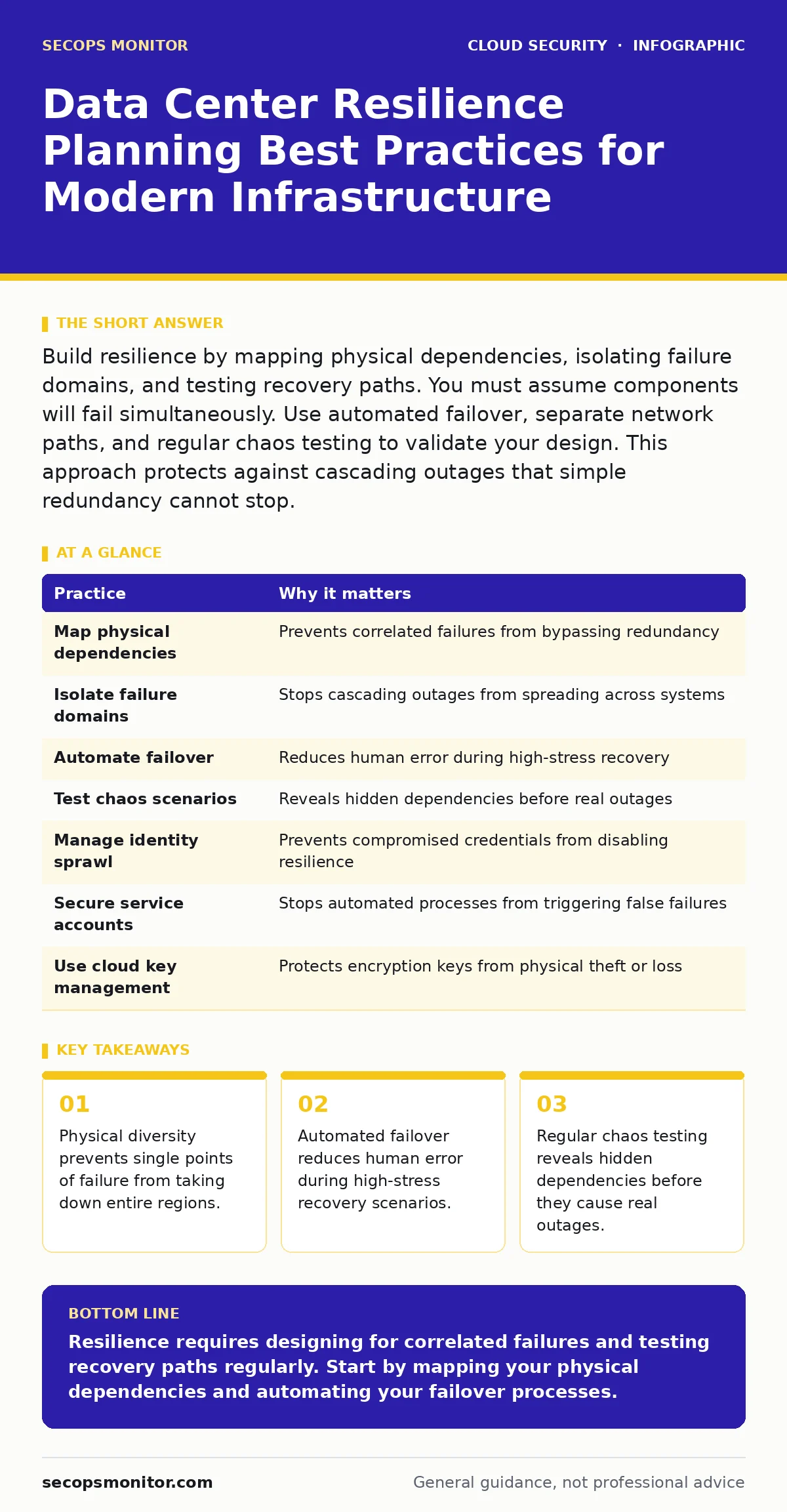
Build resilience by mapping physical dependencies, isolating failure domains, and testing recovery paths. You must assume components will fail simultaneously. Use automated failover, separate network paths, and regular chaos testing to validate your design. This approach protects against cascading outages that simple redundancy cannot stop.
Map Physical Dependencies Beyond The Rack
Standard rack-level redundancy assumes that power and network issues remain isolated. This assumption fails during regional grid failures or fiber cuts. You must map every physical dependency from the circuit breaker to the fiber splice. Identify shared conduits and shared power feeds that create single points of failure.
A single fiber cut can take down both primary and backup links if they run through the same conduit. You need to verify the physical path of every cable. Check with your provider for conduit maps. Ensure your primary and secondary links use physically separate paths. This prevents correlated failures from bypassing your redundancy.
| Practice | Why it matters |
|---|---|
| Map physical dependencies | Prevents correlated failures from bypassing redundancy |
| Isolate failure domains | Stops cascading outages from spreading across systems |
| Automate failover | Reduces human error during high-stress recovery |
| Test chaos scenarios | Reveals hidden dependencies before real outages |
| Manage identity sprawl | Prevents compromised credentials from disabling resilience |
| Secure service accounts | Stops automated processes from triggering false failures |
| Use cloud key management | Protects encryption keys from physical theft or loss |
Isolate Failure Domains Strictly
Resilience requires that a failure in one part of the system does not cascade to others. You must define failure domains based on physical and logical boundaries. Group resources so that a crash in one domain leaves others operational. This limits the blast radius of any single incident.
Microservices often share databases or message queues. This shared state creates hidden coupling. You must decouple these dependencies. Use asynchronous communication patterns. Ensure that a slow database query in one service does not block another. This isolation keeps critical functions running even when non-critical parts fail.
Automate Failover Processes
Human operators make mistakes under pressure. Automated failover systems execute predefined steps without hesitation. You must script every recovery action. Test these scripts regularly. Automation ensures consistent behavior during outages. It also reduces the time to recovery significantly.
Manual intervention introduces variability. Different operators may follow different procedures. This inconsistency can worsen an outage. Automation eliminates this risk. You must document the automation logic. Review it regularly. Ensure it handles edge cases. This builds trust in the recovery process.
Test With Chaos Engineering
You cannot trust a system you have not broken. Chaos engineering involves intentionally injecting failures to test resilience. You must simulate real-world outages. This reveals hidden weaknesses. It validates your failover mechanisms. It builds confidence in your recovery plans.
Many organizations rely on theoretical designs. These designs often fail in practice. Chaos testing exposes the gap between theory and reality. You must start small. Inject minor failures. Gradually increase complexity. This approach builds a culture of resilience. It prepares your team for real incidents.
Manage Identity Sprawl Effectively
Resilience depends on secure access. Identity sprawl creates unused accounts and excessive permissions. These weak points allow attackers to disable resilience mechanisms. You must audit identities regularly. Remove unused accounts. Restrict permissions to the minimum required. This reduces the attack surface significantly.
See our guide on identity sprawl for detailed strategies on auditing and cleaning up user accounts. Unmanaged identities can bypass security controls. They can disable monitoring or alter configurations. You must enforce strict identity governance. This ensures that only authorized personnel can impact system resilience.
See also: How Confidential Computing Works: Protecting Data in Use · Cloud Incident Response: 7 Mistakes That Escalate Breaches
Secure Service Account Credentials
Service accounts often have high privileges. They run automated processes and scripts. If compromised, attackers can disable resilience features. You must secure these credentials rigorously. Use short-lived tokens. Rotate credentials frequently. Monitor usage patterns. This prevents abuse of automated processes.
Refer to our guide on service account security for best practices on managing these critical identities. Service accounts are often forgotten in security reviews. They can be used to trigger false failures. You must treat them as high-value targets. This protects the integrity of your resilience mechanisms.
Implement Cloud Key Management
Encryption protects data at rest and in transit. However, encryption keys are critical assets. If keys are lost or compromised, data becomes inaccessible. You must use dedicated key management solutions. This ensures keys are stored securely. It enables rotation and revocation. This protects against physical theft or loss.
See our guide on cloud key management services for implementation details. Keys must be isolated from the data they protect. This prevents a single breach from compromising everything. You must test key recovery procedures. This ensures you can decrypt data when needed. This is a critical component of data resilience.
Monitor For Silent Failures
Not all failures are obvious. Silent failures involve data corruption or slow degradation. These issues are hard to detect. You must monitor for anomalies. Use advanced analytics. Detect subtle changes in performance. This allows you to intervene before a major outage.
Silent failures can erode trust in your system. They can lead to data loss. You must have robust monitoring in place. This ensures you catch issues early. It allows you to maintain high availability. This is essential for long-term resilience.
Design For Partial Degradation
Total failure is rare. Partial degradation is common. You must design systems to handle reduced capacity. This ensures critical functions remain available. You must prioritize traffic. Shed load during peak times. This prevents total collapse. It maintains service for key users.
This approach requires careful planning. You must identify critical functions. You must define acceptable degradation levels. You must test these scenarios. This ensures your system remains useful even under stress. This is a key aspect of resilience planning.
Key takeaways
- Physical diversity prevents single points of failure from taking down entire regions.
- Automated failover reduces human error during high-stress recovery scenarios.
- Regular chaos testing reveals hidden dependencies before they cause real outages.
Resilience requires designing for correlated failures and testing recovery paths regularly. Start by mapping your physical dependencies and automating your failover processes.
Frequently asked questions
How often should you test failover procedures?
Test failover procedures quarterly at a minimum. More frequent testing is recommended for critical systems. This ensures that automation works correctly and that teams are prepared.
What is the difference between redundancy and resilience?
Redundancy provides backup components. Resilience ensures the system can withstand and recover from failures. Redundancy is a component of resilience, but resilience requires broader planning and testing.
How do you handle data corruption during a failure?
Use regular backups and checksums to detect corruption. Implement automated verification processes. Ensure you can restore data from known good states quickly. This protects against silent data corruption events.
How this guide was produced: written by the SecOps Monitor editorial team with AI assistance, checked against the public references listed below, and reviewed when the facts change. See our editorial policy or report an error.