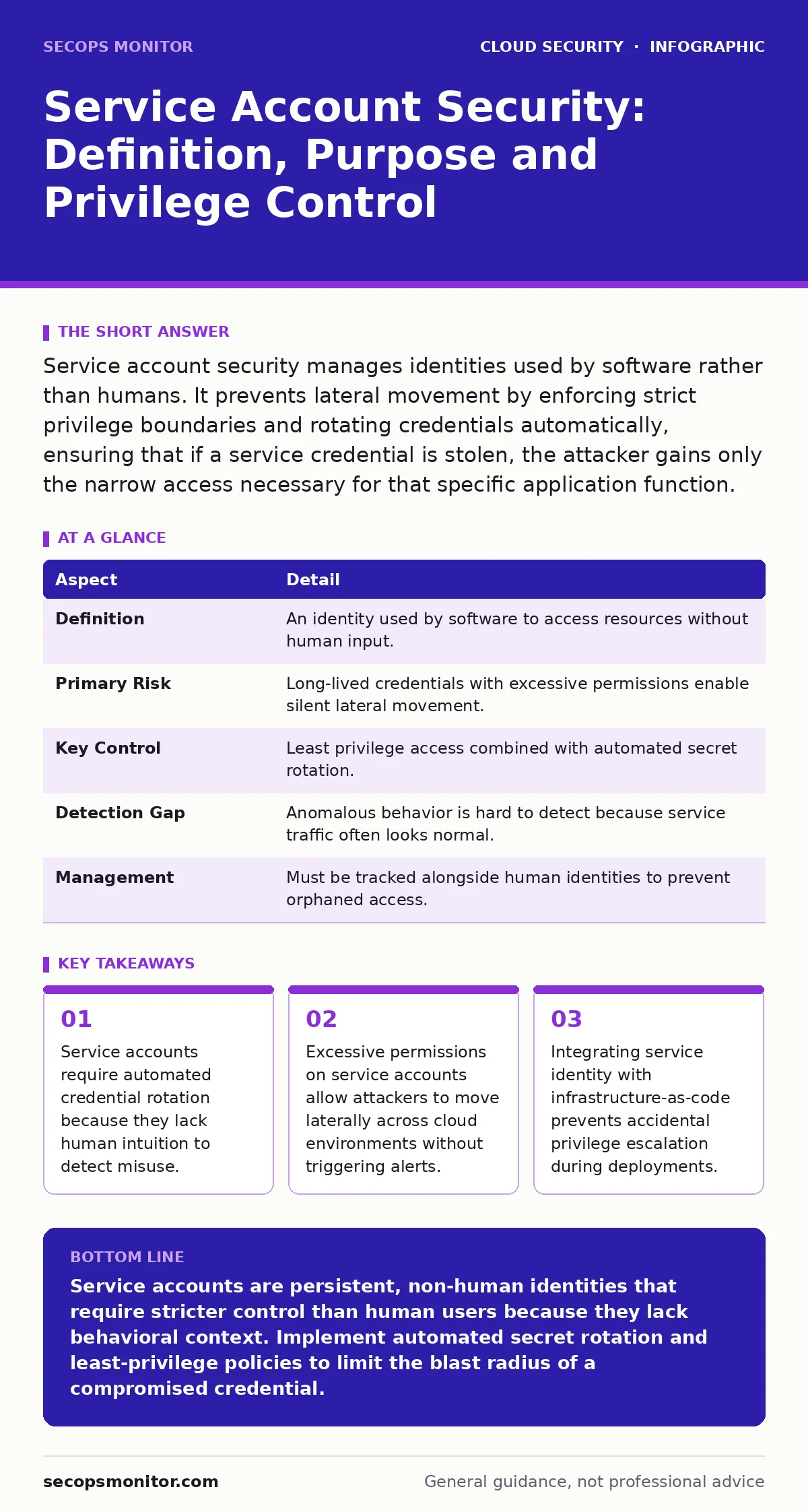
Service account security manages identities used by software rather than humans. It prevents lateral movement by enforcing strict privilege boundaries and rotating credentials automatically, ensuring that if a service credential is stolen, the attacker gains only the narrow access necessary for that specific application function.
The Non-Human Identity Crisis
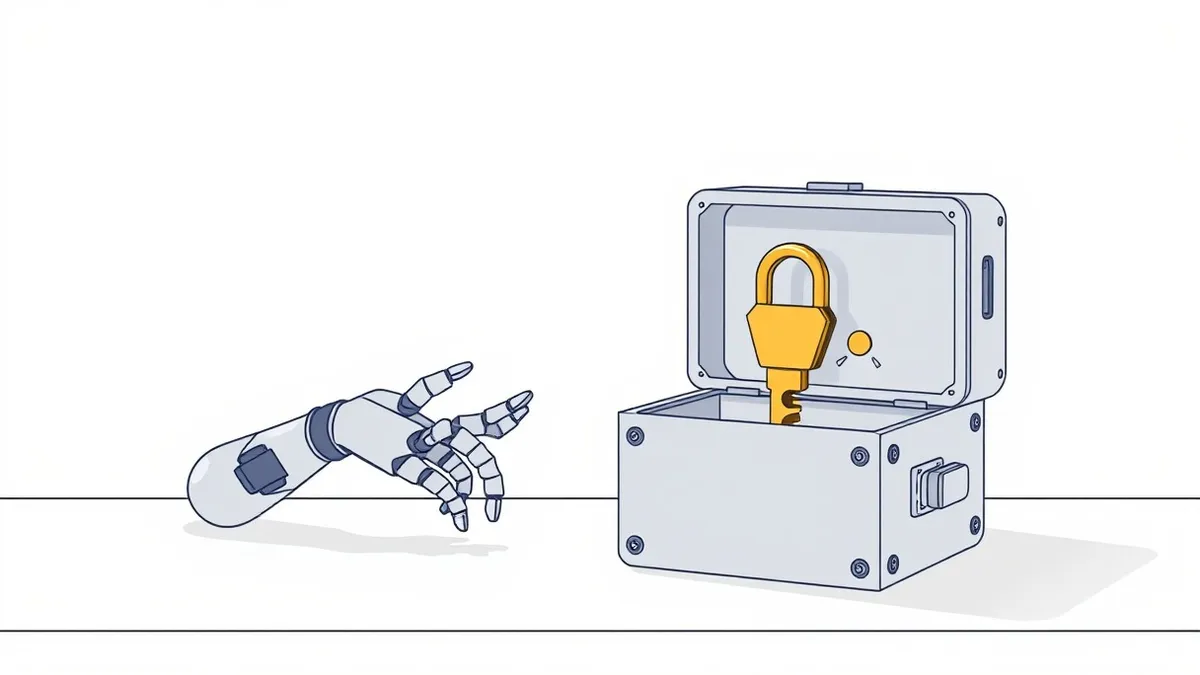
Imagine a post office where the mail carriers are not people, but robots. These robots do not sleep, they do not take breaks, and they do not question why they are carrying a package marked "Top Secret." They simply follow their programming. If someone steals a robot’s key, the thief can walk anywhere the robot is allowed to go, without ever needing to explain themselves to a security guard. This is the reality of service accounts in modern infrastructure.
Service accounts are digital identities created for software processes, scripts, and automated services. They exist to allow applications to interact with databases, file systems, or cloud APIs without human intervention. The problem is that many organizations treat these identities like human users, granting them broad permissions to "get the job done." This approach fails because software does not have context. A human administrator knows when a request is suspicious; a service account does not.
| Aspect | Detail |
|---|---|
| Definition | An identity used by software to access resources without human input. |
| Primary Risk | Long-lived credentials with excessive permissions enable silent lateral movement. |
| Key Control | Least privilege access combined with automated secret rotation. |
| Detection Gap | Anomalous behavior is hard to detect because service traffic often looks normal. |
| Management | Must be tracked alongside human identities to prevent orphaned access. |
Why Software Needs Its Own Keys
You might wonder why you cannot simply use a human user’s credentials for a backup script or a deployment pipeline. The answer lies in accountability and availability. If a script uses your personal credentials, you cannot leave the organization or change your password without breaking that script. Furthermore, if that script is compromised, the attacker gains access to everything your human account can touch, not just the database it needs to back up.
Service accounts solve the decoupling problem. They allow you to assign specific, narrow permissions to a machine process. If the database backup service is compromised, the attacker cannot access the email server because the backup service never had permission to do so. This isolation is the foundation of defense in depth. However, this isolation only works if you rigorously enforce the boundary. A service account with "admin" rights defeats the entire purpose of having a separate identity.
The Mechanics of Credential Management
The core of service account security is how you manage the secrets that prove the account’s identity. In the past, these were static passwords or long-lived API keys stored in configuration files. This model is fundamentally broken for cloud environments. Static credentials do not expire, meaning if they leak, they remain valid indefinitely until someone manually discovers the breach.
Modern approaches shift toward ephemeral credentials. Instead of storing a long-lived password, the application requests a short-lived token from an identity provider at runtime. This token expires in minutes or hours. If an attacker steals it, the window of opportunity is tiny. This mechanism requires that your infrastructure supports dynamic authentication, such as OpenID Connect or cloud-specific instance metadata services.
Another critical component is secret rotation. If you must use static credentials, you need an automated system to change them regularly. Manual rotation is error-prone and often skipped. When rotation is automated, the impact of a leaked credential is limited to the time between rotations. You must also ensure that old credentials are revoked immediately after rotation, not just left in a "disabled" state where they might still be cached by other systems.
Where Service Accounts Fit in the Defense Stack
Service account security does not exist in a vacuum. It intersects with several other security domains. For example, if you are using containers, the identity of the pod must be managed separately from the identity of the user deploying it. This is where Kubernetes RBAC becomes relevant, as it defines what actions a service account can perform within the cluster, but it does not necessarily control what that account can do in external cloud resources.
You must also consider how these identities interact with key management. If a service account accesses encrypted data, it needs permissions to decrypt it. This often involves cloud key management services, which must be configured to grant access only to the specific service account, not to all users in the project. Misconfiguring these grants is a common source of data leaks.
Furthermore, if your service accounts are used to push code to public repositories, you face the risk of public code repository leaks. A single leaked credential in a git commit can expose your entire environment. Therefore, service account security includes scanning for hardcoded secrets in your codebase before deployment.
Common Misconceptions and Pitfalls
Many administrators believe that if a service account is not used frequently, it is safe. This is a dangerous assumption. Attackers often target "sleeper" accounts that have not been used in months but still retain high privileges. These accounts are ideal for lateral movement because they are unlikely to be monitored for activity.
Another common error is assuming that internal networks are safe. In a cloud environment, there is no traditional perimeter. A service account running in a private subnet can still access public APIs if its credentials are compromised. You must assume that any credential leaving your control plane is potentially exposed.
See also: What Is Cloud Security Compliance: Mechanics, Risks, and Control · How Confidential Computing Works: Protecting Data in Use
The Hidden Cost of Identity Sprawl
As organizations scale, the number of service accounts grows exponentially. This phenomenon, known as identity sprawl, creates a blind spot. You may have hundreds of service accounts, but only a few teams know which ones exist and what they do. When an employee leaves, they may take knowledge of these accounts with them, or worse, the accounts become orphaned.
Orphaned accounts are those that are no longer associated with an active application or service. They remain active in the directory, holding permissions that are no longer needed. Attackers scan for these precisely because they are often misconfigured with broad permissions to ensure old systems continued to work. Regular auditing is required to identify and decommission these accounts. This process is difficult because you must determine if an account is truly unused or simply used by a legacy system that no one documents.
Integrating with Infrastructure as Code
To manage service accounts effectively, you must treat them as infrastructure. Manual creation of service accounts leads to inconsistency and drift. By defining service accounts and their permissions in code, you can review changes before they are applied. This allows you to catch excessive permissions at the pull request stage, rather than after a breach.
This approach also supports immutable infrastructure principles. When you deploy a new instance, it gets a fresh set of credentials or a new token, rather than reusing old ones. This reduces the risk of credential reuse and ensures that every deployment starts with a clean security posture. You should also integrate this with confidential computing if you are handling highly sensitive data, ensuring that the code running on the service account is verified and executed in a secure environment.
What to Do Next
Start by inventorying your current service accounts. Identify which ones have static credentials and which have excessive permissions. Prioritize the rotation of long-lived secrets for accounts that have access to sensitive data. Implement automated rotation for new accounts and consider moving to ephemeral tokens where possible. Finally, establish a regular audit process to detect and remove orphaned accounts, preventing them from becoming backdoors for attackers.
Key takeaways
- Service accounts require automated credential rotation because they lack human intuition to detect misuse.
- Excessive permissions on service accounts allow attackers to move laterally across cloud environments without triggering alerts.
- Integrating service identity with infrastructure-as-code prevents accidental privilege escalation during deployments.
Service accounts are persistent, non-human identities that require stricter control than human users because they lack behavioral context. Implement automated secret rotation and least-privilege policies to limit the blast radius of a compromised credential.
Frequently asked questions
How long should service account credentials last?
Ideally, they should be ephemeral, lasting only for the duration of a single operation or session. If static, they should rotate frequently, such as every 30 to 90 days, depending on your risk tolerance.
Can I use a single service account for multiple applications?
You should avoid this practice. Shared accounts make it impossible to determine which application is performing an action and increase the risk if one application is compromised.
How do I detect if a service account is compromised?
Monitor for unusual activity patterns, such as access from unexpected IP addresses, access during off-hours, or attempts to access resources outside the account’s normal scope.
What is the difference between a service account and a human account?
Human accounts are tied to individuals and often use multi-factor authentication. Service accounts are tied to software processes, cannot use MFA in the traditional sense, and require automated credential management.
How this guide was produced: written by the SecOps Monitor editorial team with AI assistance, checked against the public references listed below, and reviewed when the facts change. See our editorial policy or report an error.