Confidential computing uses hardware-based trusted execution environments to encrypt data during processing. This protects information from unauthorized access by cloud providers, system administrators, or compromised hypervisors. It extends encryption from data at rest and in transit to data in use.
The Problem with Traditional Encryption
Standard encryption protects data while it sits on disk and while it moves across networks. Once an application needs to process that data, it must decrypt it into memory. At that moment, the data is exposed.
Any process with access to the server’s memory can read it. This includes the operating system, the hypervisor, and any user with root or administrator privileges. In a multi-tenant cloud environment, this creates a significant trust gap.
You must trust the infrastructure provider to keep your data safe. Confidential computing removes that requirement by keeping data encrypted even while the CPU processes it.
Hardware-Enforced Isolation
The core mechanism is a trusted execution environment (TEE). This is a secure area within a central processing unit that guarantees code and data are loaded, stored, and processed with specified integrity and confidentiality properties.
The hardware handles the encryption and decryption of memory contents transparently. The application running inside the TEE sees normal plaintext data, but anything outside sees only ciphertext.
This isolation is physical, not virtual. A compromised hypervisor cannot peek into the TEE’s memory. Even if an administrator gains full control of the host machine, they cannot extract the keys or the data from the enclave.
Remote Attestation
Before you send sensitive data to a TEE, you need proof that the environment is genuine. This process is called remote attestation.
The hardware generates a cryptographic signature that proves the code running inside the TEE matches the expected version. It also proves the hardware itself is authentic and untampered.
You verify this signature before establishing a secure channel. If the attestation fails, you refuse to send data. This prevents running your workload on a fake or compromised enclave.
Key Management and Lifecycle
The encryption keys for the TEE are generated inside the secure hardware and never leave it. They are wrapped in a public key that only the hardware can unwrap.
This means the cloud provider never holds the keys. You manage the policy for when keys are rotated or revoked. If you revoke a key, the TEE can no longer decrypt its memory.
This control is critical for compliance. It ensures that data protection depends on your policies, not the provider’s internal processes.
Integration with Existing Security Models
Confidential computing does not replace other security controls. It complements them. For example, Kubernetes security basics still apply to how you deploy containers. You must still secure the network traffic entering and leaving the enclave.
It also works alongside just-in-time access principles. Even if an administrator has temporary access to the host, they cannot access the data inside the TEE.
However, it does not protect against vulnerabilities in the application code itself. If your code has a bug that leaks data through a side channel, the TEE cannot stop it.
See also: Data Center Resilience Planning Best Practices for Modern Infrastructure · What Is Cloud Security Compliance: Mechanics, Risks, and Control
The Stages of Protection
Understanding the flow helps you identify where protections can fail. Each stage has specific requirements and potential failure points.
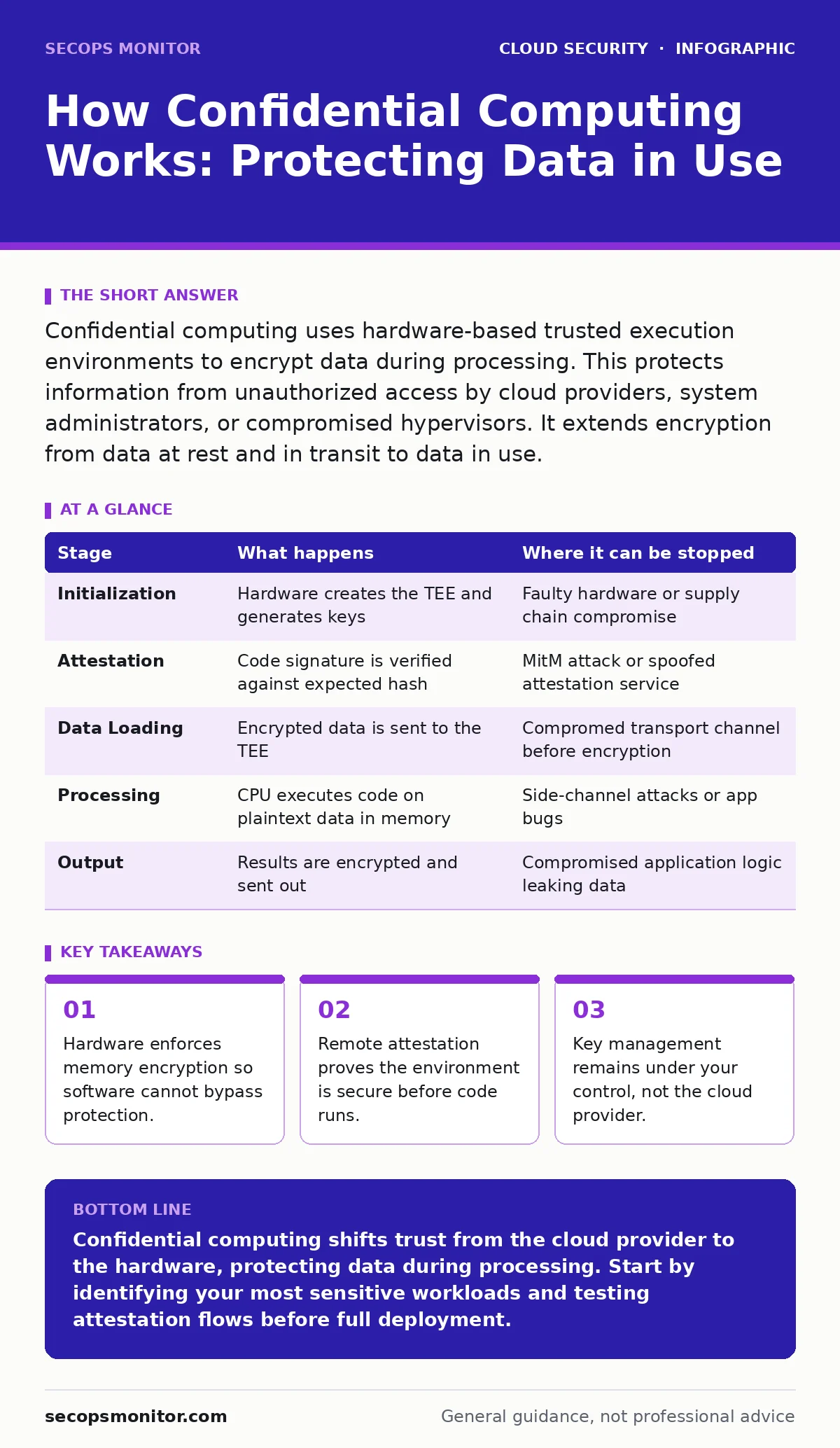
| Stage | What happens | Where it can be stopped |
|---|---|---|
| Initialization | Hardware creates the TEE and generates keys | Faulty hardware or supply chain compromise |
| Attestation | Code signature is verified against expected hash | MitM attack or spoofed attestation service |
| Data Loading | Encrypted data is sent to the TEE | Compromed transport channel before encryption |
| Processing | CPU executes code on plaintext data in memory | Side-channel attacks or app bugs |
| Output | Results are encrypted and sent out | Compromised application logic leaking data |
Performance and Operational Trade-offs
Using TEEs introduces overhead. Data must be encrypted and decrypted at the hardware level. This can slow down processing compared to standard execution.
Debugging is also harder. You cannot attach a debugger to the memory inside the TEE. You must rely on logging outputs, which can leak sensitive information if not careful.
This makes confidential computing best suited for high-value, sensitive workloads. It is not always practical for every application.
Implementation Considerations
Start by identifying workloads that handle highly sensitive data. These are the best candidates for confidential computing.
Ensure your application can be containerized or packaged for the specific TEE type. Different hardware vendors use different enclave formats.
Test the attestation flow thoroughly. If the attestation fails, your application should fail gracefully and securely.
Future-Proofing Your Architecture
As hardware evolves, new TEE types will emerge. Design your applications to abstract the TEE interface.
This allows you to switch between different hardware providers without rewriting your core logic. It also prepares you for new security features.
Integrate this with immutable infrastructure practices. Deploy sealed images to ensure the code inside the TEE has not been altered since build.
Key takeaways
- Hardware enforces memory encryption so software cannot bypass protection.
- Remote attestation proves the environment is secure before code runs.
- Key management remains under your control, not the cloud provider.
Confidential computing shifts trust from the cloud provider to the hardware, protecting data during processing. Start by identifying your most sensitive workloads and testing attestation flows before full deployment.
Frequently asked questions
Does confidential computing protect against all types of attacks?
No. It protects against memory access attacks but not side-channel attacks, application bugs, or compromised input/output channels.
Can I use confidential computing with existing applications?
Yes, but you may need to refactor code to ensure it runs correctly inside an enclave and handles attestation.
Is confidential computing only for cloud environments?
No. It can be used on-premises, but the benefits are most pronounced in multi-tenant cloud environments where you do not control the hardware.
How do I verify the attestation?
You verify the cryptographic signature provided by the hardware against a known good hash of your application code.
How this guide was produced: written by the SecOps Monitor editorial team with AI assistance, checked against the public references listed below, and reviewed when the facts change. See our editorial policy or report an error.