
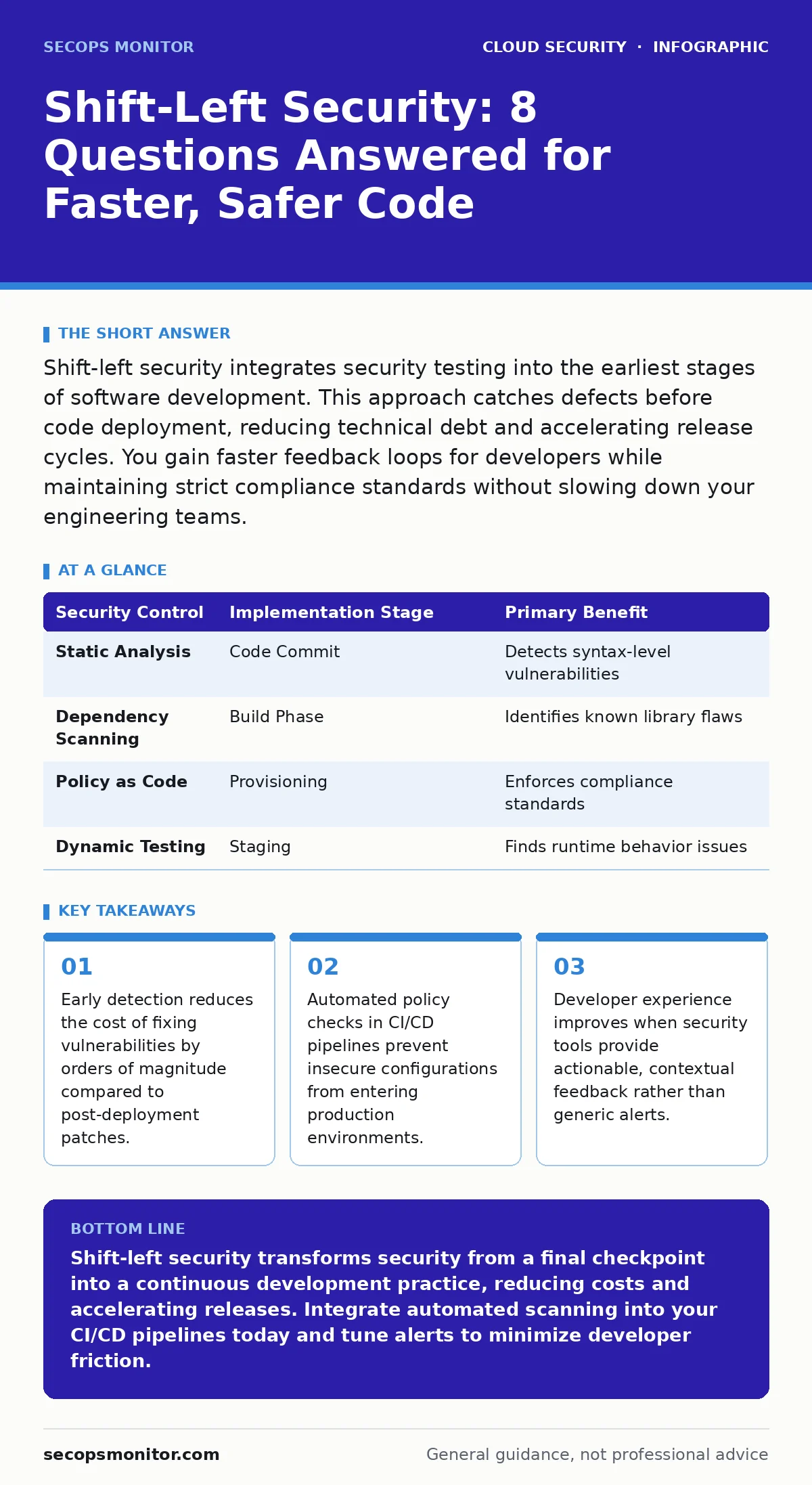
Shift-left security integrates security testing into the earliest stages of software development. This approach catches defects before code deployment, reducing technical debt and accelerating release cycles. You gain faster feedback loops for developers while maintaining strict compliance standards without slowing down your engineering teams.
What is shift-left security?
Shift-left security moves security testing and validation activities to the earliest possible stages of the software development lifecycle. Traditionally, security reviews occurred after development was complete, often just before production deployment. This late-stage approach created bottlenecks and expensive rework cycles. By integrating security controls during coding and design phases, you identify defects when they are cheapest to fix.
Why does timing matter for vulnerability remediation?
The cost of fixing a defect increases exponentially as it moves through the development pipeline. A logic error found during design requires a simple document edit. The same error found in production requires emergency patches, potential downtime, and incident response procedures. Early detection prevents these compounding costs. You avoid the hidden expense of context switching for engineers who must stop feature work to address critical security findings.
How do you integrate security into CI/CD pipelines?
You embed automated security scanners directly into your continuous integration and continuous deployment workflows. Static application security testing tools analyze source code for known vulnerability patterns without executing the program. Dependency scanning checks third-party libraries for known flaws. These checks run automatically on every code commit. Failures block the build process, preventing insecure code from advancing to staging or production environments.
What is the role of infrastructure as code?
Infrastructure as code treats server configurations and network settings as version-controlled software artifacts. You apply the same code review and testing standards to your cloud configurations as you do to application logic. This eliminates manual configuration errors that often lead to exposed storage buckets or misconfigured firewalls. Automated policy checks validate compliance rules before infrastructure is provisioned, ensuring consistent security baselines across all environments.
| Security Control | Implementation Stage | Primary Benefit |
|---|---|---|
| Static Analysis | Code Commit | Detects syntax-level vulnerabilities |
| Dependency Scanning | Build Phase | Identifies known library flaws |
| Policy as Code | Provisioning | Enforces compliance standards |
| Dynamic Testing | Staging | Finds runtime behavior issues |
How does this approach handle legacy systems?
Legacy systems often lack modern tooling integration points or standardized build processes. You cannot simply insert automated scanners into monolithic applications without significant refactoring. Start by securing the interfaces between legacy components and new services. Implement strict identity and access management controls around these integration points. Gradually modernize the outer layers while maintaining operational stability for the core system. This incremental approach reduces risk without requiring a full rewrite.
See also: MFA Misconceptions That Leave Cloud Accounts Exposed · Data Center Resilience Planning Best Practices for Modern Infrastructure
What are the common pitfalls of early security?
Developers may perceive security gates as obstacles rather than aids if feedback is unclear or slow. Tools that generate high volumes of false positives cause alert fatigue, leading teams to ignore warnings. Configuration errors in the security tools themselves can create false confidence. You must tune scanners to your specific technology stack and provide clear remediation guidance. Security teams should collaborate with developers to ensure tools integrate seamlessly into existing workflows.
How does this relate to identity management?
Strong identity controls are foundational to shift-left security, especially when dealing with complex cloud environments. Identity sprawl occurs when permissions become fragmented across multiple services and teams, creating hidden attack surfaces. You must enforce least-privilege access principles from the start of development. Automated checks should verify that service accounts and user roles have only the permissions necessary for their specific functions. This prevents privilege escalation attacks even if other controls fail.
Can automation replace human security review?
Automation handles repetitive tasks like syntax checking and dependency scanning with high accuracy. It cannot assess business logic flaws or architectural design weaknesses that require contextual understanding. Human reviewers identify nuanced risks such as data privacy implications or compliance gaps specific to your industry. The most effective strategy combines automated scanning for broad coverage with targeted human review for complex logic. This hybrid approach balances speed with depth of analysis.
How do you measure the success of shift-left?
Track the time from vulnerability detection to remediation completion. Monitor the ratio of true positives to false positives in your scanning tools. These metrics reveal whether your security controls are effective or merely obstructive. Regularly review these indicators with development teams to refine tooling and processes. Continuous improvement ensures that security remains an enabler rather than a bottleneck.
What about container and orchestration security?
Containers introduce unique risks related to image integrity and runtime behavior. You must scan container images for vulnerabilities before they are deployed to orchestration platforms. Kubernetes security basics include enforcing network policies and restricting pod privileges. Runtime protection monitors for anomalous behavior that static scans cannot detect. Combining pre-deployment scanning with runtime monitoring provides defense in depth for containerized applications.
How does this impact cloud ransomware risks?
Cloud ransomware attacks often exploit misconfigurations and weak identity controls. Shift-left security reduces these attack surfaces by enforcing strict configuration standards and least-privilege access from the start. Automated policy checks prevent insecure storage settings that attackers commonly exploit. By validating security controls before deployment, you eliminate many of the entry points that ransomware operators target. This proactive stance significantly reduces the likelihood of successful compromise.
Key takeaways
- Early detection reduces the cost of fixing vulnerabilities by orders of magnitude compared to post-deployment patches.
- Automated policy checks in CI/CD pipelines prevent insecure configurations from entering production environments.
- Developer experience improves when security tools provide actionable, contextual feedback rather than generic alerts.
Shift-left security transforms security from a final checkpoint into a continuous development practice, reducing costs and accelerating releases. Integrate automated scanning into your CI/CD pipelines today and tune alerts to minimize developer friction.
Frequently asked questions
Does shift-left security slow down development?
Initial setup requires investment, but long-term velocity increases because developers fix issues immediately rather than waiting for late-stage security reviews.
Which tools are best for static analysis?
Choose tools that integrate with your specific programming languages and CI/CD platform, ensuring they provide actionable feedback rather than just raw alerts.
How do I handle false positives?
Regularly tune your scanning rules and whitelist known safe patterns to reduce noise, ensuring developers trust and act on legitimate findings.
Can I apply this to DevOps?
Yes, shift-left is a core component of DevSecOps, embedding security responsibilities directly into the operations and development workflow.
How this guide was produced: written by the SecOps Monitor editorial team with AI assistance, checked against the public references listed below, and reviewed when the facts change. See our editorial policy or report an error.