
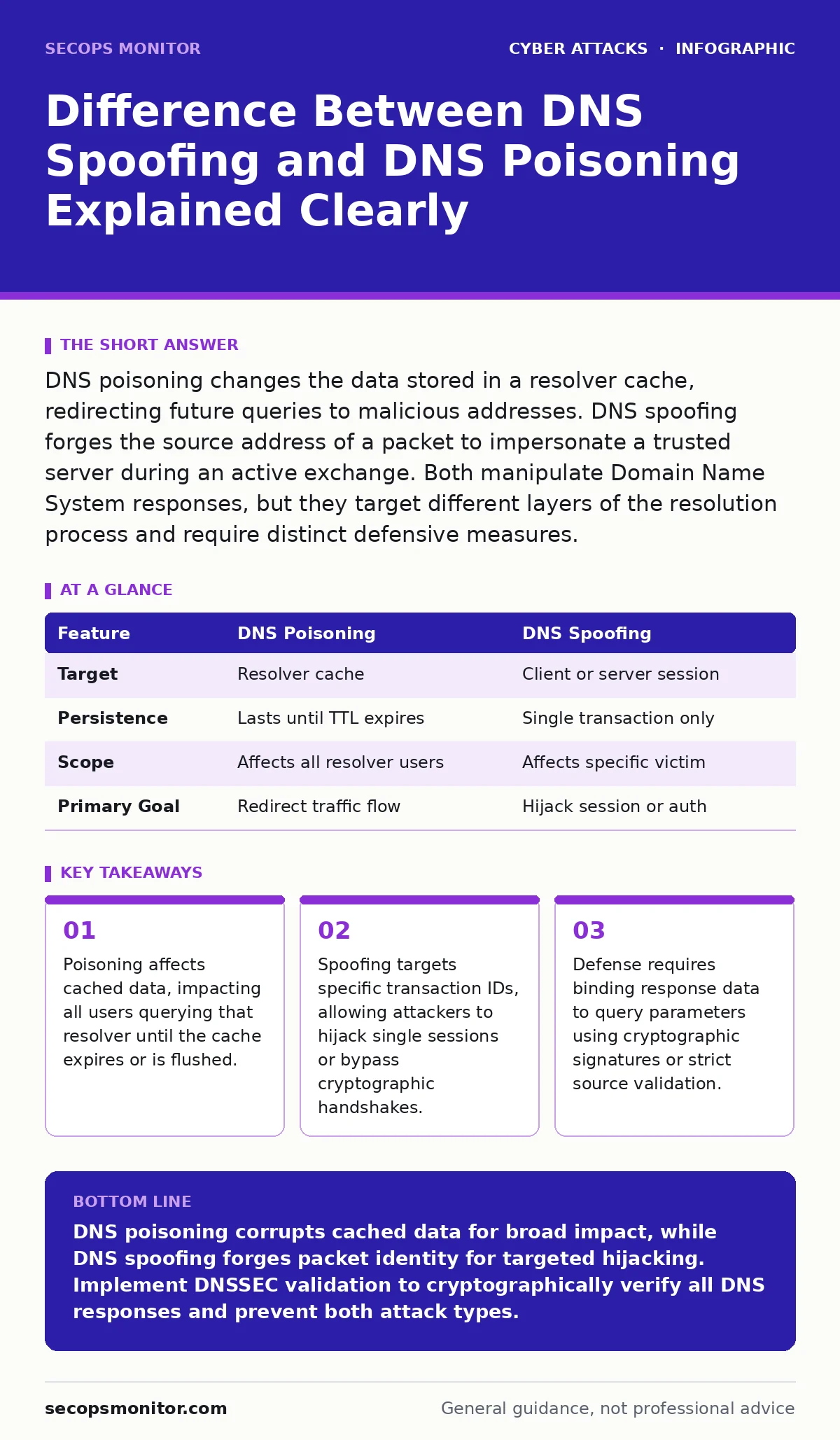
DNS poisoning changes the data stored in a resolver cache, redirecting future queries to malicious addresses. DNS spoofing forges the source address of a packet to impersonate a trusted server during an active exchange. Both manipulate Domain Name System responses, but they target different layers of the resolution process and require distinct defensive measures.
What is the difference between dns spoofing and dns poisoning?
The difference between dns spoofing and dns poisoning lies in the target of the manipulation. DNS poisoning alters the cached record within a resolver, causing all subsequent queries for that domain to resolve to an attacker-controlled address. DNS spoofing forges the source identity of a network packet to impersonate a legitimate server during a specific transaction. Poisoning is a data integrity issue in storage. Spoofing is an identity verification failure in transmission.
How does DNS poisoning actually work?
DNS poisoning works by injecting false records into a recursive resolver’s cache. An attacker sends a fraudulent response to a resolver before the legitimate authoritative server does. The resolver accepts this fake answer because it matches the query format. Once cached, every user relying on that resolver receives the malicious IP address. This creates a persistent redirection that lasts until the Time to Live (TTL) value expires. The attack exploits the trust the resolver places in unsolicited or early responses.
What mechanism drives DNS spoofing attacks?
DNS spoofing drives attacks by forging the source IP address and transaction ID of a packet. The attacker monitors a victim’s DNS query and sends a spoofed reply with a matching transaction ID. If the spoofed packet arrives before the legitimate response, the client accepts it as valid. This technique relies on guessing the correct transaction ID and port number. It is a race condition where speed and prediction matter more than data storage. The client never caches the result if it is not a recursive resolver.
| Feature | DNS Poisoning | DNS Spoofing |
|---|---|---|
| Target | Resolver cache | Client or server session |
| Persistence | Lasts until TTL expires | Single transaction only |
| Scope | Affects all resolver users | Affects specific victim |
| Primary Goal | Redirect traffic flow | Hijack session or auth |
Why do transaction IDs matter so much?
Transaction IDs matter because they link a specific DNS query to its corresponding response. Without a unique and unpredictable transaction ID, an attacker can easily forge a matching reply. Older systems used sequential or low-entropy IDs, making them trivial to guess. Modern systems use random 16-bit values to increase the search space. However, a 16-bit space only allows 65,536 possibilities. An attacker with high bandwidth can still brute-force this space if they can amplify their sending rate.
When does standard advice fail to protect you?
Standard advice fails when it relies solely on firewall rules or IP whitelisting. Firewalls cannot inspect the payload of DNS responses for correctness. They only check if the packet is allowed to pass. If a resolver accepts a spoofed packet because it matches the transaction ID, the firewall does not block it. Additionally, trusting any upstream resolver without validation is dangerous. If the upstream resolver is poisoned, your entire network inherits the false records. You must validate the data itself, not just the source IP.
How does DNSSEC prevent these attacks?
DNSSEC prevents these attacks by adding cryptographic signatures to DNS data. It binds the domain name to the IP address using digital signatures. When a resolver receives a response, it verifies the signature against a trusted chain of authority. If the signature is invalid or missing, the response is rejected. This stops both poisoning and spoofing because an attacker cannot forge a valid cryptographic signature without the private key. DNSSEC ensures data integrity and authenticity, not confidentiality.
What role do intrusion detection systems play?
Intrusion detection systems play a monitoring role by analyzing network traffic for anomalies. They can detect the high volume of DNS responses characteristic of a spoofing attempt. They may also flag responses from unexpected source IPs or ports. However, they cannot prevent the attack if the spoofed packet arrives first and is accepted. They provide visibility, not prevention. You must pair them with protocol-level defenses like DNSSEC or strict rate limiting.
How does this relate to other attack vectors?
This relates to other attack vectors like phishing and typosquatting. An attacker might use DNS poisoning to redirect a user to a phishing site that looks identical to the real one. The user sees the correct URL because the DNS record was altered, not because they typed it wrong. Similarly, DNS spoofing can facilitate payroll diversion fraud by redirecting email traffic to an attacker’s server. The attacker then intercepts payment instructions and changes the bank details. The financial loss occurs because the trust in the domain resolution was broken.
What steps should you take to secure your infrastructure?
You should take steps to validate all DNS responses cryptographically. Implement DNSSEC on your authoritative domains and ensure your resolvers validate signatures. Configure your resolvers to reject responses that do not match the expected source IP or port. Use response rate limiting to mitigate the amplification used in spoofing attempts. Regularly audit your DNS configuration for open resolvers that could be abused. Test your defenses by attempting to query for domains you know should not resolve, ensuring they do not.
Why is cache flushing not a complete solution?
Cache flushing is not a complete solution because it only removes existing poisoned records. It does not prevent new records from being poisoned. An attacker can immediately re-inject the false data after a flush. Flushing also disrupts legitimate services by forcing all clients to re-resolve domains, increasing latency. It is a reactive measure, not a preventive one. You need continuous validation of incoming data to maintain integrity. Relying on periodic flushes leaves windows of vulnerability between each event.
Key takeaways
- Poisoning affects cached data, impacting all users querying that resolver until the cache expires or is flushed.
- Spoofing targets specific transaction IDs, allowing attackers to hijack single sessions or bypass cryptographic handshakes.
- Defense requires binding response data to query parameters using cryptographic signatures or strict source validation.
DNS poisoning corrupts cached data for broad impact, while DNS spoofing forges packet identity for targeted hijacking. Implement DNSSEC validation to cryptographically verify all DNS responses and prevent both attack types.
Frequently asked questions
Can DNS spoofing be used to steal passwords?
Yes, if the spoofed response redirects a user to a malicious login page that mimics the legitimate site, the attacker can capture credentials entered by the user.
Is DNS poisoning the same as a man-in-the-middle attack?
No, DNS poisoning alters the resolution record in a cache, while a man-in-the-middle attack intercepts and potentially alters the actual data stream between two parties.
How long does a poisoned DNS record last?
It lasts for the duration of the Time to Live (TTL) value set in the DNS record, which can range from minutes to days depending on the configuration.
Do password spraying attacks use DNS spoofing?
No, password spraying attacks involve attempting many passwords against a single account or many accounts with a single password, unrelated to DNS resolution manipulation.
How this guide was produced: written by the SecOps Monitor editorial team with AI assistance, checked against the public references listed below, and reviewed when the facts change. See our editorial policy or report an error.