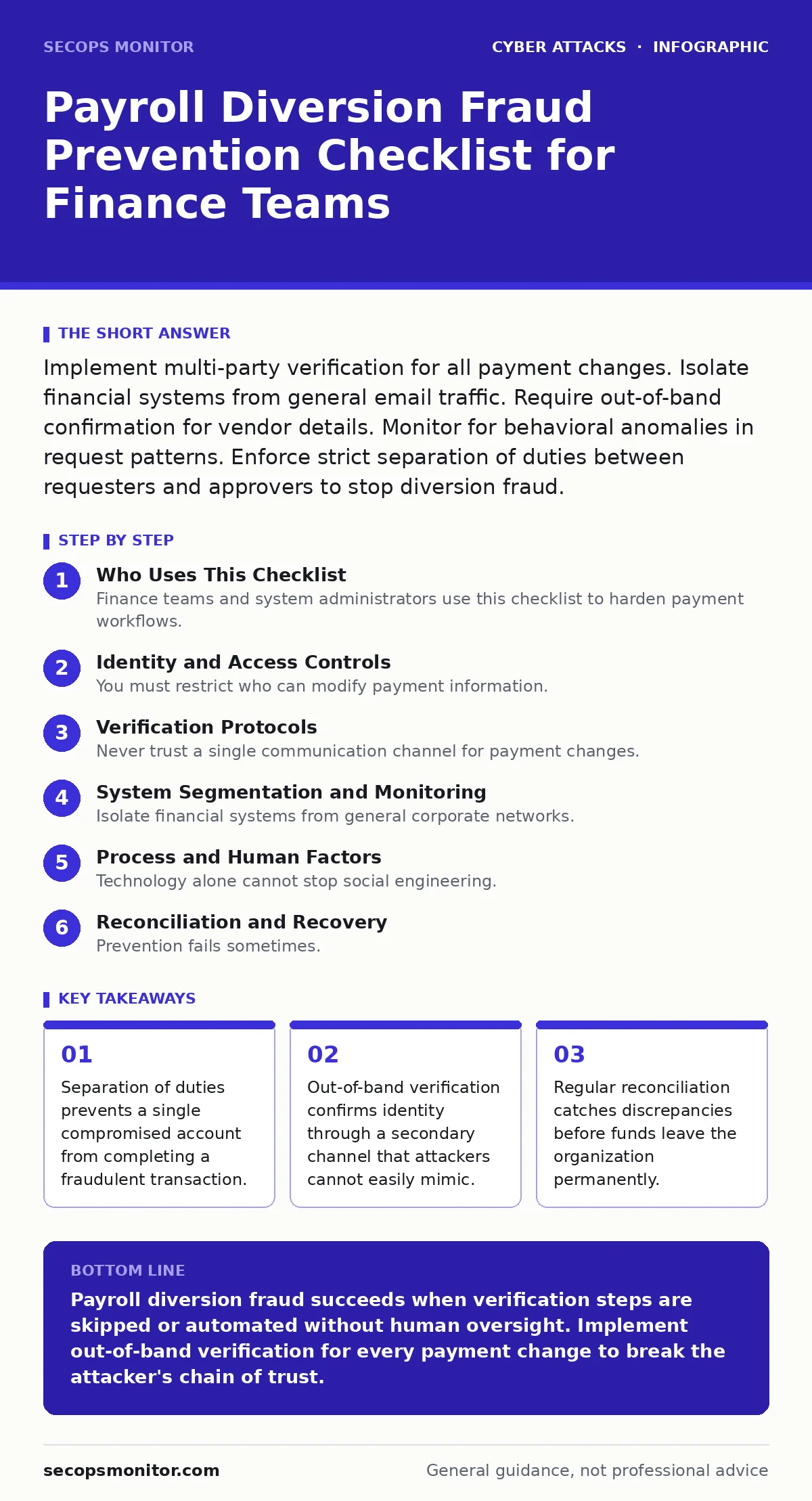
Implement multi-party verification for all payment changes. Isolate financial systems from general email traffic. Require out-of-band confirmation for vendor details. Monitor for behavioral anomalies in request patterns. Enforce strict separation of duties between requesters and approvers to stop diversion fraud.
Who Uses This Checklist
Finance teams and system administrators use this checklist to harden payment workflows. You apply these controls to prevent payroll diversion fraud. This method involves attackers tricking staff into changing bank details for vendors or employees. The goal is to redirect legitimate payments to attacker-controlled accounts. You use this list to audit your current processes. Check each item against your operational reality. Identify gaps where a single point of failure exists. Close those gaps before an incident occurs.
Identity and Access Controls
You must restrict who can modify payment information. Limit access to a small group of trusted personnel. This reduces the attack surface for credential theft.
- Enforce strict role-based access control: Only designated staff can edit vendor bank details.
- Require multi-factor authentication for financial systems: A stolen password alone cannot grant access.
- Implement just-in-time access provisioning: Privileges expire automatically after the task is complete.
- Audit user permissions monthly: Remove access for employees who change roles or leave.
- Disable dormant accounts immediately: Unused accounts are easy targets for lateral movement.
These controls ensure that compromised credentials do not lead to immediate financial loss. They force attackers to compromise multiple accounts or escalate privileges significantly. This adds friction to the attack path. Friction buys you time to detect anomalies.
Verification Protocols
Never trust a single communication channel for payment changes. Attackers often compromise email accounts or intercept messages. You must verify changes through a secondary method. This is known as out-of-band verification.
- Mandate out-of-band confirmation for all bank changes: Call the vendor using a known number.
- Establish a secondary approval workflow: A second person must approve any modification.
- Verify new account numbers against original contracts: Compare digits manually, not via copy-paste.
- Reject urgent requests without prior notice: Urgency is a common social engineering tactic.
- Document the verification step in the ticket: Create an audit trail for every change.
Imagine an attacker sends an email appearing to be from your CEO. The email requests an urgent vendor payment change. If you only check the email, you fail. You must call the vendor using a number from your records, not the email. This breaks the chain of deception. It stops the fraud before the transfer.
System Segmentation and Monitoring
Isolate financial systems from general corporate networks. This limits the spread of malware. You must monitor for unusual activity. Anomalies often precede a successful diversion attempt.
- Segment payment servers from the main network: Prevent lateral movement from infected workstations.
- Enable detailed logging for all financial actions: Record who changed what and when.
- Set alerts for off-hours payment modifications: Legitimate changes rarely happen at 2 AM.
- Monitor for new vendor creation spikes: Sudden volume indicates automated attack attempts.
- Implement transaction limits for new accounts: Cap exposure until the vendor is established.
These technical controls provide visibility. They help you spot patterns that humans might miss. For example, a sudden change in IP address for a vendor portal login is suspicious. You should investigate such events immediately. This proactive stance reduces the window of opportunity for attackers.
Process and Human Factors
Technology alone cannot stop social engineering. You must train staff to recognize manipulation. Create a culture where questioning requests is encouraged.
- Conduct regular phishing simulations: Test awareness without causing panic.
- Train staff on vishing tactics: Recognize pressure and urgency in phone calls.
- Establish a clear incident reporting channel: Make it easy to flag suspicious requests.
- Review and update fraud policies annually: Ensure they reflect current attack methods.
- Encourage skepticism of unexpected changes: Normalizing caution reduces error rates.
Attackers exploit trust and routine. They know you want to be helpful. They use that desire against you. By training staff to pause and verify, you remove the speed advantage attackers rely on. This human layer is your last line of defense.
Reconciliation and Recovery
Prevention fails sometimes. You must have detection and recovery mechanisms. Regular reconciliation catches errors and fraud early.
- Perform daily bank reconciliation: Match internal records with bank statements.
- Investigate all discrepancies immediately: Do not assume they are clerical errors.
- Maintain up-to-date contact lists for banks: Know who to call for stop payments.
- Test recovery procedures regularly: Ensure you can freeze accounts quickly.
- Document lessons learned from near-misses: Improve processes based on real data.
Reconciliation is your safety net. It ensures that even if a fraudster succeeds initially, you detect it before significant damage occurs. You cannot rely on real-time alerts alone. Human review of transaction logs is necessary. This step closes the loop on your security program.
Related Threat Vectors
Payroll diversion often overlaps with other attack types. Understanding these helps you build better defenses. For instance, DNS spoofing can redirect you to fake vendor portals. You must ensure your DNS settings are secure. Similarly, replay attacks can reuse captured data to initiate transfers. You should use nonces and timestamps to prevent this. Botnet attacks might overwhelm your systems to distract from fraud. You need rate limiting and anomaly detection. Finally, dictionary attacks can crack weak passwords for financial accounts. You must enforce strong password policies. These threats are interconnected. Defending against one helps against others.
Key takeaways
- Separation of duties prevents a single compromised account from completing a fraudulent transaction.
- Out-of-band verification confirms identity through a secondary channel that attackers cannot easily mimic.
- Regular reconciliation catches discrepancies before funds leave the organization permanently.
Payroll diversion fraud succeeds when verification steps are skipped or automated without human oversight. Implement out-of-band verification for every payment change to break the attacker's chain of trust.
Frequently asked questions
How do I verify a vendor's new bank details?
Call the vendor using a phone number from your existing records, not the one provided in the request. Confirm the new details verbally and document the conversation.
What is out-of-band verification?
It is confirming information through a different communication channel than the original request. If the request comes via email, you verify via phone or a secure portal.
Can MFA stop payroll diversion fraud?
MFA adds a layer of security but does not stop fraud if the user is coerced or tricked into approving a malicious transaction. You need process controls alongside MFA.
How often should I review vendor bank details?
Review vendor bank details quarterly or whenever a change is requested. Regular reviews catch unauthorized changes that may have slipped through initial checks.
How this guide was produced: written by the SecOps Monitor editorial team with AI assistance, checked against the public references listed below, and reviewed when the facts change. See our editorial policy or report an error.