Cryptojacking begins with a browser script or installed binary that hijacks your CPU or GPU to solve cryptographic puzzles. It operates silently, consuming resources while sending proceeds to the attacker. You can stop it by monitoring process behavior, blocking known mining pools, and restricting script execution on untrusted sites.
The Silent Entry Vector
Cryptojacking differs from ransomware because it seeks profit through resource theft rather than data extortion. The attacker does not need to exfiltrate files or lock screens. Instead, they need persistent access to computational power. The entry point is often benign in appearance. A user visits a compromised website, downloads a seemingly legitimate software package, or clicks a malicious advertisement.
The initial payload is rarely the miner itself. It is usually a dropper or a loader. This small piece of code establishes persistence and checks the environment. It looks for anti-virus software, virtual machines, or remote desktop sessions. If it detects these safeguards, it may terminate itself to avoid analysis. If the environment appears clean, it proceeds to the next stage.
This stage relies on social engineering or supply chain flaws. You might download a cracked utility that contains the loader. Or you might visit a news site where a third-party script has been injected. The flaw exploited is trust. The system trusts the browser to render content or the user to install software from a known source. That trust is the breach.
Persistence and Evasion
Once inside, the malware must survive reboots and user interventions. It modifies system settings to ensure it runs every time the machine starts. On Windows systems, it might add an entry to the startup folder or modify a registry key. On Linux systems, it might edit a crontab file or place a script in the init directory.
The malware then changes its appearance. It might rename its executable to match a common system process, such as svchost.exe or systemd. This is known as masquerading. It confuses administrators who glance at the process list but do not inspect the file path or digital signature. The process runs with low priority to avoid noticeable performance drops during casual use.
This stage is where signature-based detection often fails. If the malware uses a generic name and standard system calls, it looks like legitimate software. The security tool sees a known file name and lets it pass. The attacker relies on this blindness. They know that many organizations only check for known bad hashes, not for unusual behavior from known good files.
Resource Hijacking
The core function of cryptojacking is the execution of the mining algorithm. The malware initializes a mining client. This client connects to a remote server, known as a mining pool. The pool assigns a block of work to the infected machine. The malware uses the CPU or GPU to perform cryptographic hashing.
This process generates significant heat and consumes power. However, the malware throttles its activity. This dynamic adjustment is a key feature of modern cryptojacking. It balances profit against the risk of discovery.
The attacker relies on the fact that most monitoring tools look for anomalies in network traffic or disk I/O. Cryptojacking generates minimal network traffic. It sends small packets to the mining pool and receives work in return. It does not download large files or upload stolen data. The anomaly is purely in the local resource usage. If you do not monitor CPU temperature or fan speed, you will not see it.
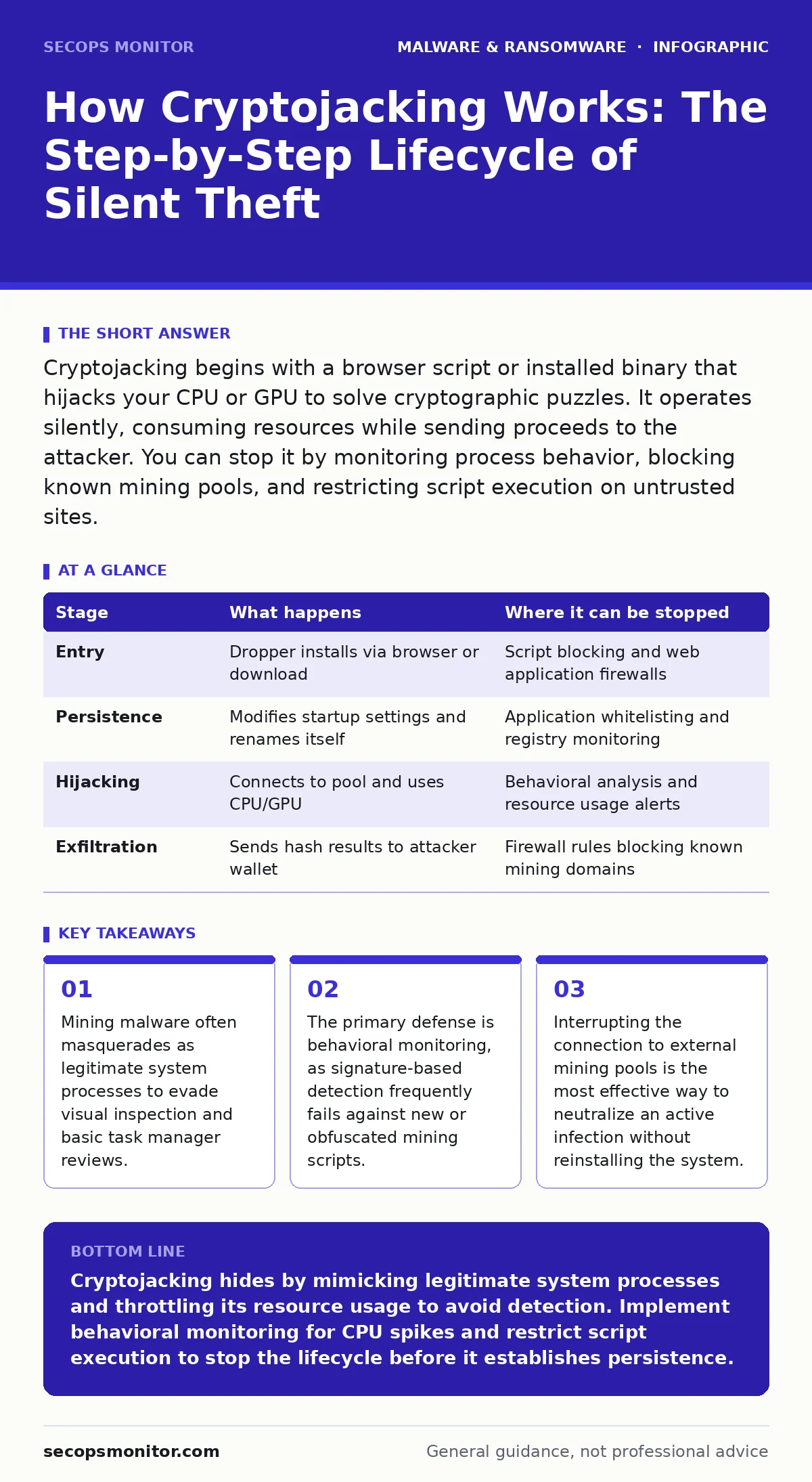
| Stage | What happens | Where it can be stopped |
|---|---|---|
| Entry | Dropper installs via browser or download | Script blocking and web application firewalls |
| Persistence | Modifies startup settings and renames itself | Application whitelisting and registry monitoring |
| Hijacking | Connects to pool and uses CPU/GPU | Behavioral analysis and resource usage alerts |
| Exfiltration | Sends hash results to attacker wallet | Firewall rules blocking known mining domains |
Network Communication
The infected machine must communicate with the outside world to receive instructions and send results. It connects to a mining pool over standard ports, often HTTP or HTTPS. This makes the traffic look like normal web browsing. The malware uses domain name system queries to find the pool’s address.
Some sophisticated variants use domain generation algorithms. They create thousands of random domain names. If one is taken down, they switch to another. This makes blocking specific IPs ineffective. The attacker relies on the difficulty of distinguishing mining traffic from legitimate cloud API calls.
You can interrupt this stage by monitoring outbound connections. Look for processes that maintain long-lived connections to unknown external hosts. A browser process talking to a server in a unexpected country is a red flag. However, many organizations allow unrestricted outbound traffic. This openness is the vulnerability. The malware assumes you will not block every unknown destination.
Detection Challenges
Traditional security tools struggle with cryptojacking. Heuristic detection might flag a new executable, but if the miner is packed or obfuscated, the heuristics may not trigger. The malware looks like a standard application until it starts hashing. By then, the damage is already occurring.
Linux malware is particularly effective at hiding. Linux servers often run with fewer security controls than desktop machines. An attacker who gains shell access can install a miner that runs as a daemon. It blends in with other background services. Without specific monitoring for high CPU usage by non-standard processes, it can run for months.
The hidden cost is hardware degradation. Constant high-load operation reduces the lifespan of CPUs and GPUs. It also increases electricity costs. You may not notice the direct financial loss from the stolen cryptocurrency. But you will pay for the extra power and the premature hardware failure. This indirect cost is often greater than the value of the mined coins.
Interruption and Remediation
Stopping an active infection requires more than killing the process. The malware will restart if the persistence mechanism remains. You must remove the startup entry, the registry key, or the cron job. Then, you must delete the executable.
In many cases, the safest path is reimaging infected computers. The attacker may have installed additional backdoors or rootkits. A clean install ensures that no hidden components remain. For servers, this is critical. You cannot afford a persistent threat in your infrastructure.
Immutable backups do not help directly, as cryptojacking does not encrypt files. However, if the attacker uses the mining resources to also deploy ransomware, immutable backups become vital. The combination of threats is common. The miner pays for the infrastructure; the ransomware extracts the profit. You must treat the machine as compromised, not just infected.
Preventing Future Infections
Prevention requires a shift from signature-based to behavior-based monitoring. You must establish a baseline for normal CPU and GPU usage. Any deviation above that baseline should trigger an alert. This is not about blocking specific files. It is about blocking specific actions.
Implement script blocking in browsers and on servers. Many cryptojacking attacks are delivered via JavaScript. If you block scripts from untrusted domains, you stop the initial payload. This is a simple control with a high return. It reduces the attack surface significantly.
Educate your users, but focus on technical controls. Users will click links. They will download files. You cannot rely on vigilance alone. You must build a system that assumes breach. Monitor for the silent signs. Heat, noise, and slow performance are not just inconveniences. They are symptoms of theft.
Key takeaways
- Mining malware often masquerades as legitimate system processes to evade visual inspection and basic task manager reviews.
- The primary defense is behavioral monitoring, as signature-based detection frequently fails against new or obfuscated mining scripts.
- Interrupting the connection to external mining pools is the most effective way to neutralize an active infection without reinstalling the system.
Cryptojacking hides by mimicking legitimate system processes and throttling its resource usage to avoid detection. Implement behavioral monitoring for CPU spikes and restrict script execution to stop the lifecycle before it establishes persistence.
Frequently asked questions
Can cryptojacking happen on mobile devices?
Yes, mobile cryptojacking exists but is less common due to hardware limitations and stricter app store controls. It usually requires the user to install a malicious app from outside the official store.
Does cryptojacking steal personal data?
No, cryptojacking focuses on computational resources. It does not typically steal passwords or files. However, the same access that allows mining can be used to install other malware that does steal data.
How do I know if my browser is being used for mining?
Check your task manager or activity monitor for high CPU usage while the browser is open. If a specific tab or extension causes the spike, it is likely running a mining script.
Is cloud-based cryptojacking a risk?
Yes, attackers frequently target cloud instances. They compromise a server and use the cloud provider’s resources to mine. This can lead to significant unexpected bills and resource exhaustion for legitimate workloads.
How this guide was produced: written by the SecOps Monitor editorial team with AI assistance, checked against the public references listed below, and reviewed when the facts change. See our editorial policy or report an error.