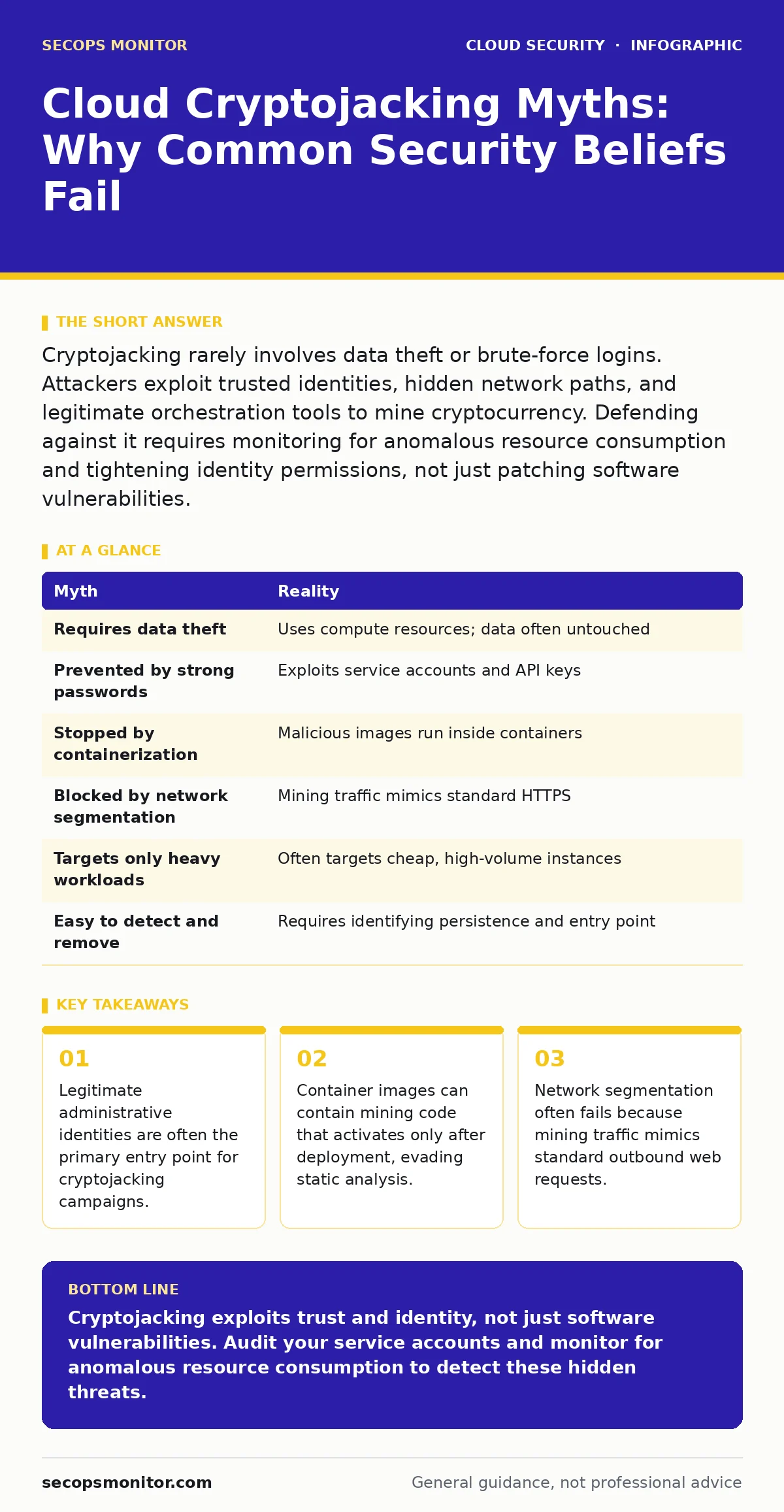
Cryptojacking rarely involves data theft or brute-force logins. Attackers exploit trusted identities, hidden network paths, and legitimate orchestration tools to mine cryptocurrency. Defending against it requires monitoring for anomalous resource consumption and tightening identity permissions, not just patching software vulnerabilities.
Myth: Cryptojacking Requires Data Theft
Reality: Most cryptocurrency mining operations are designed to be invisible and do not involve exfiltrating sensitive information. The attacker’s goal is to use your compute resources to solve cryptographic puzzles, not to copy your databases.
When you assume that cryptojacking is a precursor to data theft, you look for signs of network exfiltration. You monitor for large outbound data transfers or unusual database queries. This focus misses the actual threat, which is sustained high CPU or GPU utilization on your workloads.
The mining software runs quietly in the background. It consumes power and processing cycles while generating no significant network noise. Your data remains untouched, but your infrastructure costs rise as you pay for the electricity and compute time the attacker uses.
Myth: Strong Passwords Prevent Cryptojacking
Reality: Credential stuffing and weak passwords are rare entry points for sophisticated cloud cryptojacking. Attackers more frequently exploit compromised service accounts, exposed API keys, or misconfigured identity providers.
You might spend hours enforcing complex password policies. This effort provides little defense if an attacker gains access through a leaked access key stored in a public code repository. Many organizations ignore the risks of public code repository leaks, allowing attackers to harvest long-lived credentials.
Service accounts often have broader permissions than human users. An attacker who compromises a service account can spin up hundreds of mining instances without triggering login alerts. The breach is not a login event; it is an authorization event.
Myth: Containerization Stops Cryptojacking
Reality: Containers provide isolation, but they do not prevent malicious code from executing within them. If a container image contains mining software, it will run as soon as the container starts.
Many administrators believe that using containers automatically secures their workloads. This belief is dangerous. Attackers inject mining code into container images during the build process or pull compromised images from public registries. The container runs the code with the permissions granted to it.
You must scan images for known vulnerabilities and malicious payloads before deployment. Even then, runtime protection is necessary. A container can be compromised after deployment through a vulnerability in the application it hosts.
Myth: Network Segmentation Blocks Mining Traffic
Reality: Cryptocurrency mining traffic often resembles standard HTTPS traffic, making it difficult to block via traditional network segmentation. Attackers use peer-to-peer protocols that blend in with normal web browsing.
You may segment your network to isolate critical assets. This helps contain lateral movement, but it does not stop outbound mining traffic. The mining pool communicates over standard ports like 443, which is used for secure web traffic.
Firewalls that allow outbound HTTPS will allow mining traffic. Deep packet inspection can help, but it is resource-intensive and may not catch encrypted mining protocols. You need to monitor for connections to known mining pool domains or IPs, not just block specific ports.
Myth: Cryptojacking Only Targets Compute-Heavy Workloads
Reality: Attackers often target low-cost, high-volume instances because they can scale quickly and evade detection. A single powerful server is less profitable than thousands of small, cheap instances.
You might focus your defenses on your database servers or high-performance computing clusters. These are valuable targets, but they are also heavily monitored. Attackers prefer "noisy" environments where their activity blends in.
Small instances, such as those used for development or testing, are often overlooked. Attackers can deploy hundreds of these instances, each consuming a small amount of resources. The aggregate cost and impact are significant, but individual alerts are ignored as anomalies.
See also: What Is Cloud Security Compliance: Mechanics, Risks, and Control · How Confidential Computing Works: Protecting Data in Use
Myth: Cryptojacking Is Easy to Detect and Remove
Reality: Removing cryptojacking requires more than killing a process. You must identify the persistence mechanism, the entry point, and any lateral movement. Failure to do so leads to reinfection.
You might notice high CPU usage and kill the mining process. This stops the immediate symptom, but the attacker may have installed a cron job, a systemd service, or a modified binary that restarts the miner. You must audit the system for unauthorized changes.
Identifying the initial compromise is critical. Did the attacker exploit a vulnerability? Did they use a stolen credential? Without understanding the entry point, you cannot prevent recurrence. You may also need to review cloud incident response procedures to ensure your team can handle such events efficiently.
Myth: Cryptojacking Is a Standalone Threat
Reality: Cryptojacking is often a side effect of a larger breach. Attackers may use mining to test their access or to fund further operations. It can be a signal of deeper compromise.
You might treat cryptojacking as a nuisance and remove it without further investigation. This is a mistake. The presence of mining software indicates that an attacker has sufficient privileges to execute code on your systems. They may have also installed backdoors or exfiltrated data.
You should treat every cryptojacking incident as a potential full-scale breach. Conduct a thorough investigation to determine the scope of the compromise. Review service account security and identity sprawl to identify other potential entry points.
| Myth | Reality |
|---|---|
| Requires data theft | Uses compute resources; data often untouched |
| Prevented by strong passwords | Exploits service accounts and API keys |
| Stopped by containerization | Malicious images run inside containers |
| Blocked by network segmentation | Mining traffic mimics standard HTTPS |
| Targets only heavy workloads | Often targets cheap, high-volume instances |
| Easy to detect and remove | Requires identifying persistence and entry point |
Key takeaways
- Legitimate administrative identities are often the primary entry point for cryptojacking campaigns.
- Container images can contain mining code that activates only after deployment, evading static analysis.
- Network segmentation often fails because mining traffic mimics standard outbound web requests.
Cryptojacking exploits trust and identity, not just software vulnerabilities. Audit your service accounts and monitor for anomalous resource consumption to detect these hidden threats.
Frequently asked questions
How do I know if my cloud instance is being used for cryptojacking?
Look for sustained high CPU or GPU usage on idle instances, unexpected outbound network connections, and unfamiliar processes running with high privileges.
Can antivirus software detect cryptojacking?
Traditional antivirus may detect known mining software, but many miners are custom-built or obfuscated, evading signature-based detection.
Should I block all outbound HTTPS traffic?
No, this will break most applications. Instead, use web proxies or firewalls to filter traffic to known malicious domains and IPs.
How do I prevent container-based cryptojacking?
Scan container images for vulnerabilities and malicious code before deployment, and use runtime security tools to monitor for anomalous behavior.
How this guide was produced: written by the SecOps Monitor editorial team with AI assistance, checked against the public references listed below, and reviewed when the facts change. See our editorial policy or report an error.