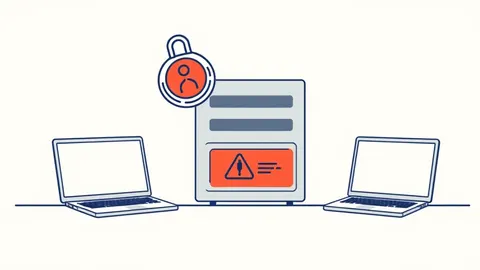
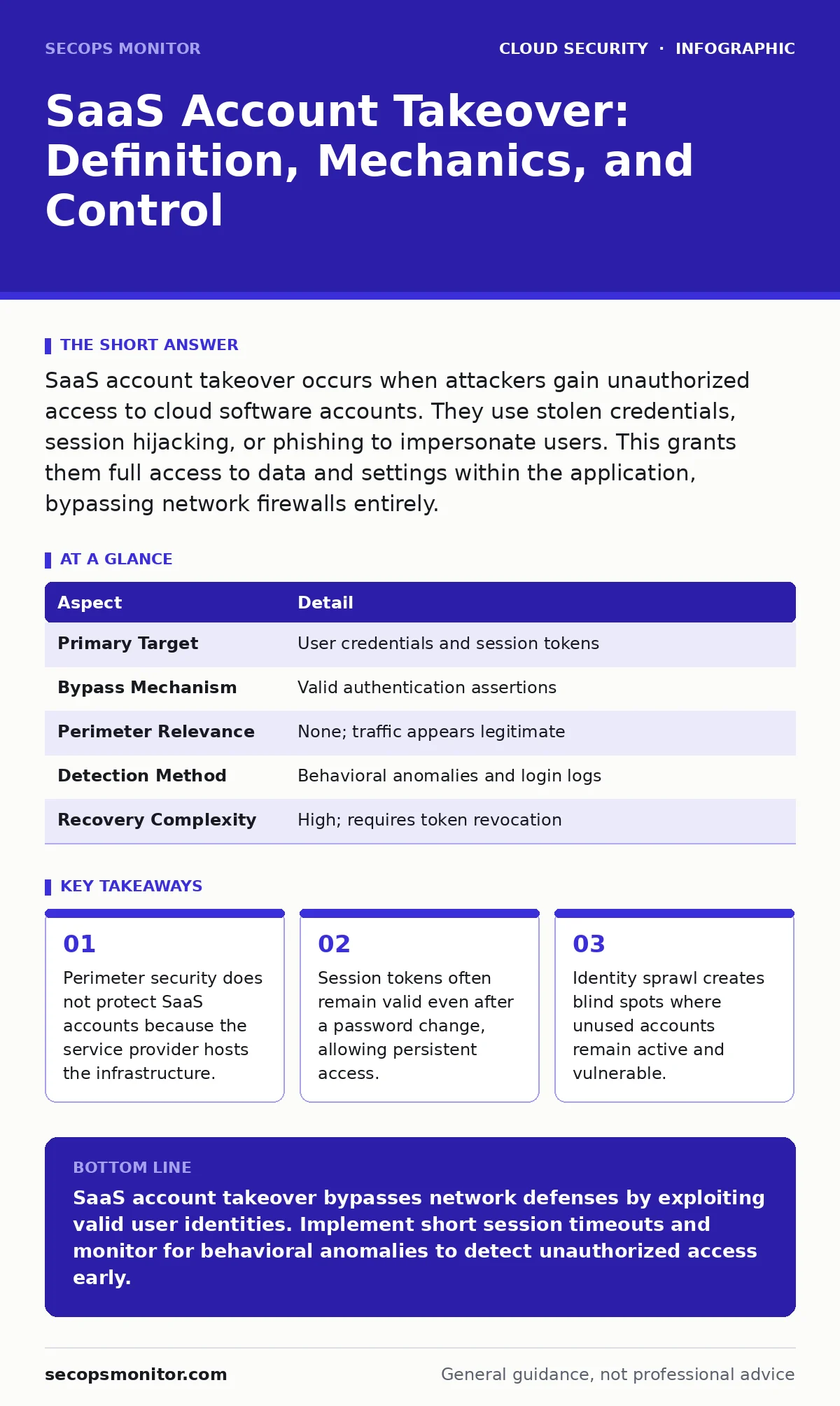
SaaS account takeover occurs when attackers gain unauthorized access to cloud software accounts. They use stolen credentials, session hijacking, or phishing to impersonate users. This grants them full access to data and settings within the application, bypassing network firewalls entirely.
The Digital House Key Analogy
Imagine you rent a storage unit. The facility has a high fence and a guard at the gate. That is your network perimeter. Now imagine someone steals your key card. They walk past the guard because the card says they belong there. Inside, they open your unit and take what they want. The fence did not stop them. The guard did not stop them. The key did.
SaaS account takeover works the same way. You trust the software provider to secure the servers. You trust your network firewall to block outside traffic. But if an attacker has a valid login token, they are already inside. The perimeter is irrelevant. The attack happens at the identity layer, not the network layer.
Defining the Attack Vector
SaaS account takeover is the unauthorized acquisition of access to a Software-as-a-Service application. It is not a breach of the provider’s database. It is a breach of the user’s identity within that application. The attacker impersonates a legitimate user. They perform actions that user is authorized to do.
This differs from a data breach where hackers dump customer records from the vendor’s backend. In a takeover, the attacker walks through the front door. They use the application exactly as you do. They export files, change settings, or invite new users. The application logs show a legitimate user session. Detection relies on behavior analysis, not intrusion alerts.
| Aspect | Detail |
|---|---|
| Primary Target | User credentials and session tokens |
| Bypass Mechanism | Valid authentication assertions |
| Perimeter Relevance | None; traffic appears legitimate |
| Detection Method | Behavioral anomalies and login logs |
| Recovery Complexity | High; requires token revocation |
How Access Is Gained
Attackers do not usually hack the SaaS provider. They hack the user or the device. The most common path is credential stuffing. Attackers use lists of usernames and passwords stolen from other breaches. They try these combinations against popular SaaS platforms. Many users reuse passwords. One breach leads to many takeovers.
Another method is session hijacking. When you log in, the application gives you a token. This token proves who you are. If an attacker steals this token from your browser or network, they can use it. They do not need your password. They do not need to pass multi-factor authentication. They simply present the stolen token. The application accepts it as valid.
Phishing remains the primary delivery mechanism. It tricks users into handing over credentials or approval codes. Social engineering adds the human element. Technical defenses struggle against a user who willingly gives up access.
Who Is Affected
Every organization using cloud software is affected. The size of the organization does not matter. A small startup with five tools is at risk. A global enterprise with five hundred tools is at risk. The risk scales with identity sprawl, which is the uncontrolled growth of user accounts and access rights across multiple services.
Administrators are high-value targets. Their accounts have elevated privileges. They can create new admin accounts, export all data, or disable security logs. Attackers prioritize these accounts. They look for the keys to the kingdom. Regular users are also targets. Their accounts can be used to move laterally. An attacker might use a regular user’s access to find sensitive data or to pivot to other connected systems.
Common Forms of Takeover
Credential stuffing is automated. Bots test thousands of accounts per minute. It relies on password reuse. If you use the same password for email and SaaS, one leak compromises both. This is a volume game. It casts a wide net.
Session fixation and hijacking are more targeted. They require access to the user’s device or network. Malware on a laptop can steal cookies. These cookies contain the session tokens. Wi-Fi sniffing on unsecured networks can also capture unencrypted tokens. This form of attack bypasses password strength entirely.
Account sharing is a structural weakness. Teams often share one login for a shared service. This violates the principle of individual accountability. When one person leaves, the account remains active. When the account is compromised, you cannot trace the action to a specific person. It also increases the attack surface. More people know the password. More devices store the token.
See also: Cloud Incident Response: 7 Mistakes That Escalate Breaches · Account Lockout Policies: Preventing Denial of Service Attacks
What People Get Wrong
Many teams believe that multi-factor authentication stops all takeovers. It stops credential stuffing. It stops simple password guessing. But it does not stop session hijacking. If an attacker has the token, they do not need to authenticate again. They are already in. MFA protects the door. It does not protect the room after you enter.
Another mistake is focusing only on password complexity. Forcing users to create complex passwords leads to poor behavior. Users write passwords on sticky notes. They reuse slight variations. This creates a false sense of security. The password is strong, but the user is weak. The defense fails at the human layer.
Organizations also ignore cloud incident response planning for identity. They have plans for server outages. They have plans for data leaks. They rarely have a playbook for a compromised admin account. When it happens, they panic. They change passwords, but they forget to revoke tokens. The attacker stays in.
Reducing the Risk
Start by enforcing passwordless authentication where possible. FIDO2 security keys or biometric login remove the password from the equation. There is nothing to steal. There is nothing to stuff. This eliminates the largest attack vector.
If passwords are required, enforce strict session management. Set short timeout periods. Invalidate tokens when a user logs out. Monitor for impossible travel. If a user logs in from New York and then from London ten minutes later, block the session. These are clear anomalies.
Review access rights regularly. Remove accounts for employees who leave. Remove access to tools that are no longer used. This reduces the blast radius. Fewer active accounts mean fewer entry points. This practice mitigates identity sprawl.
Integrate your SaaS logs with your security information and event management system. You need visibility. You need to see login failures, token usage, and permission changes in real time. Without this data, you are blind. You cannot detect what you cannot see.
Consider the role of confidential computing for sensitive data processing. While it does not prevent account takeover, it ensures that data remains encrypted even while being processed in memory. If an attacker gains access to the application, they may see the interface, but they cannot easily extract raw data if it is protected by hardware-based encryption. This adds a layer of defense in depth.
The Hidden Cost of Recovery
Recovery is not just resetting a password. It is a forensic process. You must identify what the attacker did. Did they export data? Did they add new users? Did they change API keys? Each action requires a separate remediation step.
You must revoke all active sessions. This logs out every device for that user. It causes immediate disruption. Users cannot work until they log in again. This is the trade-off. Security causes friction. You must accept this friction.
You must also check for persistence. Attackers often create backdoor accounts. They set up forwarding rules. They install webhooks that send data to external servers. If you miss these, they will take the account again. You must audit every permission change during the window of compromise.
Integrating Defense Strategies
SaaS security is part of a broader strategy. It connects to cloud key management services for protecting the encryption keys used by the application. If the keys are compromised, the data is exposed. It connects to public code repository leaks because developers often accidentally commit credentials to GitHub. These credentials can be used to access SaaS APIs.
It also relates to immutable infrastructure principles. While SaaS is not infrastructure you control, the principle applies to configuration. You should treat application settings as code. Changes should be tracked and approved. This prevents attackers from silently altering security settings.
Finally, consider Kubernetes RBAC if your SaaS applications integrate with containerized workloads. The permissions in the container orchestration layer must align with the SaaS permissions. A mismatch here can allow an attacker to move from a compromised service account to the underlying infrastructure.
Key takeaways
- Perimeter security does not protect SaaS accounts because the service provider hosts the infrastructure.
- Session tokens often remain valid even after a password change, allowing persistent access.
- Identity sprawl creates blind spots where unused accounts remain active and vulnerable.
- Multi-factor authentication reduces risk but does not eliminate it if the second factor is compromised.
SaaS account takeover bypasses network defenses by exploiting valid user identities. Implement short session timeouts and monitor for behavioral anomalies to detect unauthorized access early.
Frequently asked questions
Does multi-factor authentication prevent account takeover?
MFA prevents unauthorized login attempts using stolen passwords. It does not prevent takeover if an attacker steals an active session token or cookies, as no new authentication is required for that session.
How do I know if my account has been taken over?
Check for unknown devices in your session list, unexpected email forwarding rules, and changes to recovery email addresses. Look for login alerts from unfamiliar locations or times.
What is the difference between a breach and a takeover?
A breach involves unauthorized access to the provider’s infrastructure or database. A takeover involves unauthorized access to a specific user’s account within the application, using valid credentials or tokens.
Should I use password managers for SaaS accounts?
Yes. Password managers generate unique, complex passwords for each service. This prevents credential stuffing attacks, where attackers reuse passwords from other breaches.
How this guide was produced: written by the SecOps Monitor editorial team with AI assistance, checked against the public references listed below, and reviewed when the facts change. See our editorial policy or report an error.